

The white-fronted bee-eater is a species of bee-eater widely distributed in sub-equatorial Africa.
Region
Sub-equatorial Africa
Typical Environment
Occurs widely from East Africa through south-central regions, frequenting river valleys, floodplains, and open savanna with scattered trees. It favors eroding cliffs and sandbanks along rivers and lakes where colonies can excavate nest burrows. Also uses farmland edges, bushy grasslands, and woodland clearings provided suitable perches and banks are available. Local movements often track rainfall and insect abundance, but populations are largely resident near stable colony sites.
Altitude Range
Sea level to 2000 m
Climate Zone
Tropical
Ease of Keeping
Beginner friendly: 1/5
White-fronted bee-eaters are highly social and nest in large colonies that tunnel into vertical sandy banks. They practice cooperative breeding, with non-breeding helpers assisting related pairs. Specialists on stinging insects, they deftly remove stingers by repeatedly beating prey on a perch. They are a classic study species in research on social behavior and kin selection.


Temperament
social and active
Flight Pattern
short rapid wingbeats with agile sallies and brief glides
Social Behavior
Breeds colonially in large groups, excavating tunnels in vertical sandy banks. Pairs are typically monogamous, and many colonies exhibit cooperative breeding with helpers assisting in feeding and defense. Roosts communally and uses prominent perches for foraging and social interactions.
Migratory Pattern
Resident
Song Description
Calls are bright, rolling trills and nasal, piping notes given in rapid sequences during foraging flights. At colonies, a lively chorus of chattering contact calls maintains group cohesion.
Plumage
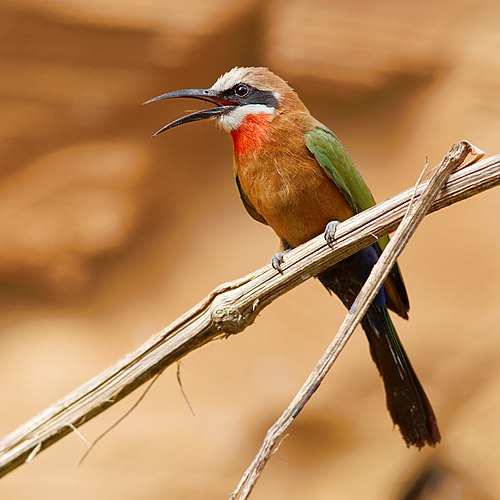
Bright green upperparts with rufous to cinnamon underparts, a vivid red throat, and white forehead with a contrasting black eye-mask. Blue tones on the undertail coverts and rump are often visible in flight. Long, slightly decurved bill and elongated central tail feathers give a sleek profile.
Diet
Primarily hunts flying insects, especially bees and wasps (Hymenoptera), along with dragonflies, beetles, and other aerial prey. Catches insects on the wing after launching from exposed perches. Before swallowing stinging prey, it repeatedly beats them to remove stingers and venom sacs. Like other bee-eaters, it may regurgitate indigestible pellets of chitin.
Preferred Environment
Often forages along river corridors, lake margins, and open savanna with scattered perches such as bushes, dead branches, or wires. Feeding typically occurs near nesting colonies where aerial insect activity is high.


