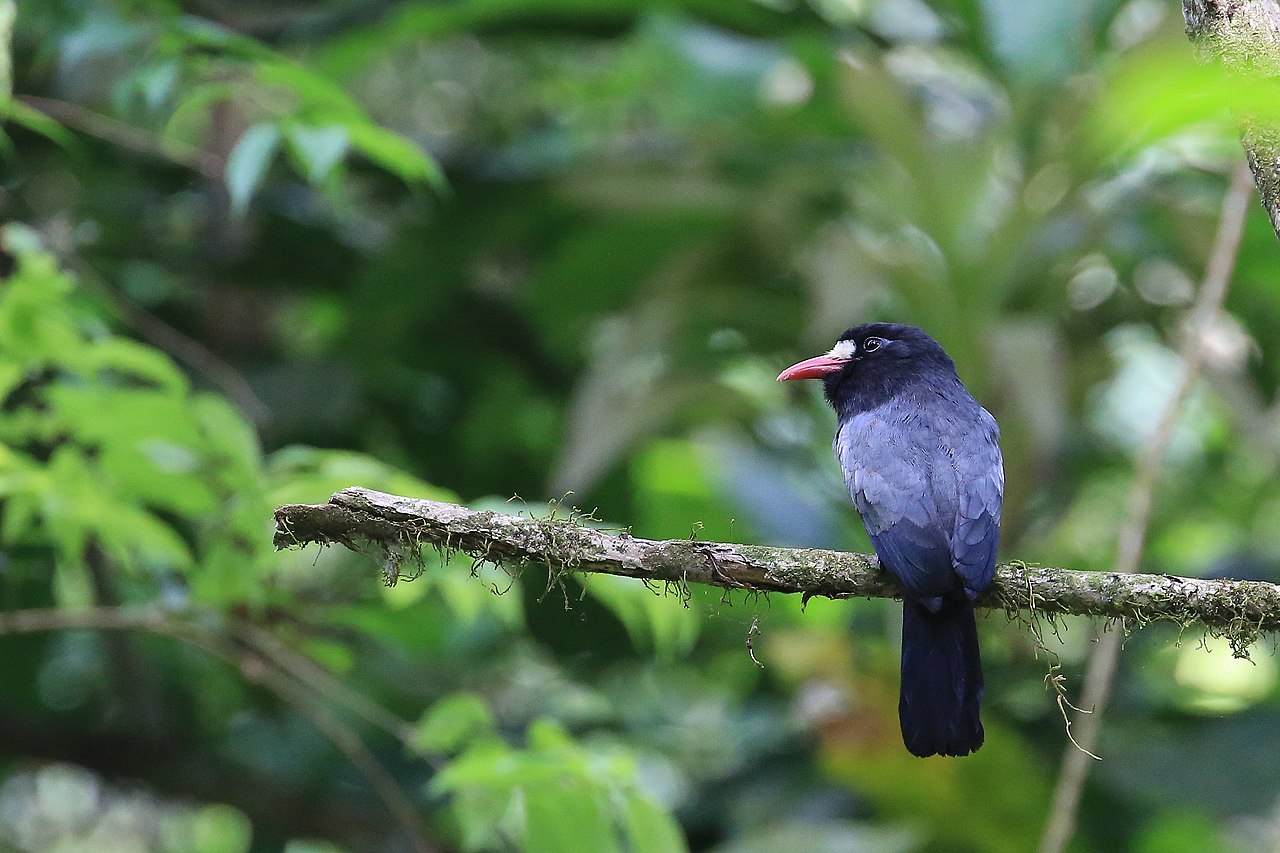
The white-fronted falconet, also called the Bornean falconet, is a species of bird of prey in the family Falconidae. Described by the British ornithologist Richard Bowdler Sharpe in 1879, it is endemic to Borneo, where it is found in Sarawak, Sabah, and extreme northeastern Kalimantan. An extremely small falcon, it is only 14–17 cm (5.5–6.7 in) long and weighs 35–65 g (1.2–2.3 oz), being the smallest species of falconet. It has glossy bluish-black upperparts, black flanks and outer thighs, and a black mask. The belly and vent are pale yellowish-brown, while the throat, cheeks, and breast are white. The species can be told apart from other falconets by the colour of its crown and forehead, which is white in males and reddish-brown in females. It has no subspecies.
Region
Borneo (Malaysia and Indonesia)
Typical Environment
Occurs in northern and northeastern Borneo, mainly in Sabah and Sarawak with a smaller presence in extreme northeastern Kalimantan. Prefers forest edges, secondary growth, riverine forest, and partially open woodland with scattered tall trees. It is often found along roadsides, clearings, and village fringes where suitable perches are available. The species generally avoids dense interior forest but uses gaps and edges extensively. It may also occur near agroforestry mosaics where tree cover remains.
Altitude Range
0–1500 m
Climate Zone
Tropical
Ease of Keeping
Beginner friendly: 1/5
Among the smallest birds of prey in the world, the white-fronted falconet is a compact, bold hunter that often perches conspicuously along forest edges. Males have a white forehead and crown, while females show a warm rufous crown, making sexing in the field straightforward. It is endemic to Borneo and currently recognized with no subspecies. It frequently hunts by sallying from exposed perches to snatch insects on the wing.


Male white-fronted falconets
Temperament
alert and bold, often in pairs
Flight Pattern
short rapid wingbeats with quick sallies
Social Behavior
Usually seen singly, in pairs, or small family groups perched on exposed snags or wires. Nests in tree cavities, often old woodpecker or barbet holes, and may reuse suitable sites. Pairs maintain small territories centered on nest or favored hunting perches.
Migratory Pattern
Resident
Song Description
Gives high-pitched, thin whistles and sharp squeaks, often in short series. Calls are piercing but not loud, used for contact between pair members and at perch shifts.
Plumage
Glossy bluish-black upperparts with a bold black mask; white throat, cheeks, and breast; pale yellowish-brown belly and vent; black flanks and outer thighs. Crown and forehead white in males and rich rufous in females, a key distinction from other falconets.
Diet
Primarily hunts flying insects such as dragonflies, butterflies, bees, and beetles, which are taken in swift aerial sallies. Will occasionally seize small lizards or very small birds. Prey is often returned to a perch to be consumed.
Preferred Environment
Open forest edges, riverbanks, clearings, and farmland with scattered trees that provide exposed perches. Frequently hunts along sunny gaps and roadside edges where insect activity is high.