
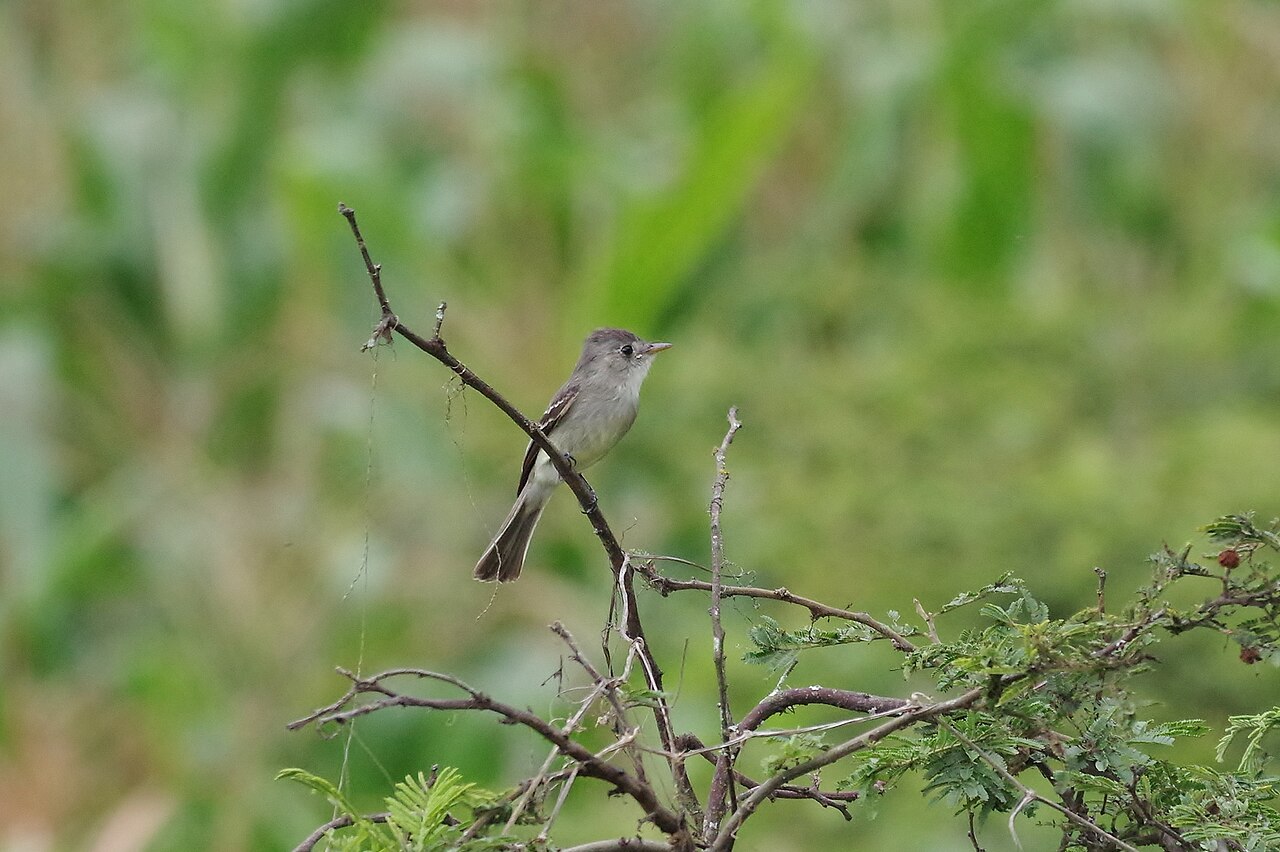
The Tumbes pewee or western tropical pewee is a passerine bird in the family Tyrannidae, the tyrant flycatchers. It is found in Ecuador and Peru.
Region
Western Ecuador and northwestern Peru (Tumbes–Piura region)
Typical Environment
Occurs in arid to semi-humid deciduous forests, dry scrub, and woodland edges of the Tumbes region and adjacent southwest Ecuador. It frequents riparian corridors, second growth, and semi-open habitats with scattered trees. The species is often found from coastal lowlands into foothills, using perches in the midstory to sally for insects. It also appears in degraded dry forest mosaics and agricultural edges.
Altitude Range
Sea level to 1200 m
Climate Zone
Tropical
Ease of Keeping
Beginner friendly: 1/5
The Tumbes pewee (also called western tropical pewee) is part of the tropical pewee complex, and its subtle differences are best detected by voice and geography. It often perches quietly in the midstory and makes short sallies to catch flying insects. This species tolerates edges and secondary growth, making it relatively adaptable within its dry-forest range.


Temperament
quiet and watchful
Flight Pattern
short rapid wingbeats with quick sallies
Social Behavior
Usually solitary or in pairs, maintaining small feeding territories. During breeding, pairs defend territories and nest on horizontal branches or in forks, typically at mid-heights. The cup nest is well camouflaged; adults share provisioning of nestlings.
Migratory Pattern
Resident
Song Description
Gives soft, whistled phrases, including plaintive pee-wee or peeer notes repeated at intervals. Calls are thin, slightly buzzy chips used frequently while foraging. Dawn and dusk periods feature more persistent, simple whistled sequences.
Plumage
Subtly colored flycatcher with gray-olive upperparts and pale gray to buffy underparts with a lightly shaded breast. Shows two narrow whitish wingbars and slightly dusky cheeks. Feathers appear smooth and unpatterned aside from the wingbars.
Diet
Primarily captures flying insects such as flies, beetles, and moths by sallying from exposed perches. Also gleans small arthropods from foliage and twigs when activity is low. Occasionally may take small berries, especially in the dry season when insect activity declines.
Preferred Environment
Feeds along forest edges, clearings with scattered trees, riparian strips, and secondary growth. Often chooses shaded midstory perches with open airspace for short aerial sallies.


