The tundra bean goose is a goose that breeds in northern Siberia. This and the taiga bean goose are recognised as separate species by the American Ornithological Society and International Ornithologists' Union, but are considered a single species by other authorities. It is migratory and winters further south in Asia. The taiga and tundra bean goose diverged about 2.5 million years ago and established secondary contact ca. 60,000 years ago, resulting in extensive gene flow.
Region
Palearctic
Typical Environment
Breeds on wet tundra, sedge meadows, and low-lying marshes across northern Siberia from European Russia to Chukotka. In winter it moves south to lowland wetlands, river floodplains, estuaries, and agricultural fields in Europe and East Asia, especially China, Korea, and Japan, with some in the North Sea region. During migration it stages on large lakes, coastal flats, and deltas where access to open water and grazing is reliable. It favors open habitats with shallow water and nearby short vegetation for grazing.
Altitude Range
Sea level to 1200 m
Climate Zone
Polar
Ease of Keeping
Beginner friendly: 2/5
The tundra bean goose breeds across the low Arctic tundra of Siberia and migrates long distances to wintering grounds in Europe and East Asia. It is closely related to the taiga bean goose, from which it differs by a typically shorter, deeper bill with more black and a narrower orange band. The species name serrirostris refers to the saw-like lamellae along the bill edges. Large flocks gather at key stopover wetlands, making them sensitive to habitat loss and disturbance.
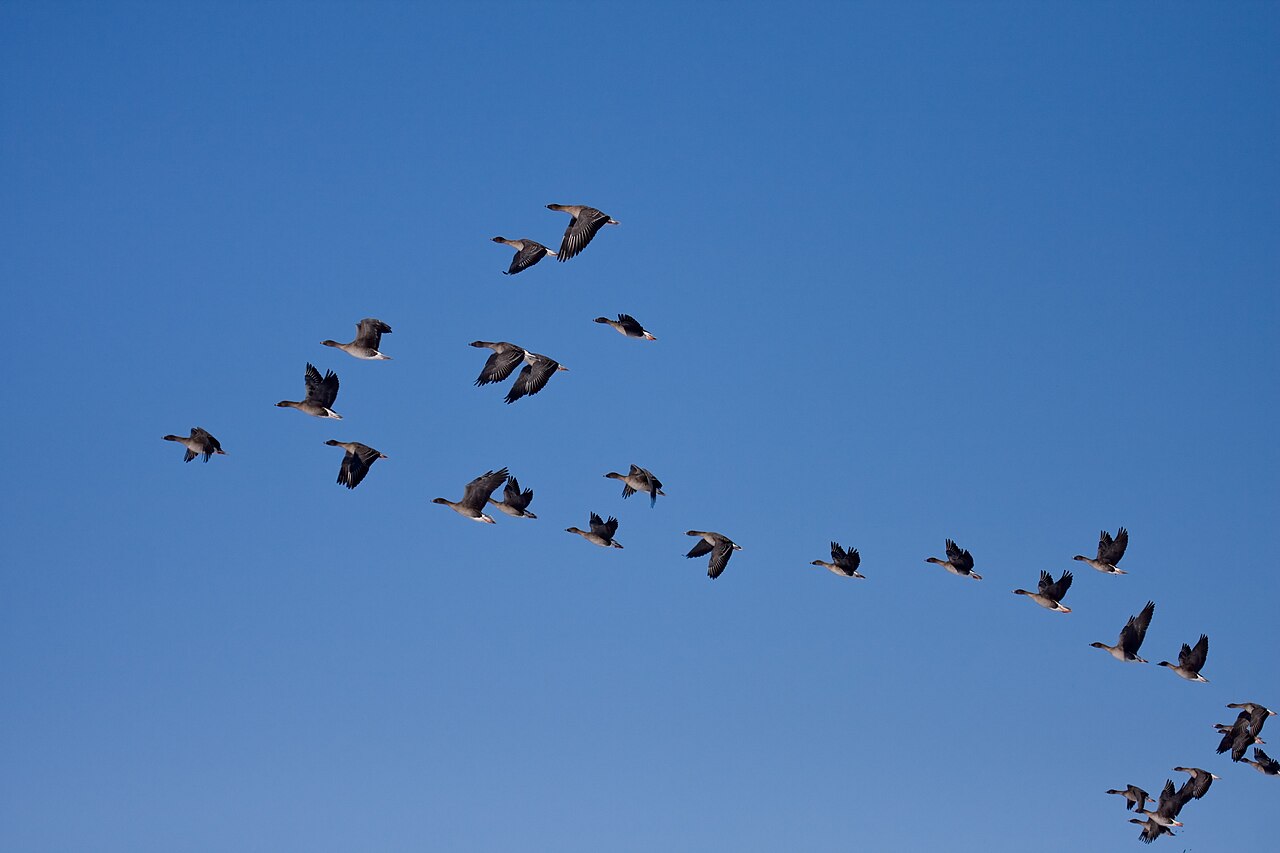
A flock of tundra bean geese
Temperament
wary but gregarious
Flight Pattern
strong flier with steady wingbeats; lines or V-formations
Social Behavior
Highly social outside the breeding season, forming large flocks at staging and wintering sites. Pairs are largely monogamous and defend a small area around the nest. Nests are on the ground near water, with 4–6 eggs; the female incubates while the male guards nearby.
Migratory Pattern
Seasonal migrant
Song Description
Calls are nasal, burry honks and yelps, often rendered as ank-ank or aink-aink. Flocks in flight produce a loud, chattering chorus that carries over long distances.
Plumage
Grey-brown upperparts with paler fringes, darker chocolate-brown head and neck, and a generally pale belly with subtle mottling. Upperwing shows pale-edged coverts and a narrow, pale wing bar; tail with a whitish band. The bill is mostly black with a narrow orange band, and the legs are bright orange.
Diet
Primarily grazes on grasses, sedges, and rushes in the breeding season. In migration and winter, it takes agricultural grains and shoots, including wheat, barley, and rice stubble. It also consumes roots, tubers, and aquatic plants, and goslings may take small invertebrates opportunistically.
Preferred Environment
Feeds in open tundra meadows, floodplain pastures, and shallow marsh edges. In winter it regularly uses farmland, stubble fields, and rice paddies, commuting to roost on lakes or estuaries.