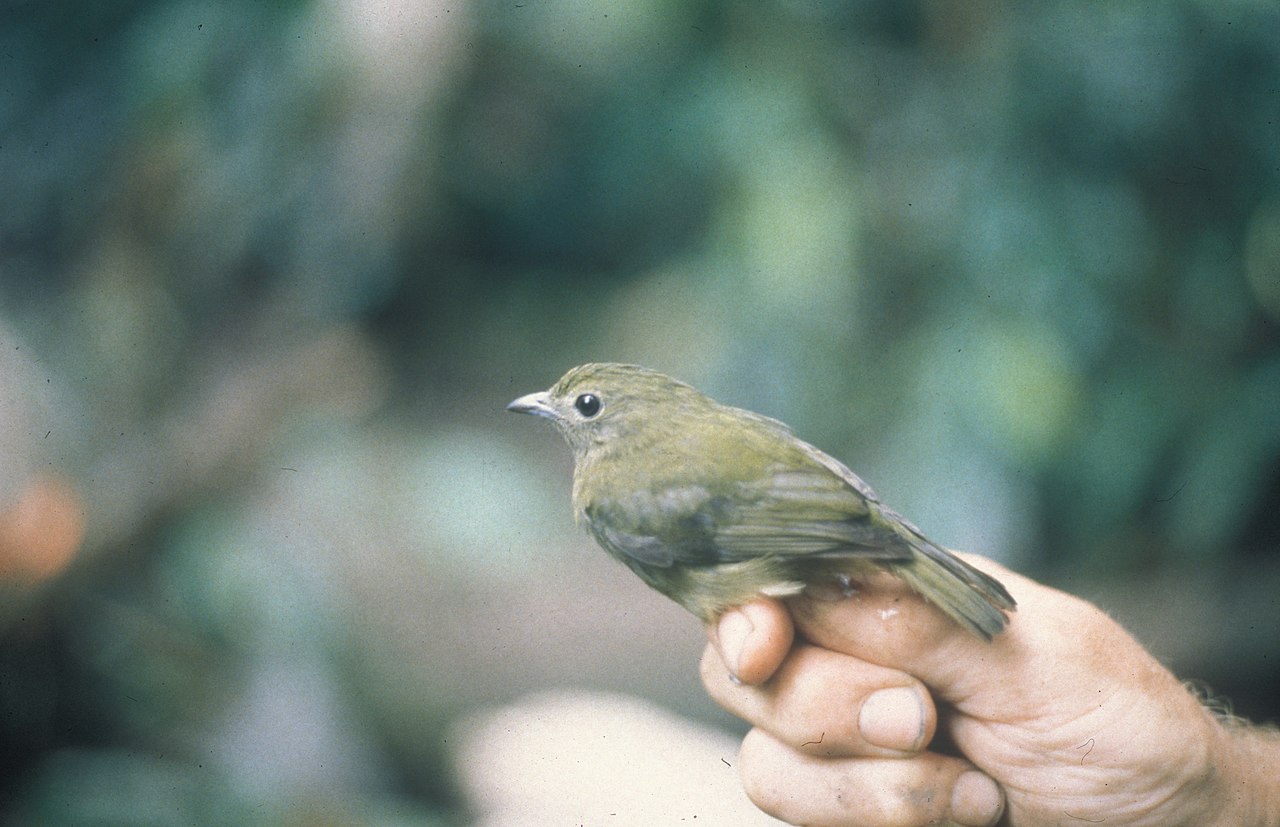
The green manakin is a species of bird in the family Pipridae. It is found in Colombia, Ecuador, and Peru.
Region
Andes Mountains
Typical Environment
Occurs on the humid foothills and lower montane slopes of the Andes in Colombia, Ecuador, and Peru. Prefers mature and secondary cloud forest with dense midstory and canopy fruit resources. Often found along forest edges, ravines, and in areas with abundant epiphytes and moss. It uses the understory to mid-canopy and is most frequently detected near fruiting trees.
Altitude Range
300–1600 m
Climate Zone
Tropical
Ease of Keeping
Beginner friendly: 1/5
Green manakins are small, canopy-dwelling birds of Andean humid forests and are often overlooked due to their uniformly green plumage. Like many manakins, males engage in discreet display behaviors and subtle mechanical sounds, though their leks are less conspicuous than in some relatives. They primarily follow fruiting trees and may join mixed-species flocks in the midstory.


Temperament
shy and inconspicuous
Flight Pattern
short rapid wingbeats
Social Behavior
Generally solitary or in pairs while foraging, but may join mixed-species flocks around fruiting trees. Males perform modest display behaviors typical of manakins, and breeding likely involves lekking with females visiting display sites. Nests are small cups placed low to mid-level in dense vegetation; the female performs most nesting duties.
Migratory Pattern
Resident
Song Description
Vocalizations are soft, thin whistles interspersed with faint ticks. Display may include subtle wing snaps or mechanical sounds, easily missed in dense forest.
Plumage
Mostly uniform olive-green with slightly paler underparts and a smooth, unmarked appearance.
Diet
Feeds chiefly on small fruits and berries from understory and mid-canopy plants. Takes advantage of seasonal fruiting events and may track fruit availability along slopes. Occasionally supplements diet with small arthropods gleaned from foliage.
Preferred Environment
Forages in dense humid forest, especially at fruiting trees in the midstory and canopy. Also uses forest edges and gaps where fruiting shrubs are abundant.