
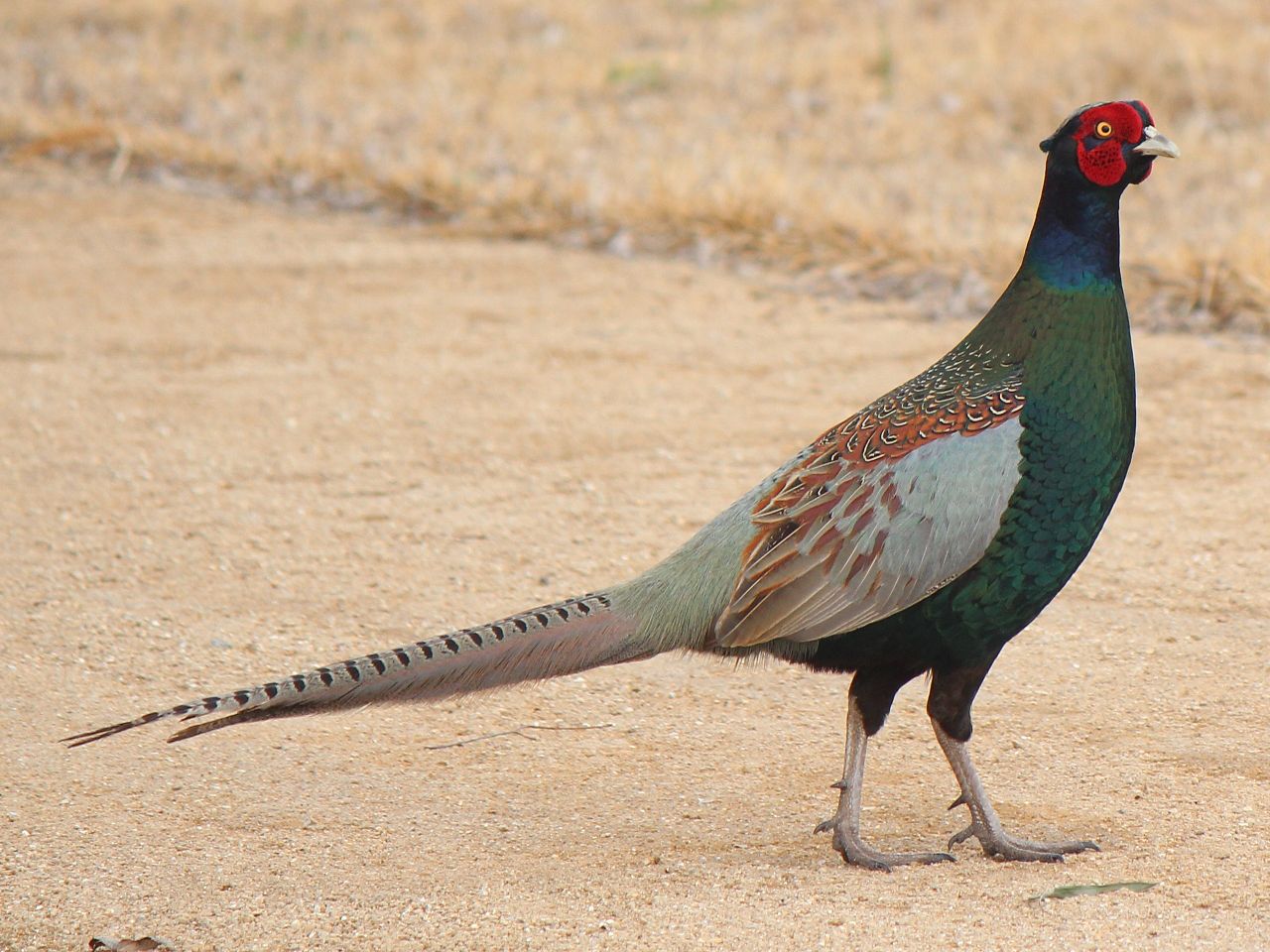
The green pheasant, also known as the Japanese green pheasant or Kiji, is an omnivorous bird native to the Japanese archipelago, to which it is endemic. Some taxonomic authorities consider it a subspecies of the common pheasant, Phasianus colchicus. It is the national bird of Japan.
Region
East Asia
Typical Environment
Primarily found on Honshu, Shikoku, and Kyushu, the species favors a mosaic of lowland farmland, rice paddies, riverbanks, and woodland edges. It thrives in hedgerows, fallow fields, and weedy margins where cover and food are abundant. Dense grasses and shrub thickets are used for nesting and shelter. It avoids deep, closed-canopy forests but readily uses forest margins and secondary growth. Outside Japan, small introduced populations persist locally where similar agricultural habitats exist.
Altitude Range
Sea level to 1200 m
Climate Zone
Temperate
Ease of Keeping
Beginner friendly: 3/5
The green pheasant, or Kiji, is Japan’s national bird and is largely confined to the main Japanese islands. Males are famed for their iridescent bottle‑green plumage and loud spring crowing, often given after sudden noises like thunder. It is sometimes treated as a subspecies of the common pheasant. Small introduced populations have been reported outside Japan, including in Hawaii.


A green pheasant egg


Temperament
wary but bold near cover; males strongly territorial in breeding season
Flight Pattern
short rapid wingbeats followed by a brief glide
Social Behavior
Outside the breeding season they may form small coveys, often family groups, that feed and roost together. In spring, males establish territories and display to multiple females (polygyny), using crowing and wing-flapping. Nests are shallow ground scrapes hidden in tall grass or shrubs, where the female incubates alone.
Migratory Pattern
Resident
Song Description
The male gives a sharp, ringing two‑note crow often rendered as ‘ko-kee’, especially at dawn and during spring. He also produces rapid wing‑whirring displays and various clucks and alarm calls when disturbed.
Plumage
Male with glossy, iridescent green body, darker green to bluish head and breast, and a long brown, finely barred tail; female mottled brown with fine streaking for camouflage.
Diet
An opportunistic omnivore, it consumes seeds, grains, and green shoots from crops and wild plants. Berries and other fruits are taken seasonally. It also eats insects, worms, and other small invertebrates, especially in spring and summer when protein needs are high for breeding and chick growth.
Preferred Environment
Forages mostly on the ground along field margins, rice paddies, ditches, and brushy edges that provide both food and quick cover. It often scratches leaf litter and soil to uncover seeds and invertebrates.


