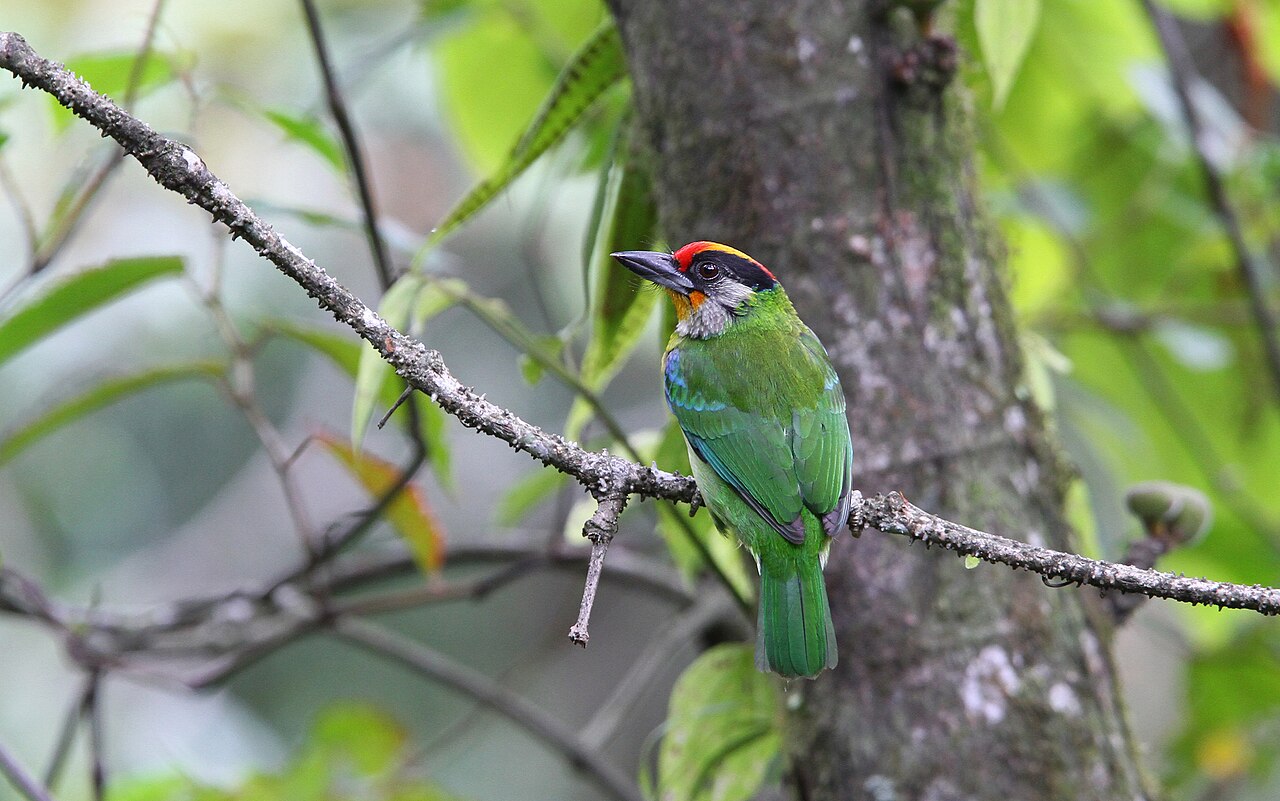
The golden-spangled piculet is a species of bird in subfamily Picumninae of the woodpecker family Picidae. It is found in Brazil, Colombia, French Guiana, Guyana, Suriname, and Venezuela.
Region
Northern South America
Typical Environment
Occurs across the Guianas, southeastern Venezuela, southern Colombia, and northern Brazil, including parts of the Amazon Basin and the Guianan Shield. It inhabits lowland tropical forest edges, secondary growth, gallery forest, and riverine woodland. The species favors areas with abundant small branches, vines, and bamboo where it can glean insects. It is typically found in the understory to midstory rather than on large trunks. Human-altered habitats with regenerating scrub are also used.
Altitude Range
Sea level to 1200 m
Climate Zone
Tropical
Ease of Keeping
Beginner friendly: 1/5
The golden-spangled piculet is one of the smallest woodpeckers, often foraging acrobatically on thin twigs and vine tangles. Males have a small reddish crown patch, while females show only pale speckling. It frequently joins mixed-species flocks in the understory, making it easier to detect by its high, thin calls than by sight.


Temperament
active and unobtrusive
Flight Pattern
short rapid wingbeats with brief undulations
Social Behavior
Often seen singly, in pairs, or family groups, and commonly joins mixed-species flocks in the understory. Both sexes excavate small nest cavities in dead twigs or soft wood and share incubation and chick-rearing. Clutches are small, and nesting tends to occur in the drier part of the rainy season window depending on locality.
Migratory Pattern
Resident
Song Description
Voice is a high, thin series of short notes or a rapid, tinkling trill. Calls include sharp seep or tsip notes given while foraging. Drumming is rare and very soft, more like light tapping on thin branches.
Plumage
Upperparts olive-brown densely spangled with golden-yellow spots; underparts buff to whitish with dark barring or mottling giving a scaly look. Crown finely spotted; male shows a small reddish patch on the crown. Throat pale buff with faint streaking; wings and tail dark with pale barring.
Diet
Feeds primarily on small insects and their larvae, including ants, termites, beetles, and other arthropods. It gleans prey from bark, lichens, and leaf petioles and probes crevices on slender twigs. Pecking is delicate rather than forceful, consistent with its preference for fine substrates. Occasionally takes small spiders and other invertebrates.
Preferred Environment
Forages in the understory and midstory, especially in vine tangles, bamboo, second growth, and forest edges. It uses thin branches and dead twigs where soft wood and bark harbor insect prey.