
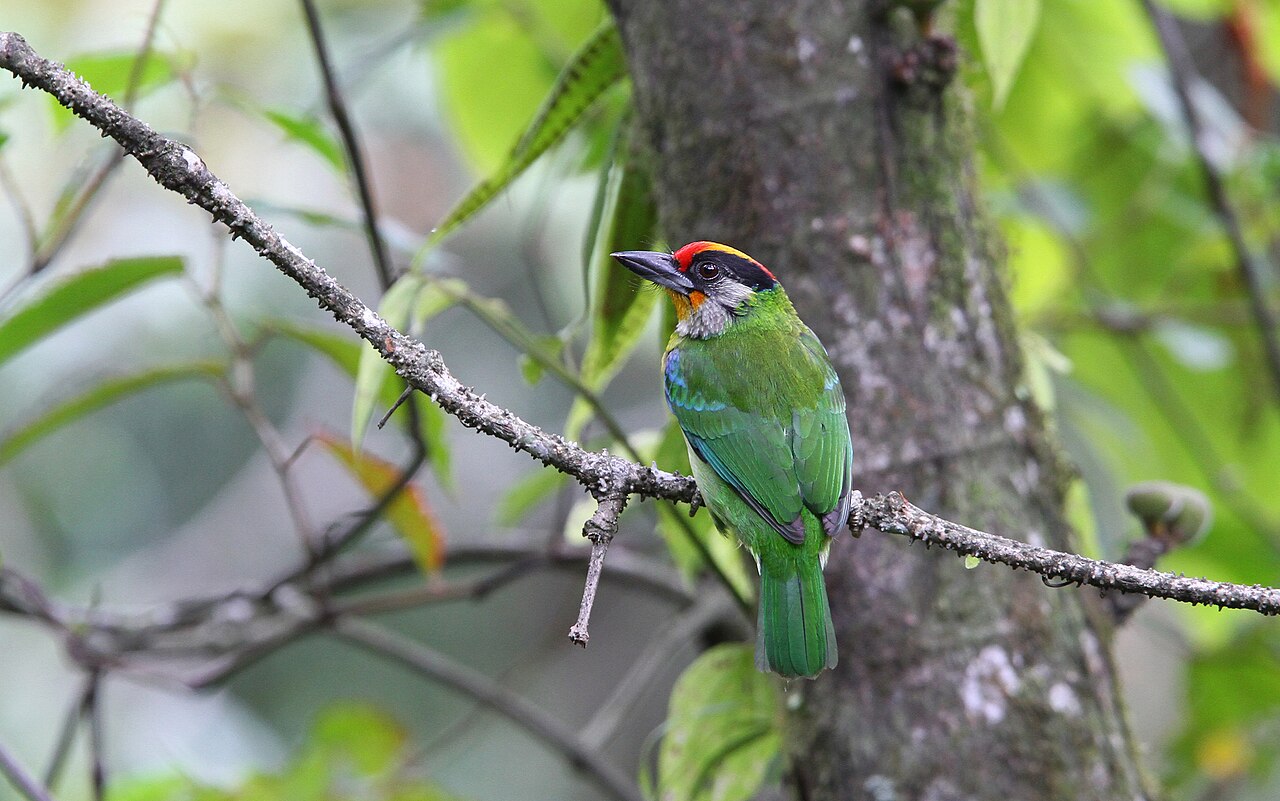
The golden-throated barbet is an Asian barbet native to Southeast Asia, where it inhabits foremost forests between 900 and 2,700 m altitude. It is listed as Least Concern on the IUCN Red List because of its wide distribution and stable population.
Region
Eastern Himalayas and Southeast Asia
Typical Environment
Occurs from the Himalayan foothills through northeastern India and Myanmar into southern China (e.g., Yunnan) and Indochina, extending into Thailand, Laos, and Vietnam. Prefers montane evergreen and moist broadleaf forests, forest edges, and well-wooded secondary growth. Often found in fruiting fig trees and occasionally in orchards and gardens near forest. It spends most of its time in the mid to upper canopy, descending lower when feeding opportunities arise.
Altitude Range
900–2700 m
Climate Zone
Highland
Ease of Keeping
Beginner friendly: 1/5
The golden-throated barbet is a canopy-dwelling frugivore whose loud, repetitive calls often reveal its presence long before it is seen. It excavates its own nesting cavities in dead or decaying wood, with both sexes participating in digging and incubation. By swallowing fruits whole and dispersing seeds, it plays a key role in forest regeneration.

Temperament
secretive in canopy but vocal
Flight Pattern
short rapid wingbeats with direct, undulating flight between trees
Social Behavior
Typically seen singly, in pairs, or in small family groups around fruiting trees. Both sexes excavate nest cavities in soft or decaying wood and share incubation and chick-rearing duties. Breeding timing varies by region but often coincides with warmer, wetter months when fruit and insects are abundant.
Migratory Pattern
Resident
Song Description
A loud, rhythmic series of hollow notes reminiscent of a metronome, repeated for long periods. Calls carry far through the forest and are often the best clue to its presence.
Plumage
Dense, glossy plumage; mostly green body with a striking golden-yellow throat and multicolored head. The face shows blue patches with a contrasting black moustachial line and a red forehead/crown area.
Diet
Primarily eats fruits such as figs, berries, and drupes, often swallowing them whole and later regurgitating seeds. Supplements its diet with insects including beetles, ants, and caterpillars, especially when feeding young. Will occasionally take nectar and small invertebrates gleaned from foliage.
Preferred Environment
Forages mainly in the mid to upper canopy of evergreen and moist broadleaf forests. Frequently visits fruiting trees at forest edges, secondary growth, and sometimes orchards and gardens.


