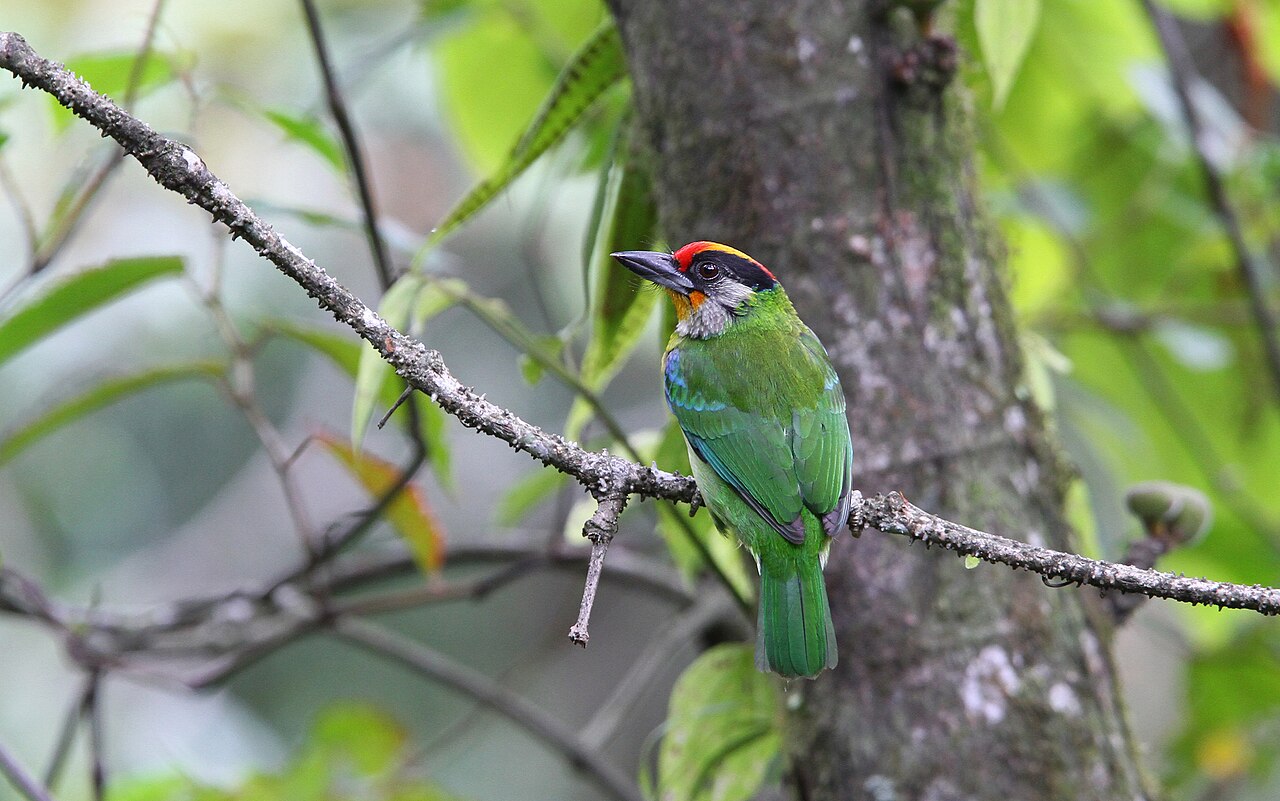
The golden-tailed parrotlet is a Vulnerable species of bird in subfamily Arinae of the family Psittacidae, the African and New World parrots. It is endemic to eastern Brazil.
Region
Eastern Brazil (Atlantic Forest)
Typical Environment
Occurs in remnant tracts of moist Atlantic Forest, favoring mature and secondary evergreen forest with a well-developed canopy. It is most often detected around fruiting trees along forest edges, ridgelines, and riverine corridors. The species can use partially degraded or secondary growth when fruit is abundant but depends on nearby intact forest. Records indicate a patchy distribution shaped by habitat availability and seasonal food resources.
Altitude Range
Sea level to 1200 m
Climate Zone
Tropical
Ease of Keeping
Beginner friendly: 1/5
A small, canopy-dwelling parrot, the golden-tailed parrotlet is notoriously hard to spot because it moves quietly through high foliage and often forages in small, fast-moving groups. It is threatened primarily by the loss and fragmentation of Brazil’s Atlantic Forest. Like other Touit parrotlets, it likely makes irregular local movements following fruiting trees. It is rarely seen in captivity and is best known from field observations in native habitat.


A golden-tailed parrotlet mid-flight near João Pessoa, Paraíba

Temperament
shy and cryptic
Flight Pattern
fast direct flight with short rapid wingbeats
Social Behavior
Usually seen in pairs or small groups, occasionally joining mixed-species feeding flocks at fruiting trees. Likely nests in natural tree cavities, though breeding details are poorly documented. Pairs maintain contact calls while foraging and keep to the upper canopy, dropping lower only to exploit specific food sources.
Migratory Pattern
Partial migrant
Song Description
Vocalizations are soft, high-pitched whistles and thin chirps, often given in flight. Calls can be easily missed against insect noise and wind in the canopy.
Plumage
Predominantly green with a contrasting golden-yellow tail and subtle bluish tones in the wings; compact, short-tailed parrotlet form.
Diet
Feeds primarily on small fruits, berries, and seeds from native Atlantic Forest trees and shrubs. It is known to exploit seasonal fruiting events, moving locally to track abundant resources. It may also take flower buds and nectar opportunistically. Foraging is typically careful and deliberate, with short flights between canopy fruiting clusters.
Preferred Environment
Mostly forages in the mid to upper canopy of moist evergreen forest, especially at forest edges and clearings with fruiting trees. Will use secondary growth and forest fragments when key food plants are present.