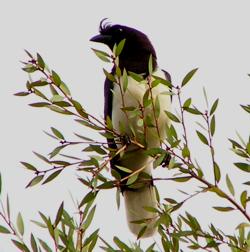
The Cuban vireo is a species of bird in the family Vireonidae that is endemic to Cuba. Its natural habitats are dry forests, lowland moist forests, xeric shrublands, and heavily degraded former forest.
Region
Greater Antilles (Cuba)
Typical Environment
Endemic to Cuba, including the main island, Isla de la Juventud, and surrounding cays. It inhabits dry forests, coastal scrub, thorny thickets, and xeric shrublands, as well as edges of lowland moist forests. The species tolerates human-altered landscapes and may occur in plantations, second growth, and degraded woodland. It is most frequently encountered in low to mid-level vegetation where it gleans from leaves and twigs.
Altitude Range
Sea level to 800 m
Climate Zone
Tropical
Ease of Keeping
Beginner friendly: 2/5
Named after the Cuban naturalist Juan Gundlach, the Cuban vireo is a small, often inconspicuous songbird of scrub and dry forest. It forages methodically among foliage, often in pairs, and will join mixed-species flocks outside the breeding season. Its repetitive, scolding song can make it easier to detect than to see.

Temperament
active but somewhat skulking
Flight Pattern
short, direct flights with rapid wingbeats
Social Behavior
Typically found singly or in pairs during the breeding season, defending small territories. Builds a neat cup nest in a fork of a shrub or small tree; both sexes participate in nest building and incubation. Outside of breeding, it may join mixed-species foraging flocks in scrub and forest edge.
Migratory Pattern
Resident
Song Description
Delivers a repetitive series of short, clear phrases and scolding notes, often from concealed perches. Calls include sharp chips and churrs, with a steady cadence that carries through scrub.
Plumage
Olive-green upperparts with a grayish head, whitish throat and belly, and a subtle yellow wash on the flanks. The plumage is relatively plain, with fine, clean feathering and minimal streaking. A faint pale supercilium and thin eye ring can be visible at close range.
Diet
Primarily consumes insects and other arthropods such as caterpillars, beetles, and spiders, gleaned from foliage. It will also take small fruits and berries, especially in the dry season when insects are less abundant. Occasional hovering and sallying may be used to snatch prey from leaves or the air.
Preferred Environment
Forages in low to mid-story of dry forest, scrub, hedgerows, and forest edges. Often works methodically through dense foliage, using short hops and pauses to inspect leaves and twigs.