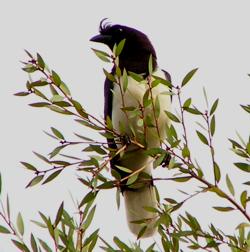
The cuckoo-finch, also known as the parasitic weaver or cuckoo weaver, is a small passerine bird now placed in the family Viduidae with the indigobirds and whydahs. It occurs in grassland in Africa south of the Sahara. The male is mainly yellow and green while the female is buff with dark streaks. They lay their eggs in the nests of other birds.
Region
Sub-Saharan Africa
Typical Environment
Found across savannas and open grasslands, often with scattered shrubs and near wetlands. It favors rank grass, fallow fields, and lightly cultivated areas where host species are common. The cuckoo-finch avoids dense forest and extremely arid desert. It can occur locally in high densities where suitable hosts and tall grasses coincide.
Altitude Range
0–2000 m
Climate Zone
Tropical
Ease of Keeping
Beginner friendly: 1/5
Also called the parasitic weaver, the cuckoo-finch is an obligate brood parasite that lays its eggs in the nests of small warblers such as prinias and cisticolas. Its eggs and nestlings often mimic those of its hosts, improving the chances of successful parasitism. Males become brighter yellow-green in breeding season, while females and non-breeding males are buff and heavily streaked. It ranges widely across sub-Saharan Africa in grassy habitats.


Temperament
secretive and skulking
Flight Pattern
short rapid wingbeats with low, undulating flights
Social Behavior
Often seen singly or in pairs, sometimes in small loose groups where hosts are abundant. It does not build its own nest; females stealthily place eggs in the nests of prinias and cisticolas and may remove host eggs. Courtship includes brief aerial chases and display flights by the male. Parental care is outsourced entirely to the host species.
Migratory Pattern
Resident
Song Description
Vocalizations are soft and wheezy, with thin high-pitched notes and short trills. Calls include sharp tsip and chit notes given from cover. The repertoire is modest and often delivered inconspicuously.
Plumage
Male in breeding plumage is bright yellow to yellow-green with darker streaks on the upperparts; non-breeding male and female are buff to sandy with heavy dark streaking above and on the flanks. The underparts are paler with less streaking. Feathers are short and neat, giving a compact, finch-like appearance.
Diet
Feeds mainly on grass seeds and small seeds gleaned from stems and the ground. It supplements this with small insects and other invertebrates, especially in the wet season. Foraging is typically low in grass or on the ground, picking items delicately with its conical bill. It will opportunistically visit crop edges and disturbed ground.
Preferred Environment
Most often forages in rank or tussocky grass, along paths, and at the margins of wetlands and fields. It keeps close to cover and frequently drops into grass when disturbed. Edges of savanna thickets and lightly grazed pastures are commonly used.