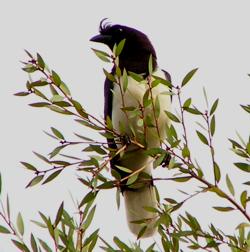
The cuckoo-roller or courol is the only bird in the family Leptosomidae, which was previously often placed in the order Coraciiformes but is now placed in its own order Leptosomiformes. The cuckoo-roller is at the root of a group that contains the Trogoniformes, Bucerotiformes, Piciformes, and Coraciiformes. Despite its name, the Cuckoo-roller does not share close evolutionary origins with cuckoos or rollers.
Region
Madagascar and Comoros
Typical Environment
Occurs across Madagascar from coastal lowlands to interior forests and wooded savannas, and also on the Comoros (including Mayotte). It uses primary and secondary forest, forest edges, gallery woodland, and even plantations and large gardens with tall trees. Often perches high in the canopy, scanning for prey and making short sallies into open airspace or along edges. Tolerant of habitat mosaic provided tall trees remain for foraging and nesting. Nests in natural tree cavities.
Altitude Range
Sea level to 2000 m
Climate Zone
Tropical
Ease of Keeping
Beginner friendly: 1/5
The cuckoo-roller is the sole member of the family Leptosomidae and is placed in its own order, Leptosomiformes. It shows strong sexual dimorphism: males are iridescent green with a grey head, while females are brown and heavily spotted. It performs dramatic rolling display flights and often sallies from perches to catch large insects and small reptiles like chameleons. Despite its name, it is not closely related to cuckoos or rollers.


The cuckoo-roller exhibits a pronounced sexual dichromatism in the plumage.
Temperament
solitary to paired, moderately territorial
Flight Pattern
buoyant flier with deep wingbeats and long glides; performs rolling display flights
Social Behavior
Usually seen alone or in pairs perched high in tall trees. Breeds in natural tree cavities; pairs defend nest areas and both parents are involved in care. Courtship includes aerial displays and food offerings. Nesting is timed to periods of higher prey availability.
Migratory Pattern
Resident
Song Description
Voice is a far-carrying, mellow series of whistled notes, often rendered as a descending whee-ooo. Also gives softer coos and chattering calls during display and at the nest.
Plumage
Male with iridescent green upperparts and a pale grey head and breast, clean whitish belly; female brown above with mottling and buff underparts thickly spotted or barred dark. Both have a long tail and broad wings giving a buoyant, gliding silhouette.
Diet
Feeds mainly on large insects such as grasshoppers, beetles, mantises, and stick insects, and also takes small lizards and chameleons. Hunts by sit-and-wait from exposed perches, making quick sallies to seize prey. Will glean prey from foliage and occasionally hawk flying insects. Diet composition varies with season and habitat.
Preferred Environment
Forages along forest edges, clearings, canopy gaps, and above plantations where prey is abundant. Prefers tall perches with open sightlines for sallying and scanning.