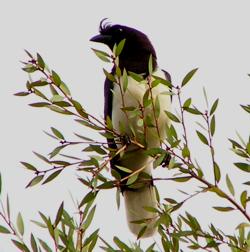
The curl-crested aracari or curl-crested araçari is a near-passerine bird in the toucan family Ramphastidae. It is found in Bolivia, Brazil, and Peru.
Region
Southwestern Amazonia
Typical Environment
Occurs in lowland rainforest of western Brazil, northern Bolivia, and southeastern Peru, favoring terra firme and seasonally flooded várzea forests. It frequents mature canopy, forest edges, and river corridors, and will use secondary growth with tall trees. Groups move along fruiting trees within the canopy and occasionally descend to midstory. The species tolerates moderate habitat mosaic but declines with extensive deforestation.
Altitude Range
Sea level to 700 m
Climate Zone
Tropical
Ease of Keeping
Beginner friendly: 2/5
Famed for its unique curled, hair-like crown feathers, the curl-crested aracari is one of the most distinctive toucans. It travels in small, noisy groups through the Amazonian canopy and often follows fruiting trees. Its large, lightweight bill helps it reach fruit on slender branches. Though primarily frugivorous, it will opportunistically take insects, eggs, and small vertebrates.


Temperament
social and active
Flight Pattern
short rapid wingbeats with undulating canopy flights
Social Behavior
Usually found in pairs or small groups of 3–10 birds moving through the canopy. Nests in tree cavities; both sexes share incubation and chick-rearing. Often joins mixed-species frugivore flocks and engages in bill-clacking displays during interactions.
Migratory Pattern
Resident
Song Description
Vocalizations are a series of rattling, croaking notes and sharp yelps, often delivered in quick sequences by multiple birds. Calls carry well through the canopy and are accompanied by bill clacks.
Plumage
Glossy dark green upperparts with a contrasting yellow underbody crossed by a broad reddish band; rump and undertail show red tones. Crown feathers are curled and filamentous, forming a distinctive crest. Tail dark with greenish sheen; bare facial skin bluish.
Diet
Primarily eats a wide variety of soft fruits, especially figs and palm drupes. It supplements with insects and other arthropods gleaned from foliage and bark. Opportunistically takes bird eggs and small vertebrates, particularly during the breeding season. Its long bill allows it to reach fruit on slender peripheral branches.
Preferred Environment
Forages mainly in the upper canopy and along forest edges and river margins where fruiting trees are abundant. Will enter tall secondary growth and clearings with remnant fruiting trees.