

The calliope hummingbird is the smallest bird native to the United States and Canada. It has a western breeding range mainly from California to British Columbia, and migrates to the Southwestern United States, Mexico, and Central America for its wintering grounds. The calliope hummingbird is the smallest known long-distance bird migrant, completing migrations twice per year of some 9,000 km (5,600 mi).
Region
Western North America
Typical Environment
Breeds in the mountains and plateaus of the western United States and southern Canada, favoring open conifer forests, riparian thickets, and wildflower meadows. During migration it uses river corridors, sagebrush steppe, and foothills where flowers are abundant. Winters primarily in the highlands of Mexico and occasionally the southwestern United States. Common in gardens with nectar-rich flowers and feeders along its route.
Altitude Range
0–3300 m
Climate Zone
Highland
Ease of Keeping
Beginner friendly: 1/5
The Calliope Hummingbird is the smallest bird native to the United States and Canada and the smallest known long‑distance migrant, traveling around 9,000 km annually. Males have a distinctive magenta, streaked gorget that fans into a starburst during displays. They breed mainly in montane conifer forests and meadows from California to British Columbia and winter in Mexico and the southwestern U.S. Females alone build tiny nests bound with spider silk and raise two chicks per brood.


Male calliope hummingbird with its purple gorget (neck) feathers slightly extended

Female feeding insects to chicks
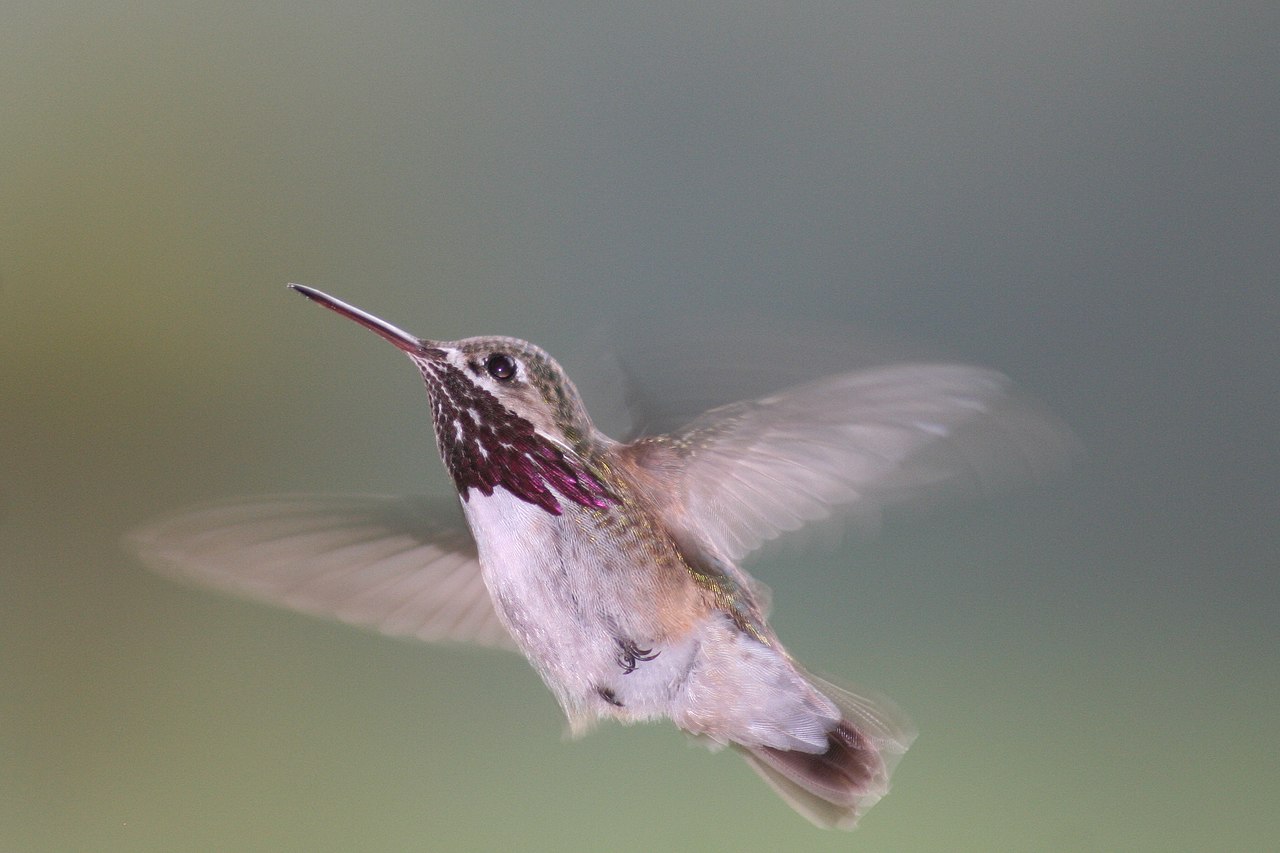
A hovering male calliope
Temperament
solitary and territorial
Flight Pattern
short rapid wingbeats and agile hovering
Social Behavior
Males defend small feeding and display territories and perform shuttle displays with buzzing sounds. The species is polygynous; males do not assist with nesting. Females build tiny cup nests from plant down and spider silk, usually on conifer branches, and lay two eggs.
Migratory Pattern
Seasonal migrant
Song Description
Vocalizations are high, thin tseeps and soft twittering. During displays, males add a distinctive buzzy or zinging sound produced by the wings and tail feathers.
Plumage
Metallic green upperparts with whitish underparts and buffy flanks; short, slightly notched tail. Males show a striking magenta, streaked gorget with elongated rays; females/immatures have a whitish throat with fine dusky spotting and rufous tones in the tail.
Diet
Takes nectar from tubular wildflowers such as penstemon, columbine, and paintbrush, and readily visits hummingbird feeders. Also consumes small insects and spiders for protein, catching them in the air or gleaning from foliage. May use sapsucker wells to feed on sap and associated insects, especially during migration.
Preferred Environment
Feeds in flower-rich meadows, forest edges, riparian thickets, and montane shrublands. In migration and winter, frequents gardens, canyons, and oak-pine highlands where blossoms are abundant.


