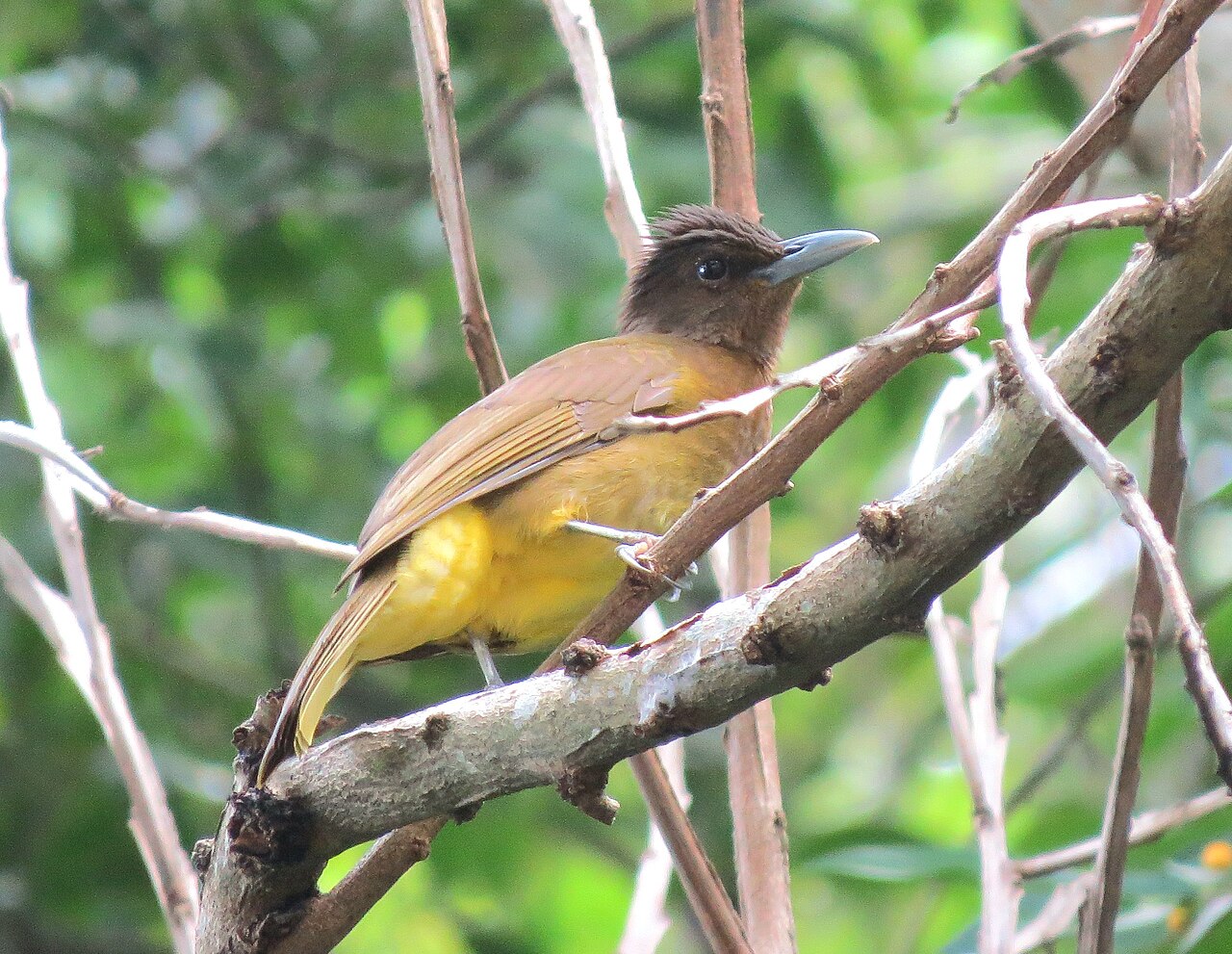
The Camiguin boobook or Camiguin hawk-owl is an owl species resident to the Camiguin island in the Philippines. It is the only owl in the country with greenish-yellow or grayish eyes. It was previously known as a subspecies of the Philippine hawk-owl, but was reclassified in 2012, as voice and other evidence suggested it a distinct species. Its native name is kugkug
Region
Philippine Archipelago
Typical Environment
This species is restricted to the island of Camiguin off the northern coast of Mindanao. It inhabits primary and secondary lowland to montane forest, forest edges, and wooded mosaics including agroforestry areas with tall trees. It can persist in semi-disturbed habitats provided there are suitable perches and cavity-bearing trees for nesting. Protected forest on the Timpoong–Hibok-Hibok range is a stronghold.
Altitude Range
Sea level to 1500 m
Climate Zone
Tropical
Ease of Keeping
Beginner friendly: 1/5
The Camiguin boobook, or Camiguin hawk-owl, is confined to Camiguin Island in the Philippines and is noted as the country's only owl with greenish-yellow to grayish eyes. Formerly treated as a subspecies of Philippine hawk-owl, it was elevated to full species in 2012 based on distinctive vocalizations and morphology. Locally it is known as “kugkug,” reflecting its characteristic call. It typically duets at night, with a rhythmic, bouncing-ball sequence of hoots.


Temperament
solitary and territorial
Flight Pattern
short rapid wingbeats with agile maneuvering through forest
Social Behavior
Usually encountered as territorial pairs that duet at night, especially during the breeding season. Nests are likely placed in natural cavities or old woodpecker holes in mature trees. Clutches are small, and both parents participate in territory defense and provisioning.
Migratory Pattern
Resident
Song Description
The call is a rhythmic series of accelerating hoots, often described as a bouncing-ball pattern. Pairs often duet, with the female’s notes higher and slightly softer, creating an alternating sequence that carries well through forest at night.
Plumage
Rich brown upperparts with fine spotting, contrasting with pale buff to whitish underparts marked by bold brown streaks. The throat is whitish with a clean patch; tail is brown with narrow barring. Compact, earless silhouette with relatively large head and short tail.
Diet
Primarily hunts large insects such as beetles, katydids, crickets, and moths. It will also take small vertebrates including geckos, frogs, and occasionally rodents when available. Prey is typically taken from perches in short sallies or gleaned from foliage and trunks.
Preferred Environment
Forages along forest edges, clearings, and semi-open woodland with scattered tall trees. Uses perches along trails, streams, and the edges of agroforests or coconut groves near intact forest.