The black stilt or kakī (Māori) is a wading bird found in New Zealand. It is one of the world's rarest birds, with 169 adults surviving in the wild as of May 2020. Adult kakī have distinctive black plumage, long pink legs, and a long thin black bill. Black stilts largely breed in the Mackenzie Basin in the South Island, and are threatened by introduced feral cats, ferrets, and hedgehogs as well as habitat degradation from hydroelectric dams, agriculture, and invasive weeds.
Region
South Island, New Zealand
Typical Environment
The species now breeds mainly in the Mackenzie Basin, favoring braided riverbeds, shallow lakes, and wetlands with open gravel islands and sparse vegetation. Outside the breeding season it forages along lake margins, river shallows, and occasionally irrigated paddocks. Historically it also occurred in coastal wetlands, but today it is largely restricted to inland habitats. Nest sites are typically on gravel bars or islands where visibility is high but predation risk can be significant.
Altitude Range
Sea level to 1000 m
Climate Zone
Temperate
Ease of Keeping
Beginner friendly: 1/5
Also known as kakī in Māori, the black stilt is one of the world’s rarest waders and a flagship for New Zealand conservation. Intensive management includes predator control, captive breeding, and release of juveniles to bolster the wild population. Adults are uniformly black with striking pink legs and a red eye, a combination unique among stilts. Juveniles are mottled black-and-white before moulting into the adult’s all-black plumage.


Black stilt (Himantopus novaezealandiae), compared with the closely related pied stilt (H. himantopus). Painted by John Gould.

Kakī nest in the Mackenzie Basin.

Black stilt near Twizel

Pied stilt (Himantopus leucocephalus) on nest
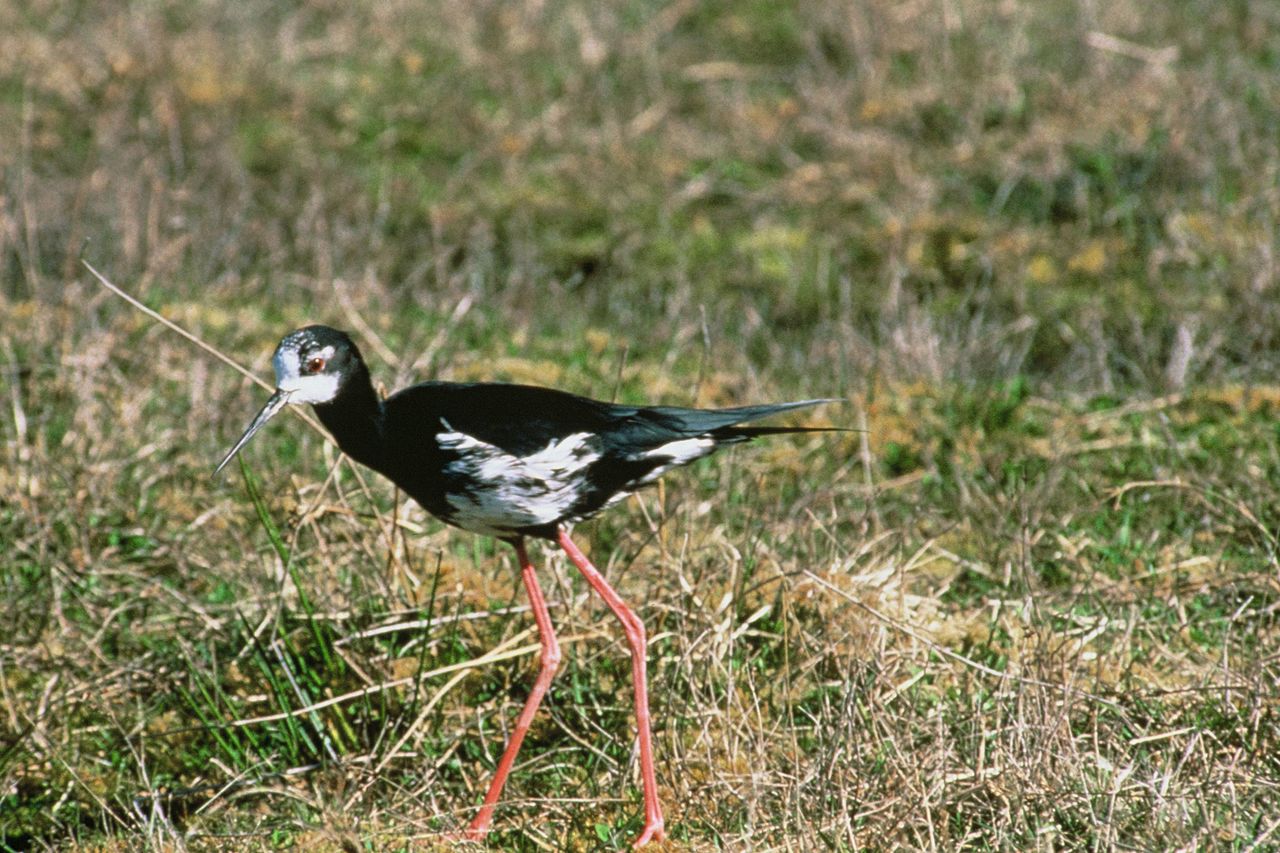
Hybrid (black × pied) stilt, showing node F plumage. (Hybrid black stilt colour patterns are described as 'nodes', ranging from 'A', closest to a pied stilt, to 'J', closest to a black stilt.)
Temperament
solitary and territorial
Flight Pattern
fast direct flight with rapid wingbeats
Social Behavior
Typically forms solitary pairs during breeding and defends territories along braided rivers. Nests are shallow scrapes on gravel islands or bars, sometimes lined with small stones or vegetation. Pairs are generally monogamous within a season, and both adults share incubation and chick-rearing duties.
Migratory Pattern
Resident
Song Description
Calls are sharp, high-pitched piping notes, often given in rapid series when alarmed. Soft contact calls are used between mates and with chicks, with louder, more insistent calls during territorial disputes.
Plumage
Adults are uniformly glossy-black with fine feathering; juveniles show mottled black-and-white before turning fully black.
Diet
Primarily takes aquatic and terrestrial invertebrates such as mayfly and caddisfly larvae, midges, beetles, worms, and small crustaceans. It occasionally consumes small mollusks and, rarely, tiny fish. Foraging involves pecking and gleaning from the surface or just below, and sometimes probing in soft sediments.
Preferred Environment
Feeds along shallow river margins, lake edges, and wet gravel bars where water is clear and depths are minimal. It also uses managed wetlands and sometimes irrigated pasture with standing water.