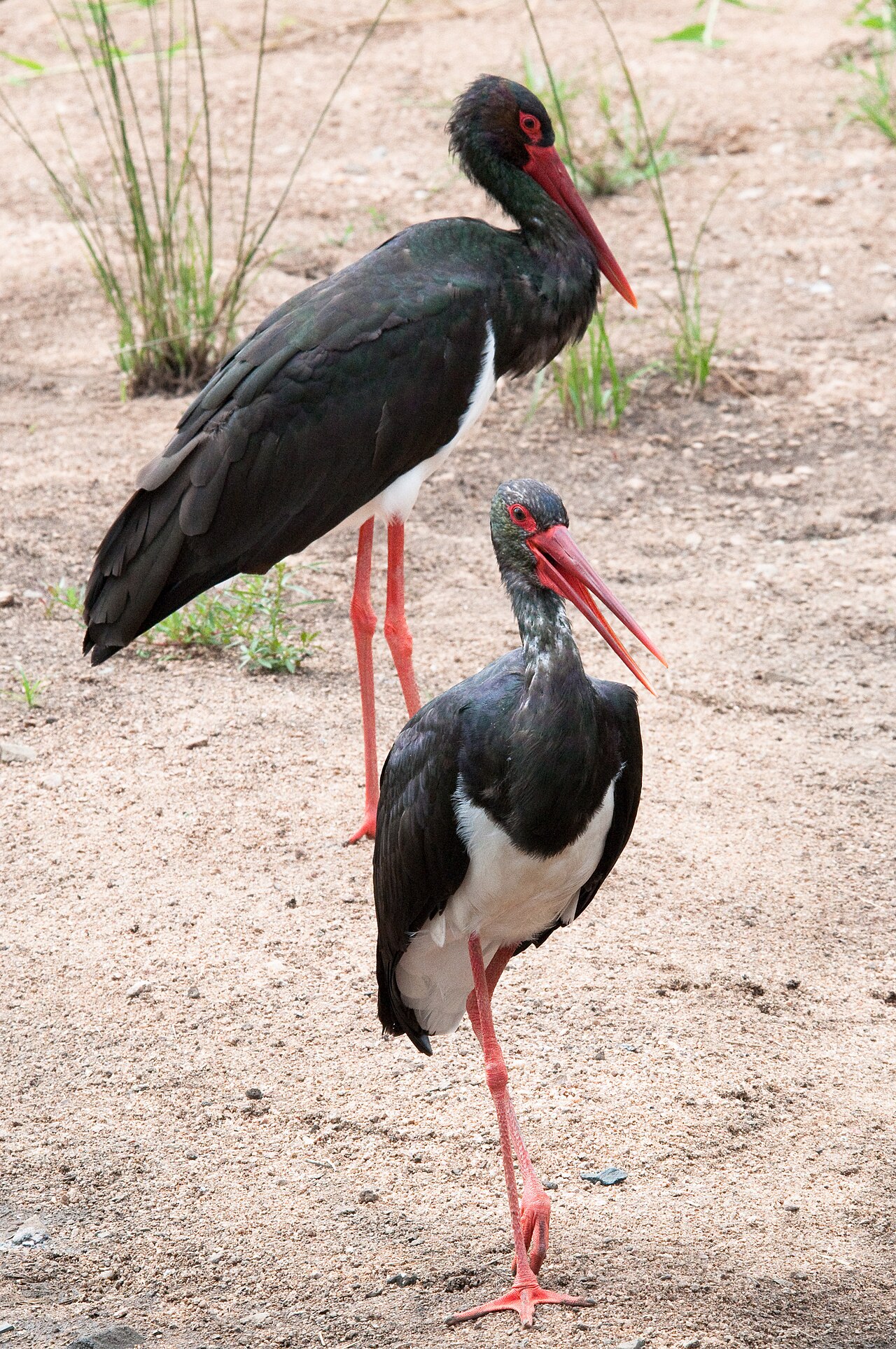
The black stork is a large bird in the stork family Ciconiidae. It was first described by Carl Linnaeus in the 10th edition of his Systema Naturae. Measuring on average 95 to 100 cm from beak tip to end of tail with a 145-to-155 cm (57-to-61 in) wingspan, the adult black stork has mainly black plumage, with white underparts, long red legs and a long pointed red beak. A widespread but uncommon species, it breeds in scattered locations across Europe, and east across the Palearctic to the Pacific Ocean. It is a long-distance migrant, with European populations wintering in tropical Sub-Saharan Africa, and Asian populations in the Indian subcontinent. When migrating between Europe and Africa, it avoids crossing broad expanses of the Mediterranean Sea and detours via the Levant in the east, the Strait of Sicily in the center, or the Strait of Gibraltar in the west. An isolated non-migratory population lives in Southern Africa.
Region
Palearctic (Europe to East Asia); winters in Sub-Saharan Africa and the Indian Subcontinent
Typical Environment
Breeds in scattered parts of Europe and across temperate Asia, favoring large, old-growth or mature forests near rivers, marshes, and floodplains. In winter it occupies wetlands, river valleys, and shallow lakes in tropical Africa and the Indian subcontinent. It avoids open sea crossings and follows land corridors and major flyways. Nests are typically placed high in trees or on cliffs in remote areas with minimal disturbance.
Altitude Range
Sea level to 2000 m
Climate Zone
Temperate
Ease of Keeping
Beginner friendly: 2/5
The black stork is a shy, forest-dwelling stork that nests on secluded trees or cliffs near rivers and wetlands. It is a long-distance migrant that relies on thermal updrafts, often detouring around large water bodies such as the Mediterranean Sea. Conservation depends on preserving undisturbed riparian forests and maintaining clean, free-flowing waterways.


From Manas Tiger Reserve, Assam, India.

Adult in a Dutch zoo

Black stork in flight

Red line: Migration border Orange arrow: Western migrationYellow arrow: Eastern migrationBlue: Winter location

pair with eggs in nest; Salto Del Gitano, Cáceres, Spain

Black stork foraging

Egg, Collection Museum Wiesbaden
Temperament
solitary and wary
Flight Pattern
soaring glider
Social Behavior
Usually solitary or in pairs during breeding, forming loose flocks on migration and at rich feeding sites. Monogamous within a season, it builds large stick nests on tall trees or cliffs. Both parents incubate and feed the young.
Migratory Pattern
Seasonal migrant
Song Description
Generally silent away from the nest. Communicates with bill-clattering displays and soft hisses or whistles near the nest.
Plumage
Glossy black upperparts with green and purple sheen, sharply contrasting white underparts.
Diet
Primarily takes small fish, amphibians, aquatic insects, and crustaceans captured by stalking in shallow water. Also consumes small reptiles, worms, and occasionally small mammals. Prey is seized by quick jabs and swallowed whole.
Preferred Environment
Feeds along slow-moving rivers, oxbow lakes, marsh edges, and floodplains with clear, shallow water. Will also forage on exposed mudflats and wet meadows, especially during migration and winter.