
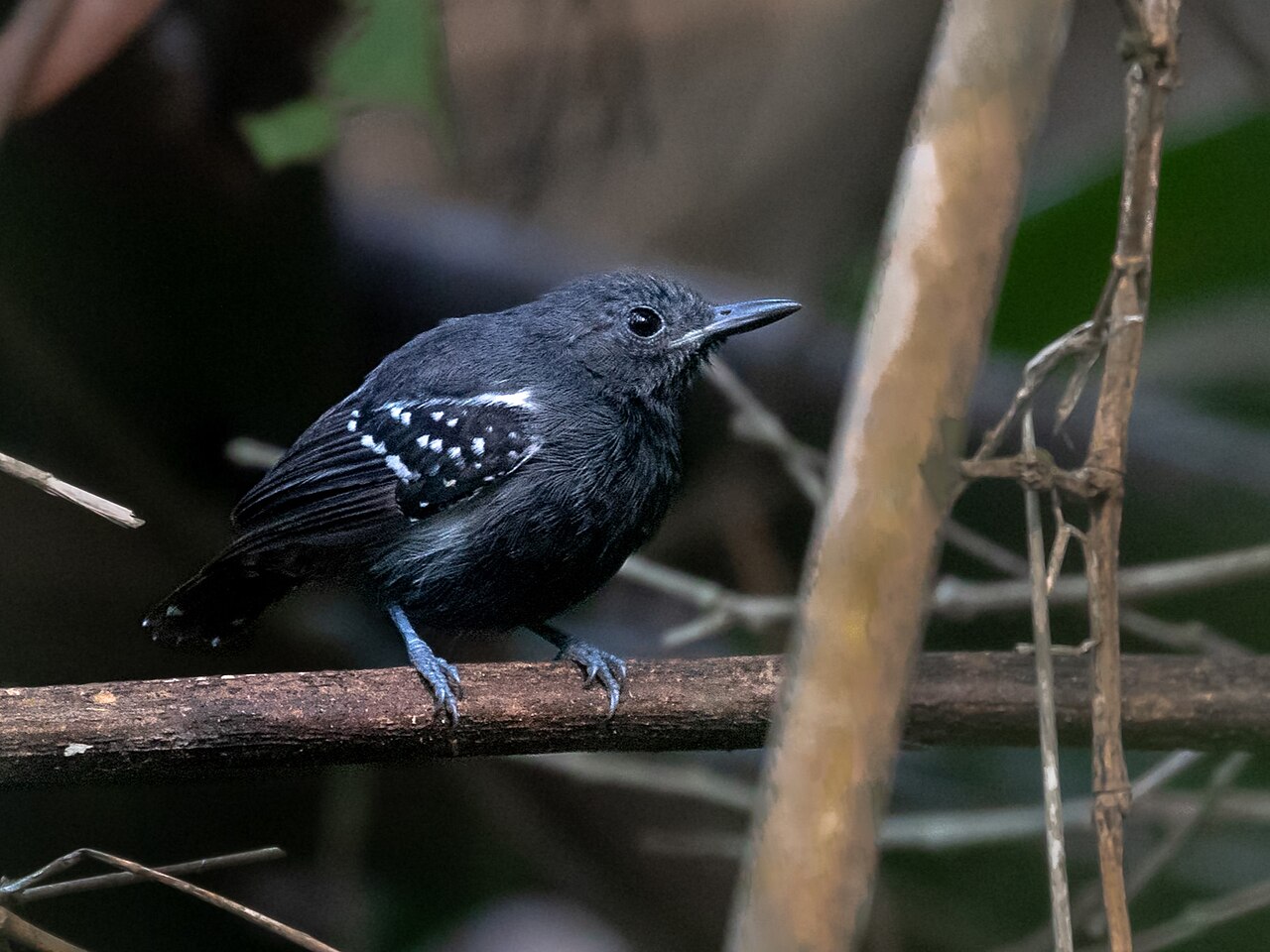
The white-flanked antwren is a species of bird in subfamily Thamnophilinae of family Thamnophilidae, the "typical antbirds". It is found from Honduras to Panama in Central America, in every mainland South American country except Argentina, Chile, Paraguay, and Uruguay, and on Trinidad.
Region
Central America and the Amazon Basin to the Guianas and Trinidad
Typical Environment
Occurs from Honduras through Panama and widely across northern and central South America, including Colombia, Venezuela, the Guianas, Ecuador, Peru, Bolivia, and much of Brazil; also on Trinidad. Favors humid lowland and foothill forests, edges, and secondary growth. Common in terra firme and seasonally flooded (várzea) forests, as well as along streams and in dense thickets. Generally keeps to the shaded understory and lower midstory, where it moves rapidly among foliage.
Altitude Range
0–1500 m
Climate Zone
Tropical
Ease of Keeping
Beginner friendly: 1/5
A tiny antbird of the understory, the white-flanked antwren often joins mixed-species flocks and occasionally follows army ant swarms to pick off fleeing insects. Males flash striking white patches on their flanks during quick, flicking movements, while females are warm brown and buff. It is widespread from Central America into much of tropical South America, including Trinidad. Secretive but active, it is more often detected by its thin, rapid song than seen clearly.


Temperament
secretive and active
Flight Pattern
short rapid wingbeats between close perches
Social Behavior
Usually found in pairs or small family groups, often accompanying mixed-species flocks in the understory. Territories are defended with soft calls and display of the white flanks by males. The cup nest is placed low in dense vegetation, and both sexes typically participate in care.
Migratory Pattern
Resident
Song Description
Song is a thin, rapid series of high notes or a short accelerating trill that can cut through understory noise. Calls include sharp chips and soft contact notes exchanged between pair members.
Plumage
Male is slate-black to black with bold white patches on the flanks and subtle pale edging on the wings; female is warm brown above with buffy underparts and paler throat, the white flanks less conspicuous. Both sexes are small, short-tailed, with fine, pointed bills suited to gleaning. Subtle regional variation occurs across its wide range.
Diet
Primarily small arthropods such as insects and spiders gleaned from leaves, twigs, and vine tangles. Frequently picks prey from the undersides of foliage and probes clusters of dead leaves. At times follows army ant swarms to capture flushed invertebrates, and may sally short distances to take mobile prey.
Preferred Environment
Feeds in the shaded understory and lower midstory of humid forests, especially in dense thickets and along edges. Often forages within mixed-species flocks, moving methodically but quickly through complex vegetation.


