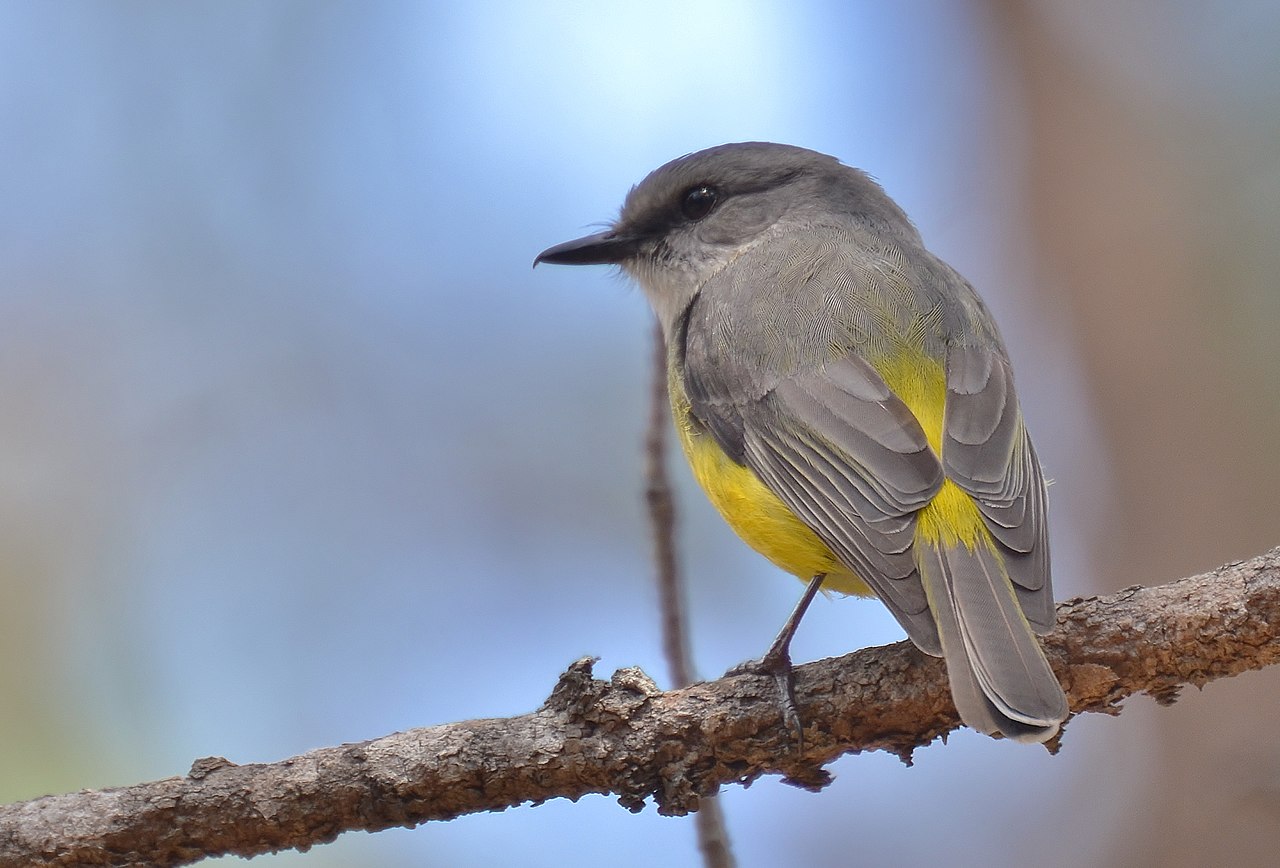
The western wattled cuckooshrike or Ghana cuckooshrike is a species of bird in the family Campephagidae. It is native to the Upper Guinean Forests. Its natural habitats are subtropical or tropical moist lowland forest and subtropical or tropical swamps. It is threatened by habitat loss.
Region
Upper Guinean Forests, West Africa
Typical Environment
Found patchily from Guinea and Sierra Leone through Liberia and Côte d’Ivoire to Ghana, tied to intact lowland rainforest blocks. It favors primary and mature secondary evergreen and semi-deciduous forests, as well as swamp forests and tall gallery forest. The species forages mainly in the canopy and subcanopy, occasionally along forest edges and in selectively logged areas if large trees remain. It is generally absent from heavily degraded forest and open farmland.
Altitude Range
Sea level to 1200 m
Climate Zone
Tropical
Ease of Keeping
Beginner friendly: 1/5
Also known as the Ghana cuckooshrike, this species is a canopy-dwelling member of the cuckooshrike family (Campephagidae) restricted to the Upper Guinean forests of West Africa. Males have small fleshy wattles at the base of the bill, a distinctive feature within the group. It often joins mixed-species flocks high in the forest, where it gleans insects from foliage and twigs. Ongoing deforestation and fragmentation of lowland rainforest are its main threats.

Temperament
secretive and canopy-oriented
Flight Pattern
short rapid wingbeats with brief glides between canopy crowns
Social Behavior
Usually seen singly or in pairs, but regularly joins mixed-species flocks moving through the canopy. Nests are small cups placed on horizontal branches high above ground. Both sexes likely share incubation and chick-rearing duties. Territorial behavior is subdued, with much activity occurring within dense foliage.
Migratory Pattern
Resident
Song Description
A soft series of mellow whistles interspersed with brief churring notes. Calls are understated and can be easily overlooked amid forest ambient sounds.
Plumage
Mostly medium grey with slightly paler underparts and subtle mottling; smooth, sleek plumage suited to canopy foraging.
Diet
Primarily feeds on insects such as caterpillars, beetles, and orthopterans, gleaned from leaves and small branches. It occasionally sallies to capture flying prey and may take small arachnids. Fruit and berries are sometimes consumed, especially when insect prey is scarce. Foraging is methodical and typically occurs high in the canopy.
Preferred Environment
Feeds in the upper strata of primary and mature secondary rainforest, including swamp forest. It also uses tall forest edges and lightly logged forest where large trees persist. Often accompanies mixed-species flocks along canopy pathways.