
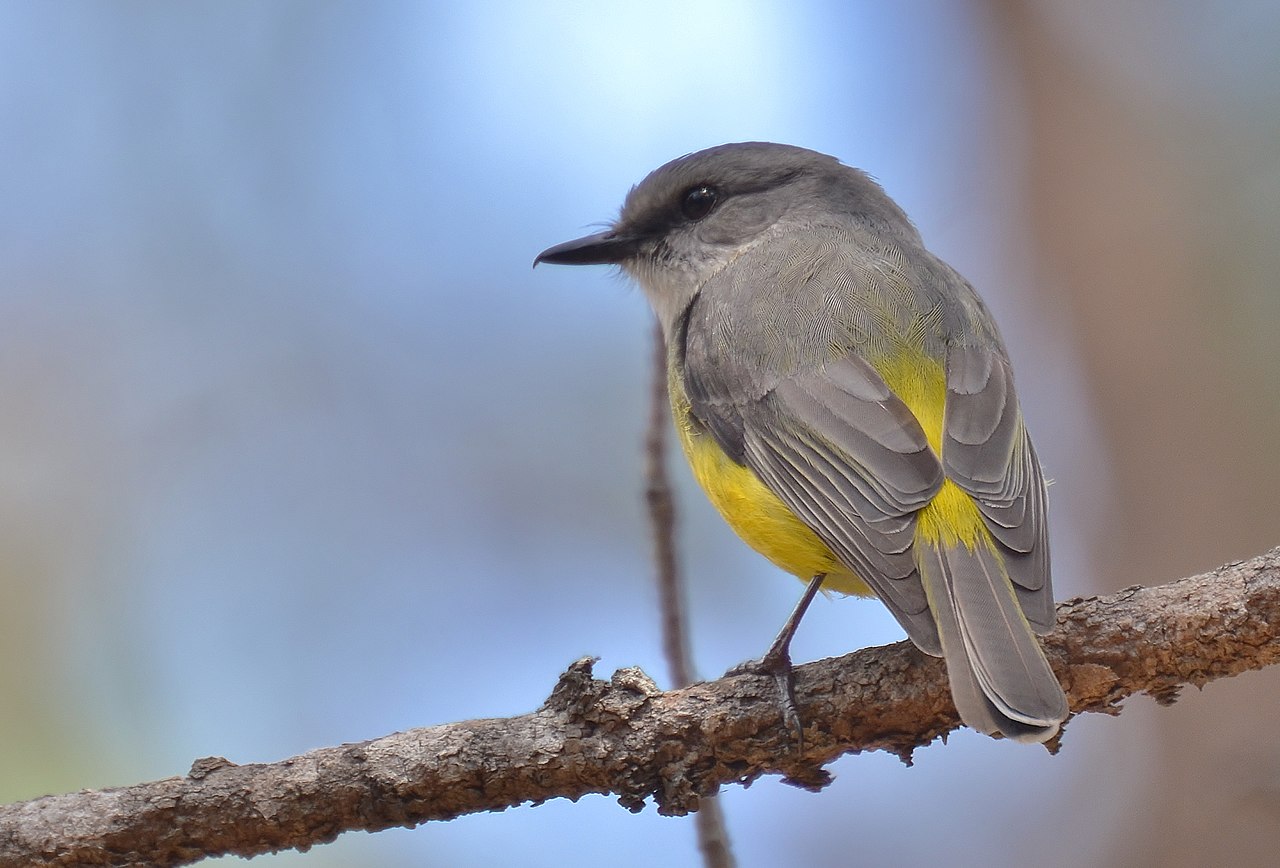
The western yellow robin is a species of bird in the Australasian robin family, Petroicidae, native to Australia. Described by John Gould in 1838, the western yellow robin and its Australian relatives are not closely related to either the European or American robins, but they appear to be an early offshoot of the Passerida group of songbirds. Ranging between 13.5 and 15.5 cm long, it has grey upperparts, and a grey breast and head, broken by whitish streaks near the bill and below the eye, with a conspicuous yellow belly. The sexes are similar in appearance. Two subspecies are recognized: subspecies griseogularis, which has a yellow rump, and subspecies rosinae with an olive-green rump.
Region
Southwest Australia
Typical Environment
Occurs across the woodlands and forests of southwestern Western Australia, including jarrah, marri, and wandoo eucalypt communities. It also uses coastal heath, mallee, and acacia shrublands where there is a moderately open understory and scattered perches. Birds are commonly found in riparian strips, forest edges, and lightly disturbed habitats. They are generally sedentary within territories but may shift locally in response to drought or fire.
Altitude Range
Sea level to 800 m
Climate Zone
Temperate
Ease of Keeping
Beginner friendly: 1/5
The western yellow robin is an Australasian robin native to southwestern Australia and is not closely related to European or American robins. It often perches low and makes short sallies to the ground to snatch insects. Two subspecies are recognized: griseogularis with a yellow rump, and rosinae with an olive-green rump. Despite its bright belly, it can be surprisingly inconspicuous in shaded eucalypt understory.


Seen from below, showing yellow underparts
Temperament
quiet but territorial
Flight Pattern
short rapid wingbeats
Social Behavior
Typically seen singly or in pairs, maintaining year-round territories. Pairs nest in a neat cup of bark strips and spider silk placed low to mid-height in shrubs or small trees. The female primarily incubates while the male provides food and both attend the young.
Migratory Pattern
Resident
Song Description
Song is a soft series of clear, whistled phrases, often descending in pitch. Calls include thin contact notes and sharper ticks when alarmed.
Plumage
Smooth grey upperparts with a grey head and breast, broken by fine whitish streaks at the lores and below the eye; vivid yellow belly contrasts with the grey foreparts.
Diet
Feeds mainly on insects and other small arthropods such as beetles, caterpillars, and spiders. It hunts by perching quietly and scanning the ground, then pouncing to capture prey. Occasional gleaning from low foliage and trunks is also practiced. It may supplement its diet with small invertebrates hidden in leaf litter after rain.
Preferred Environment
Forages in open to moderately dense understory within eucalypt woodland, forest edges, and heath. Often uses low branches, fence lines, and stumps as hunting perches and searches among leaf litter and fallen logs.


