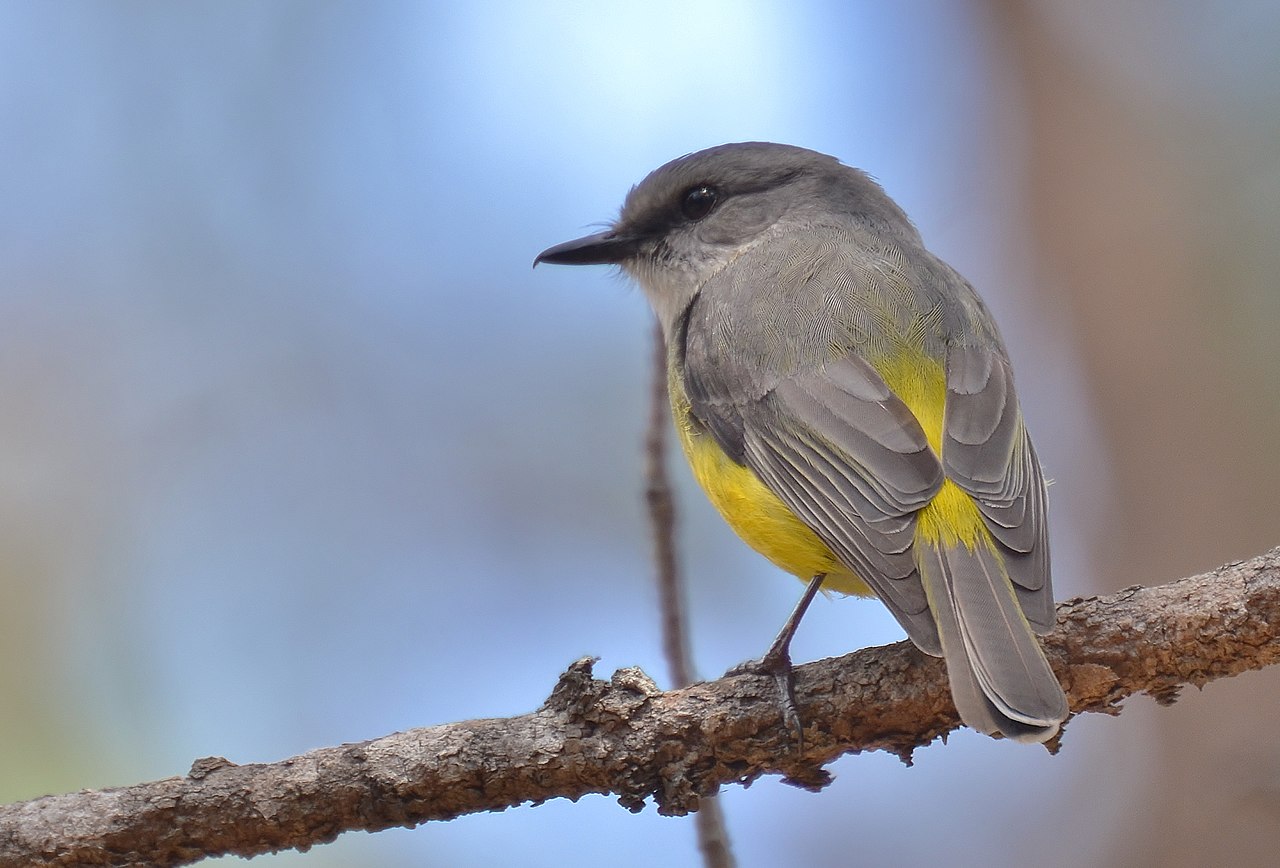
The western whipbird is a passerine bird found in several scattered populations in Southwest Australia. It is predominantly olive green in colour. The western whipbird has sometimes been split into two species: the black-throated whipbird and the white-bellied whipbird.
Region
Southwest Australia
Typical Environment
Occurs in scattered, isolated populations in dense coastal and mallee-heath thickets, favoring tangled understorey of Acacia, Melaleuca, and coastal scrub. It keeps close to the ground, using cover along dune systems, granite outcrops, and mallee shrublands. The species avoids open woodland and requires mid- to late-successional vegetation with substantial leaf litter. Fire history strongly shapes its occurrence, with birds most common where habitat has had time to recover post-burn.
Altitude Range
Sea level to 600 m
Climate Zone
Temperate
Ease of Keeping
Beginner friendly: 1/5
A secretive, ground-foraging songbird of dense Australian scrub, the western whipbird is famous for its sharp, whip-like duet—often a male’s piercing crack answered immediately by the female. The name historically covered two forms now often treated as separate species: the black-throated and the white-bellied whipbirds. It relies on mature, dense understorey and is highly sensitive to frequent fires and habitat fragmentation. Patience is key to seeing one; they are far more often heard than seen.

Temperament
secretive and skulking
Flight Pattern
short rapid wingbeats, low and direct between cover
Social Behavior
Typically encountered as pairs or small family groups maintaining year-round territories. Pairs are strongly bonded and perform coordinated duets. Nests are cup-shaped and placed low in dense shrubs, with 2–3 eggs typical. Breeding occurs mainly in spring to early summer.
Migratory Pattern
Resident
Song Description
A loud, metallic whip-crack or piercing whistle often followed by a rattling trill. Duets are tightly timed, with the female’s response almost overlapping the male’s call, making the pair sound like a single bird.
Plumage
Olive-green upperparts with a long, graduated tail and dense, sleek body plumage suited to scrub. Face shows a dark mask with a crisp white malar stripe; throat varies from black to dusky depending on population, with underparts olive to whitish. Wings are darker olive-brown with subtle edging. The overall look is subdued but with strong facial contrast.
Diet
Primarily hunts insects and other small invertebrates such as beetles, ants, caterpillars, and spiders gleaned from leaf litter and low foliage. Occasionally takes small fruits or seeds, especially in drier periods. Foraging is methodical, with frequent pauses to listen and flick through debris. It rarely feeds in the open, preferring deep cover.
Preferred Environment
Feeds near or on the ground within dense mallee-heath, coastal thickets, and regenerating shrublands with heavy leaf litter. Often uses edges of paths or openings but remains close to shelter.