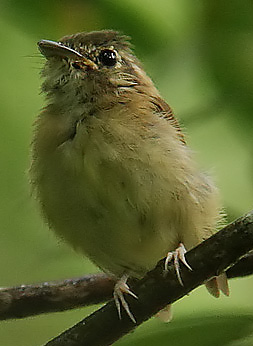
The striped wren-babbler is a species of bird in the family Pellorneidae. It is monotypic within the genus Kenopia. It is found in Brunei, Indonesia, Malaysia, and Thailand. Its natural habitats are subtropical or tropical moist lowland forest and subtropical or tropical swampland. It is threatened by habitat loss.
Region
Sundaland, Southeast Asia
Typical Environment
Occurs patchily in Brunei, Indonesia (Borneo and Sumatra), Malaysia (Peninsular and Bornean), and southern Thailand. It favors primary and older secondary lowland evergreen forest with dense undergrowth, and is strongly associated with peat and freshwater swamp forests. Birds keep close to the ground in tangled vegetation, forest edges near wetlands, and along shaded streams. It tolerates some degradation but declines sharply with extensive logging and conversion to plantations.
Altitude Range
Sea level to 600 m
Climate Zone
Tropical
Ease of Keeping
Beginner friendly: 1/5
The striped wren-babbler is the sole member of the genus Kenopia, making it taxonomically unique. It is a shy, ground-favoring skulker of dense lowland forest and swamp thickets, where it forages in leaf litter. Ongoing loss of Sundaic lowland forests places pressure on its populations.

Temperament
secretive and skulking
Flight Pattern
short rapid wingbeats close to the ground
Social Behavior
Most often seen in pairs or small family groups, sometimes accompanying mixed-species understory flocks. Nests are placed low in dense vegetation or thickets, with both parents participating in care. Likely largely monogamous and strongly tied to territories in suitable habitat.
Migratory Pattern
Resident
Song Description
Song is a series of clear, ringing whistles that accelerate slightly, often delivered as antiphonal duets between pair members. Calls include sharp chips and soft contact notes from within cover.
Plumage
Warm brown upperparts with bold black-and-buff streaking on the underparts; fine streaks may extend onto the throat and breast. Feathers are soft and loosely textured, aiding a cryptic, mottled appearance in leaf litter. Tail is short and often held cocked.
Diet
Primarily hunts small invertebrates such as beetles, ants, termites, spiders, and other arthropods gleaned from leaf litter and low vegetation. It occasionally probes rotting wood and bark crevices. Small snails and other soft-bodied prey may be taken opportunistically.
Preferred Environment
Forages on the forest floor and in dense understory tangles, especially near swamps, streams, and peat forest edges. Often remains in shaded, humid microhabitats with thick leaf litter and fallen branches.