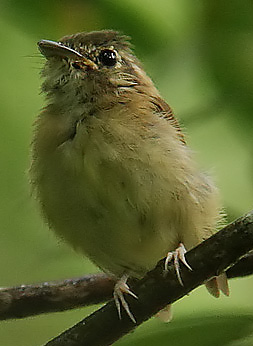
The stub-tailed antbird is a species of bird in subfamily Thamnophilinae of family Thamnophilidae, the "typical antbirds". It is found in Colombia and Ecuador.
Region
Chocó biogeographic region (W Colombia to NW Ecuador)
Typical Environment
Occurs in humid lowland and foothill rainforests of western Colombia and northwestern Ecuador, especially within the Chocó. It favors dense, shadowy understory near streams, vine tangles, and thickets, and also uses secondary forest with intact undergrowth. The species is typically found close to the forest floor and along edges where cover remains thick. Habitat loss from deforestation can restrict it to remnant forest patches.
Altitude Range
Sea level to 900 m
Climate Zone
Tropical
Ease of Keeping
Beginner friendly: 1/5
A secretive understory specialist of the Chocó forests, the stub-tailed antbird is named for its conspicuously short tail that helps it maneuver through dense vegetation. It often forages near the ground and may attend army-ant swarms to snatch flushed insects, though it is not an obligate follower. Pairs maintain territories year-round and frequently duet, a hallmark of many antbirds.


Temperament
skulking and territorial
Flight Pattern
short rapid wingbeats, low to the ground
Social Behavior
Usually found as solitary individuals or in pairs that defend territories year-round. Pairs often duet, with coordinated songs used to maintain pair bonds and mark territory. Nests are placed low in dense vegetation, and both sexes participate in nesting duties.
Migratory Pattern
Resident
Song Description
A series of clear whistles and chipping notes that may accelerate or end in a short trill; pairs often deliver antiphonal duets. Calls include sharp scolds and soft contact notes from the understory.
Plumage
Compact, short-tailed antbird with a stout bill and rounded wings. Male is mostly dark slate to blackish with small pale spotting on the wing coverts and a very short, square-cut tail. Female is warm rufous-brown above with paler, buffy underparts and a duskier head; both sexes appear almost tailless at a glance.
Diet
Primarily small arthropods such as ants, beetles, spiders, and other insects taken from the leaf litter and low vegetation. It gleans methodically, probes into tangles, and may sally a short distance to catch prey. It sometimes attends army-ant swarms to capture flushed invertebrates but is not an obligate follower.
Preferred Environment
Feeds in dense understory of humid forest, along shaded trails, stream margins, and vine tangles. Often remains within a meter or two of the ground where cover is thick.