
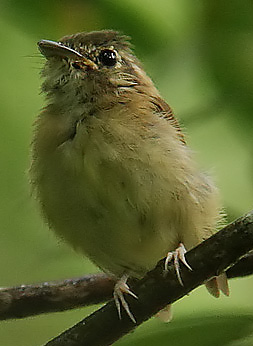
The stub-tailed spadebill is a passerine bird in the Tyrannidae family. It is commonly found in tropical dry rainforests or tropical moist lowlands throughout Central America. First scientifically described in 1860, it was originally thought to be the same as Platyrinchus mystaceus but was later reclassified as a sympatric species. The stub-tailed spadebill may grow up to 9.5 cm (3.74 in) long and may weigh up to 12 g (0.42 oz). It has a white throat, yellow breast, and brown mantle and wings. The stub-tailed spadebill is most easily recognizable due to its stubby tail, broad bill, and its distinctive bird song. Some morphological differences like its greatly reduced crown differentiate it from other related species.
Region
Central America
Typical Environment
Occurs from southern Mexico through Belize, Guatemala, Honduras, and Nicaragua into Costa Rica and western Panama. Prefers the shaded understory of tropical moist lowland forests, tall second growth, and forest edges, often near streams and vine tangles. Typically forages 1–3 meters above ground, making short sallies from low perches. It tolerates some disturbance but is most common in extensive, mature forest.
Altitude Range
Sea level to 1000 m
Climate Zone
Tropical
Ease of Keeping
Beginner friendly: 1/5
A tiny tyrant flycatcher, the stub-tailed spadebill is named for its extremely short tail and broad, spatulate bill used to snatch insects at close range. It inhabits dense understory of humid lowland and foothill forests across Central America, where it is often heard before seen. Its crisp, high-pitched, repetitive song and white throat contrasting with a yellowish breast help clinch identification. Formerly confused with the White-throated Spadebill, it is now recognized as a distinct, sympatric species.


Naturalis Biodiversity Center - RMNH.AVES.120710 - Platyrinchus cancrominus timothei Paynter, 1954 - Tyrannidae - bird skin specimen
Temperament
secretive and active
Flight Pattern
short rapid wingbeats with brief darting sallies
Social Behavior
Usually solitary or in pairs within dense understory, often joining mixed-species flocks. Nests are placed low, typically concealed in tangles or saplings. Breeding behavior includes quiet, close-range courtship and low, concealed nesting to avoid predation.
Migratory Pattern
Resident
Song Description
A series of sharp, high-pitched whistles delivered in steady, rhythmic bursts. Notes can accelerate slightly and carry well through the understory, making the bird easier to detect by ear than by sight.
Plumage
Warm brown to olive-brown upperparts with two faint buffy wingbars; clean white throat grading to yellowish breast and buff belly; very short tail and broad, flattened bill.
Diet
Feeds primarily on small insects such as flies, beetles, and ants, as well as spiders. Captures prey by short sallies from low, shaded perches and by gleaning from leaves and twigs. Occasionally takes tiny fruits or seeds but remains predominantly insectivorous.
Preferred Environment
Forages in dense, shaded understory of humid forests, along stream corridors, and in vine tangles. Often remains within a meter or two of the ground, working through thickets and sapling layers.


