

The red-gartered coot is a species of bird in subfamily Rallinae of family Rallidae, the rails, gallinules, and coots. It is found in Argentina, Brazil, Chile, Paraguay, and Uruguay.
Region
Southern South America
Typical Environment
Occurs widely in Argentina, Chile, Uruguay, Paraguay, and southern Brazil, favoring lowland wetlands. It inhabits freshwater lakes, marshes, large ponds, reservoirs, and slow-flowing rivers with extensive reedbeds. The species also uses coastal lagoons and human-made impoundments when suitable vegetation is present. Outside breeding, it may gather in sizable rafts on open water while foraging near vegetated margins.
Altitude Range
Sea level to 1500 m
Climate Zone
Temperate
Ease of Keeping
Beginner friendly: 2/5
The red-gartered coot is a robust rail that thrives on large freshwater bodies with abundant emergent vegetation. Its name comes from the distinctive red 'garters' on its upper legs, complemented by a colored frontal shield. It often forms large aggregations outside the breeding season and readily uses artificial water bodies such as reservoirs. Like other coots, it can run across the water surface to take flight.


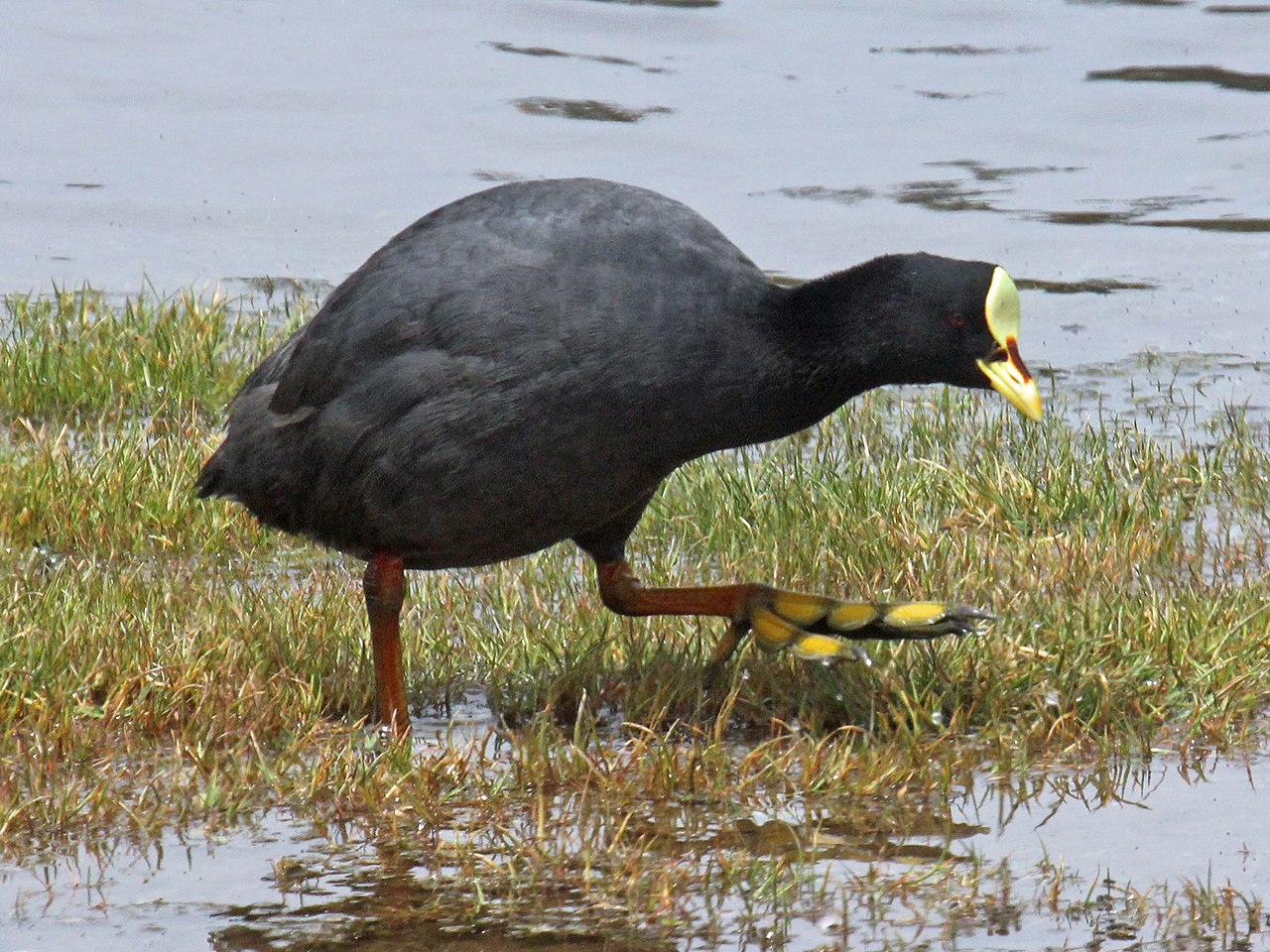
At La Laguna, Chile

Temperament
social and active
Flight Pattern
short rapid wingbeats after a running takeoff; low, direct flights between waterbodies
Social Behavior
Breeds in pairs that defend small territories within dense emergent vegetation, building floating nests anchored to reeds. Outside the breeding season it is gregarious and forms flocks or loose rafts on open water. Pair bonds may persist across seasons, and both sexes participate in nest building and chick care.
Migratory Pattern
Partial migrant
Song Description
Vocalizations are loud, clucking and piping notes, often given in series. Calls carry over water and are used for contact, alarm, and territorial displays.
Plumage
Mostly uniform dark slate-gray to black with a slightly paler belly and white undertail coverts.
Diet
Primarily consumes aquatic plants, shoots, seeds, and algae. It also takes small invertebrates such as insects, mollusks, and crustaceans, especially during the breeding season. Opportunistically it may glean food from the water surface or snatch items near the shoreline. Chicks receive a higher proportion of animal matter.
Preferred Environment
Feeds along vegetated margins of lakes and marshes, often among reeds and submerged macrophytes. It swims and up-ends or makes short dives in shallow water, and also grazes on floating vegetation or exposed banks.


