The red-headed bunting is a passerine bird in the bunting family Emberizidae.
Region
Central and South Asia
Typical Environment
Breeds in open, semi-arid landscapes with scattered shrubs, field edges, and riverine thickets across Central Asia. It favors agricultural mosaics, weedy margins, and reed-fringed waterways during the breeding season. In winter it moves to the Indian subcontinent, using open countryside, crop fields, stubble, and scrub. The species readily occupies human-modified habitats as long as there is ample seed and low cover.
Altitude Range
Sea level to 1800 m
Climate Zone
Temperate
Ease of Keeping
Beginner friendly: 2/5
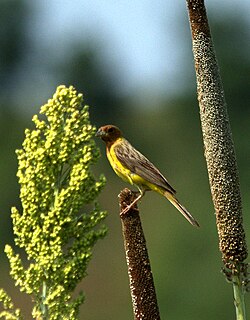
The red-headed bunting is often confused with the closely related black-headed bunting, but males show a striking chestnut-red head and brighter yellow underparts. It breeds across Central Asia and winters largely in the Indian subcontinent. This species is a regular long-distance migrant and occasionally appears as a vagrant in Europe. Flocks outside the breeding season often mix with other buntings and finches in open farmland.




Temperament
wary and active
Flight Pattern
short rapid wingbeats with bounding, undulating flight
Social Behavior
Breeds in dispersed pairs; males sing from exposed perches to advertise territories. The nest is a cup placed low in shrubs or dense herbaceous cover, often near fields. Clutches usually contain 3–5 eggs, and both parents feed the young. Outside the breeding season it forms small to medium-sized flocks, sometimes mixed with other buntings.
Migratory Pattern
Seasonal migrant
Song Description
The male delivers a bright, jingling series of clear notes and short phrases from a perch. Calls include a metallic 'tsip' and sharper contact notes given in flight. The song carries well over open country.
Plumage
Male with chestnut-red head, bright yellow underparts, and brown, lightly streaked upperparts with pale wing bars; female/immature are duller brown with streaked upperparts and buffy, washed underparts.
Diet
Primarily seeds and grains from grasses and weeds, especially outside the breeding season. Insects such as beetles, caterpillars, and other invertebrates are taken more frequently during breeding to feed growing chicks. It also consumes spilled cereal grains in farmland and along tracks. Foraging is mostly on the ground with occasional gleaning from low vegetation.
Preferred Environment
Open farmland, stubble fields, and weedy edges are favored, as well as scrubby steppe and riverine thickets. In winter it often feeds in agricultural landscapes and around villages where grain is available.