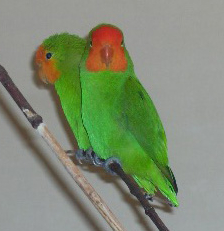
The red-headed bluebill is a common species of estrildid finch found in Sub-Saharan Africa.
Region
Central and East Africa
Typical Environment
This species inhabits lowland and submontane moist forests, forest edges, riverine thickets, and secondary growth. It favors dense understorey and tangles along streams and clearings where cover is abundant. It adapts to human-altered habitats with sufficient shrub layer, including plantations near forest. It is generally sedentary within its range, moving locally with food availability.
Altitude Range
Sea level to 1800 m
Climate Zone
Tropical
Ease of Keeping
Beginner friendly: 2/5
The red-headed bluebill is an estrildid finch of African forests and thickets, named for its vivid crimson head and contrasting powder-blue bill. It often keeps to dense cover and is more frequently heard than seen, giving soft whistles. Pairs or small family groups forage quietly near the ground. It belongs to the bluebill genus Spermophaga, noted for strong, thick bills adapted to cracking seeds.

Temperament
secretive and wary
Flight Pattern
short rapid wingbeats
Social Behavior
Often found in pairs or small family groups within dense undergrowth. Likely monogamous, nesting low in thick vegetation where a domed grass nest is built. Both parents participate in caring for the young, and groups may remain together after fledging.
Migratory Pattern
Resident
Song Description
Vocalizations are soft, thin whistles and sibilant notes, delivered from concealed perches. Calls include gentle tsip and seep notes used to maintain contact in cover.
Plumage
Male shows an intense red head and throat contrasting with a mostly black body and darker wings; plumage appears sleek with minimal patterning. Female is warmer brown to olive-brown on the body with a duller reddish head and throat and paler underparts, sometimes with faint mottling.
Diet
Feeds primarily on small grass and herb seeds, which it cracks with its stout bill. Supplements diet with small insects and other invertebrates, especially during breeding. Will also take soft fruits and flower parts opportunistically. Foraging is methodical and quiet, often gleaning fallen seeds from the ground or low stems.
Preferred Environment
Forages in dense undergrowth along forest edges, clearings, and riverbanks. Frequently uses tangles of vines and shrubs, and will enter nearby secondary growth and plantations with adequate cover.