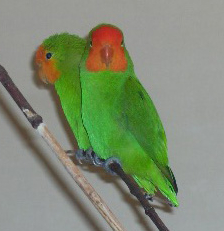
The red-headed finch is a common species of estrildid finch found in Africa. It has an estimated global extent of occurrence of 1,600,000 km2 (620,000 sq mi). It is found in Angola, Botswana, Lesotho, Namibia, South Africa and Zimbabwe.
Region
Southern Africa
Typical Environment
Occurs widely in semi-arid to arid regions including parts of Angola, Botswana, Lesotho, Namibia, South Africa, and Zimbabwe. Prefers open savanna, dry scrub, thornveld, and lightly grazed rangelands, often near water sources. Frequently uses agricultural edges, fallow fields, and villages where spilled grain is available. Roosts communally in dense shrubs or reeds and forages extensively on the ground.
Altitude Range
Sea level to 1800 m
Climate Zone
Arid
Ease of Keeping
Beginner friendly: 3/5
The red-headed finch is a colonial, sociable estrildid often seen in flocks around waterholes and farmlands. Males have a striking brick-red head, while females are duller and lack the red, making the species easy to sex. It readily adapts to human-modified landscapes, nesting in thorny shrubs, farm structures, and occasionally near weaver colonies. Local movements often track rainfall and seed availability.

Temperament
social and active
Flight Pattern
short rapid wingbeats with bounding flight
Social Behavior
Often forms flocks outside the breeding season and feeds in loose, noisy groups. Nests are dome-shaped structures placed in thorny bushes or suitable cavities, sometimes near or within colonies of other small passerines. Pairs are monogamous during the breeding period and may nest semi-colonially.
Migratory Pattern
Partial migrant
Song Description
Soft, twittering series of chirps and trills, interspersed with buzzy notes. Calls are contact-oriented and given frequently in flight and while foraging.
Plumage
Fine, barred pattern on the underparts and flanks with brown upperparts; compact, sturdy build with a short tail.
Diet
Primarily consumes grass seeds and spilled grain, cracking them with its stout bill. Supplements diet with small insects—such as termites and other arthropods—especially during the breeding season. Also takes buds and green seeds when available.
Preferred Environment
Forages mainly on open ground, along track edges, fallow fields, and around water points. Frequently visits farmyards and village margins where seed is abundant.