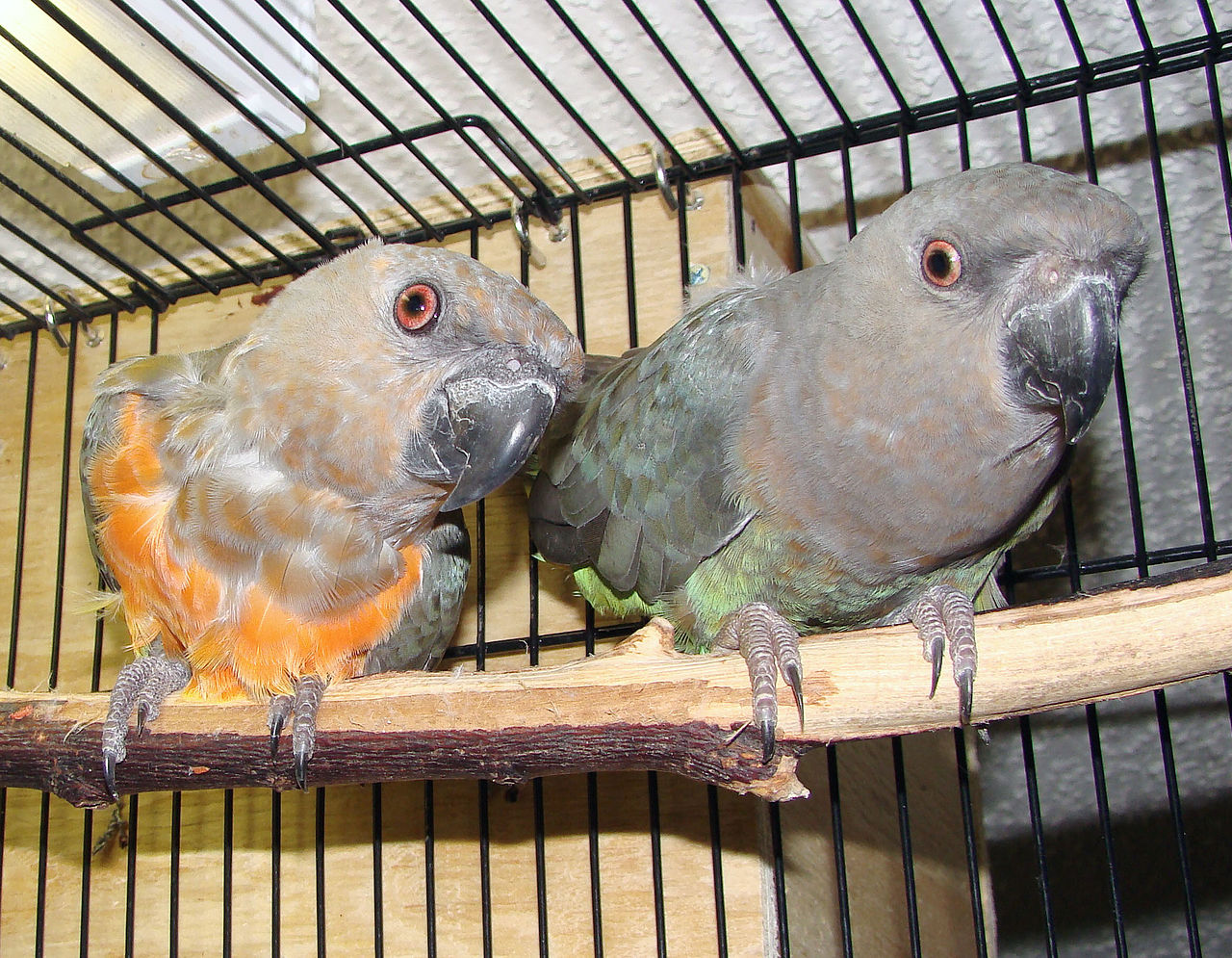
The red-bellied parrot is a small African parrot about 23 cm (9 in) long of the genus Poicephalus. The genus Poicephalus has the greatest quantity of species and is widely spread in Africa. It is a mostly greenish and grey parrot. Males have a bright orange belly and females have a greenish belly.
Region
East Africa
Typical Environment
The red-bellied parrot inhabits semi-arid bushland and acacia savannas across parts of Ethiopia, Somalia, Kenya, and northern Tanzania. It favors open woodland, thorn scrub, and riverine edges where large trees provide cavities for nesting. Birds often move locally in response to food availability, especially seeding acacias and seasonal fruiting trees. It is tolerant of dry conditions but remains tied to areas with scattered trees.
Altitude Range
Sea level to 1800 m
Climate Zone
Arid
Ease of Keeping
Beginner friendly: 3/5
This species shows clear sexual dimorphism: males have a bright orange belly while females have a green belly. It is one of the quieter Poicephalus parrots and is often observed in pairs or small groups in semi-arid savannas. Like many cavity-nesting parrots, it relies on mature trees for nesting sites.


A juvenile male stretching. Note dark irises typical of juveniles.

A pair of red-bellied parrots in the Samburu National Reserve, Kenya. The male (outside) has built a nest for the female (inside)
Temperament
social and alert
Flight Pattern
fast, direct flight with rapid wingbeats
Social Behavior
Usually seen in pairs or small family groups, occasionally forming larger foraging flocks when food is abundant. Pairs are monogamous and nest in natural tree cavities. They roost communally in trees and may be shy and inconspicuous when perched.
Migratory Pattern
Resident
Song Description
Vocalizations include sharp whistles, chattering notes, and rough screeches given in flight. Calls are repetitive and carry well over open savanna. Overall, they are quieter than many similarly sized parrots when feeding.
Plumage
Compact parrot with a grey head and upper breast, green wings and back, and contrasting belly coloration depending on sex. Feathers are smooth with minimal barring, giving a clean, even appearance.
Diet
Feeds primarily on seeds, fruits, and berries, including acacia pods and figs when available. It also takes buds and flowers and may visit cultivated areas for grain occasionally. Foraging is mostly arboreal, with birds gleaning from branches and seed heads.
Preferred Environment
Typically forages in acacia and mixed savanna trees, along bushy river courses, and at the edges of open woodland. Will use scattered farm trees and village groves where food resources are present.