
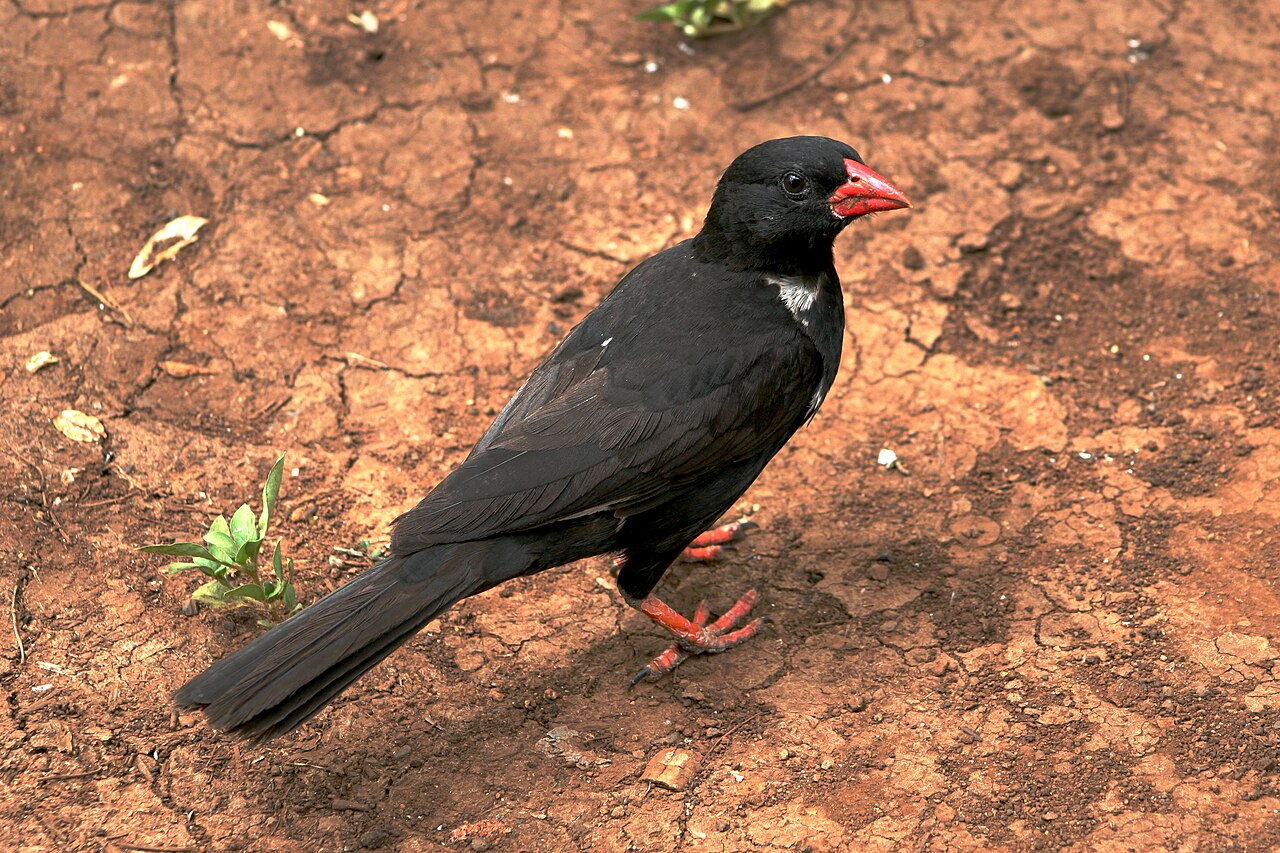
The red-billed buffalo weaver is a species of bird in the family Ploceidae. It is found in eastern and southern Africa. Its natural habitat is the dry savanna.
Region
Eastern and Southern Africa
Typical Environment
Occurs widely in dry savanna, thornveld, and open scrub with scattered trees and shrubs. Common around human settlements, cattle posts, and agricultural edges where nest sites and food are plentiful. Avoids dense forests and true deserts but occupies semi-arid rangelands and riparian trees in otherwise open country. Nests are usually placed in tall, thorny trees that deter predators. Frequently associates with grazing herds, which flush insect prey.
Altitude Range
0–1800 m
Climate Zone
Tropical
Ease of Keeping
Beginner friendly: 2/5
Red-billed buffalo weavers live in noisy colonies and build massive, thorny stick nests with multiple chambers, often in acacias or other spiny trees. They are polygynous, with dominant males controlling parts of a communal nest and pairing with several females. Their bright red bill is most vivid in the breeding season, and a striking white wing patch flashes in flight. They often forage near large mammals or livestock, snapping up insects disturbed in the grass.


Nests in a baobab in northern Tanzania
Temperament
social and noisy
Flight Pattern
short rapid wingbeats with direct, purposeful flight
Social Behavior
Breeds colonially, constructing large communal stick nests with multiple compartments. Polygynous mating system where a dominant male controls nest sections and mates with several females, each tending her own chamber. Pairs and helpers defend the immediate nest area vigorously and roost communally in the structure outside breeding.
Migratory Pattern
Resident
Song Description
A mix of harsh, buzzy chatters and squeaky notes rather than a melodious song. Calls are given frequently during social interactions and at the colony, creating a constant, chattering chorus.
Plumage
Predominantly dark brown to black with a contrasting white wing patch that is most visible in flight; plumage appears slightly glossy in good light.
Diet
Takes a wide range of insects such as beetles, grasshoppers, and termites, often captured on or near the ground. Also eats seeds, grains, and small fruits, especially in the dry season when insects are scarce. Will opportunistically pick at invertebrates flushed by livestock or wild herbivores and glean prey from low foliage.
Preferred Environment
Forages in open savanna, along roadsides, around kraals and cattle posts, and beneath thorny trees that host colonies. Frequently feeds on the ground or low shrubs and visits recently burned or grazed patches where prey is exposed.


