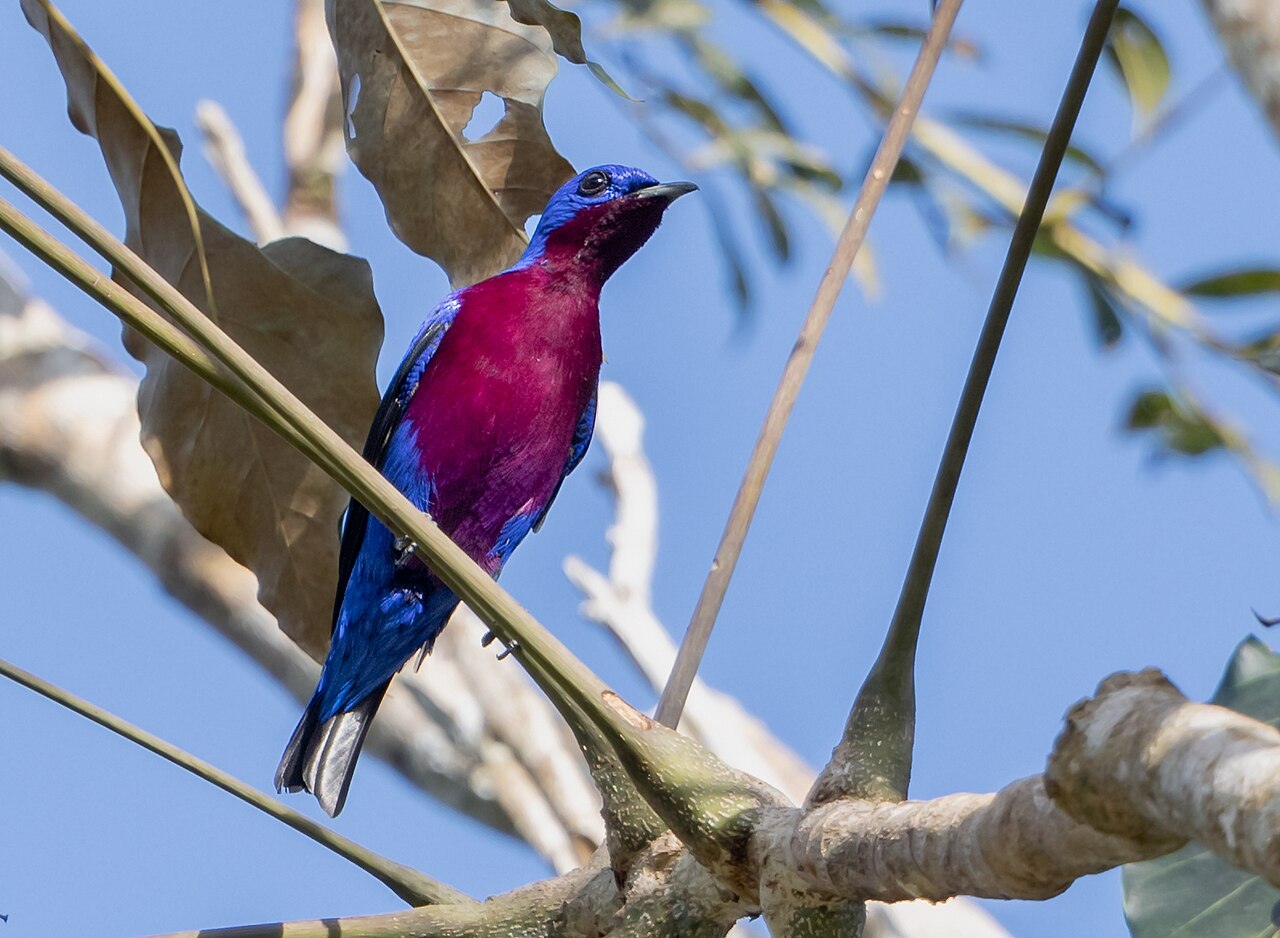
The purple-bellied lory is a species of parrot in the family Psittaculidae. It is endemic to Papua New Guinea. It is found in south-east New Guinea, the Bismarck Archipelago, the d'Entrecasteaux Islands, the Louisiade Archipelago, the Trobriand Islands and Woodlark Island.
Region
Melanesia
Typical Environment
Occurs in southeast New Guinea, the Bismarck Archipelago, the d’Entrecasteaux Islands, the Louisiade Archipelago, the Trobriand Islands, and Woodlark Island. It inhabits lowland and hill rainforests, forest edges, secondary growth, and mangroves, and often visits coconut plantations and village gardens. The species is commonly seen in the canopy but will descend to mid-levels where flowering and fruiting trees are available. It adapts well to mosaics of forest and cultivated land provided floral resources persist.
Altitude Range
Sea level to 1500 m
Climate Zone
Tropical
Ease of Keeping
Beginner friendly: 2/5
This striking lory is a nectar and pollen specialist with a brush-tipped tongue adapted for feeding at flowers. It is noisy and conspicuous, often traveling in small, fast-moving groups between fruiting or flowering trees. Despite being confined to Papua New Guinea and adjacent islands, it tolerates disturbed habitats and village gardens. Its subspecies vary slightly in the extent and tone of the purple belly patch.

Temperament
social and active
Flight Pattern
fast direct flight with rapid wingbeats
Social Behavior
Usually seen in pairs or small, chattering groups that commute between flowering trees. Pairs are likely monogamous and nest in tree cavities, where both parents attend the young. They often join mixed-species feeding flocks at abundant nectar sources.
Migratory Pattern
Resident
Song Description
Vocalizations are loud and piercing, dominated by harsh screeches and chattering calls in flight. At feeding sites they give rapid, excited notes and chatter, with occasional clear whistles.
Plumage
Mostly bright red with a distinct deep purple belly patch; green mantle and wings with some blue-violet tones on the lower underparts and underwings. The tail is dark with bluish or purplish hues. Plumage is glossy and compact, typical of lories.
Diet
Feeds primarily on nectar and pollen from a variety of flowering trees, using a brush-tipped tongue. Also consumes soft fruits such as figs and berries, and occasionally flower buds. Small invertebrates may be taken opportunistically while foraging among blossoms.
Preferred Environment
Forages high in the forest canopy, along edges, and in secondary growth where flowering trees are abundant. Frequently visits coconut and other cultivated trees in village gardens and plantations.