The malachite sunbird is a small nectarivorous bird found from the highlands of Ethiopia southwards to South Africa. They pollinate many flowering plants, particularly those with long corolla tubes, in the Fynbos.
Region
Eastern and Southern Africa
Typical Environment
Occurs from the Ethiopian highlands south through East Africa to South Africa, with strong associations to fynbos, montane grasslands, and ericaceous shrublands. Frequently visits flowering aloes, proteas, and heaths, and readily uses gardens and parks with nectar-rich plantings. Found along forest edges and rocky slopes where nectar sources are abundant. Locally moves in response to flowering cycles, sometimes forming loose feeding aggregations.
Altitude Range
Sea level to 3000 m
Climate Zone
Highland
Ease of Keeping
Beginner friendly: 1/5
The malachite sunbird is a long-billed nectar specialist that plays a key role in pollinating aloes, proteas, and ericas, especially in South Africa’s fynbos. Breeding males turn a striking metallic malachite-green and grow very long tail streamers, while females remain more subdued olive-brown. They can hover like hummingbirds but often perch to feed. Insects and spiders supplement their nectar diet, especially when feeding young.


Male in South Africa
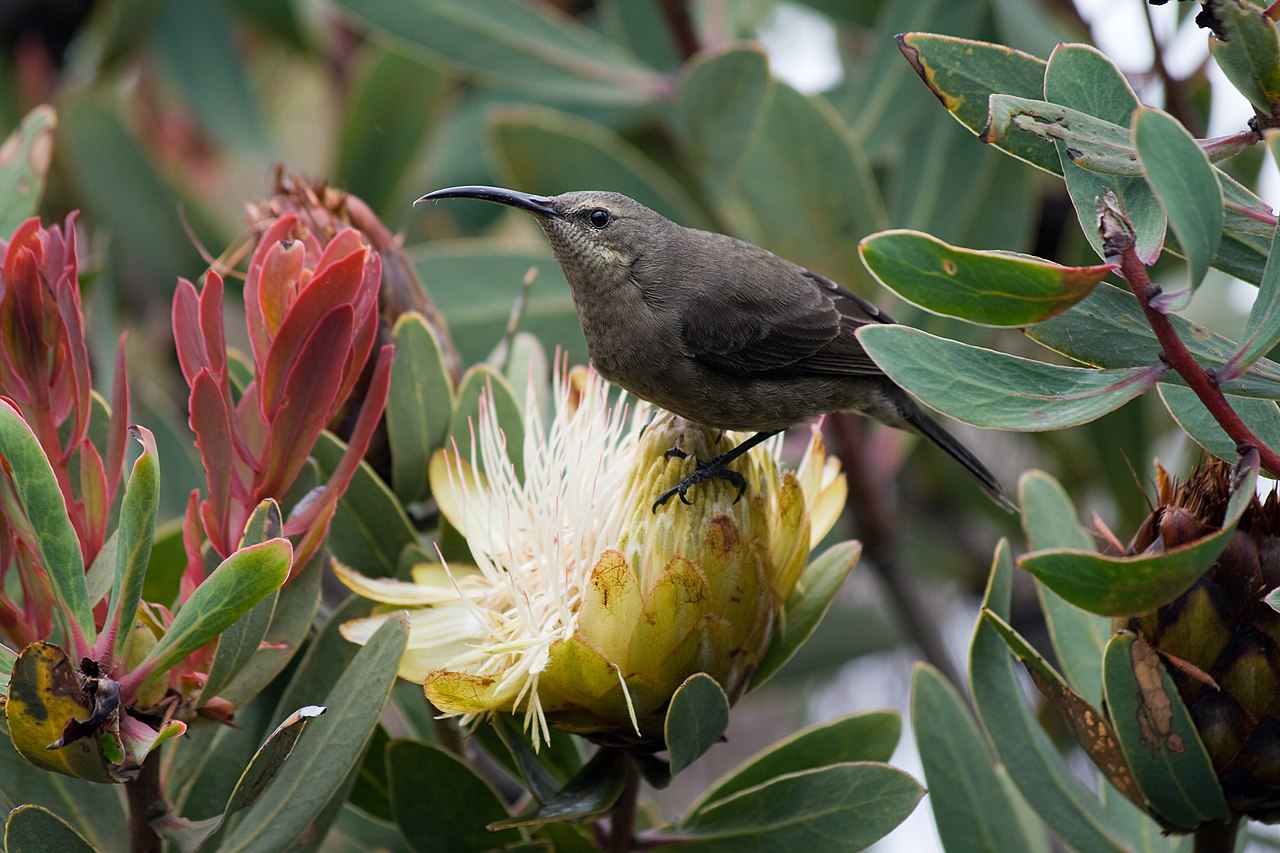
Female feeding

A breeding-plumage male feeding on Leonotis flower nectar.
Temperament
territorial around rich nectar sources
Flight Pattern
short rapid wingbeats with frequent hovering at flowers; swift, direct dashes between perches
Social Behavior
Pairs defend flowering territories vigorously during the breeding season. The nest is a neat, domed structure suspended in vegetation; the female incubates while the male often helps defend the territory. Outside breeding, they may wander locally following blooms and can gather loosely at mass-flowering plants.
Migratory Pattern
Partial migrant
Song Description
Song is a bright, jingling warble interspersed with sharp tseep notes. Calls include thin, high-pitched chips and chattering scolds during territorial disputes.
Plumage
Breeding male is shimmering metallic malachite-green with very long, filamentous tail streamers; non-breeding male is browner with green gloss on wings and tail. Female is olive-brown above with paler yellowish underparts and fine streaking. Both sexes have sleek, iridescent tones in good light and a slender, decurved bill.
Diet
Primarily nectar from aloes, proteas, ericas, and other tubular flowers, for which their long decurved bill is well adapted. They take insects and spiders by sallying from perches or gleaning foliage, an important protein source for chicks. Occasionally laps sap or soft fruit and may probe flowers from the side when nectar is scarce.
Preferred Environment
Feeds in flower-rich shrublands, montane grasslands, and gardens, especially where aloes and proteas are abundant. Often perches to feed but will hover briefly at pendant blooms.