
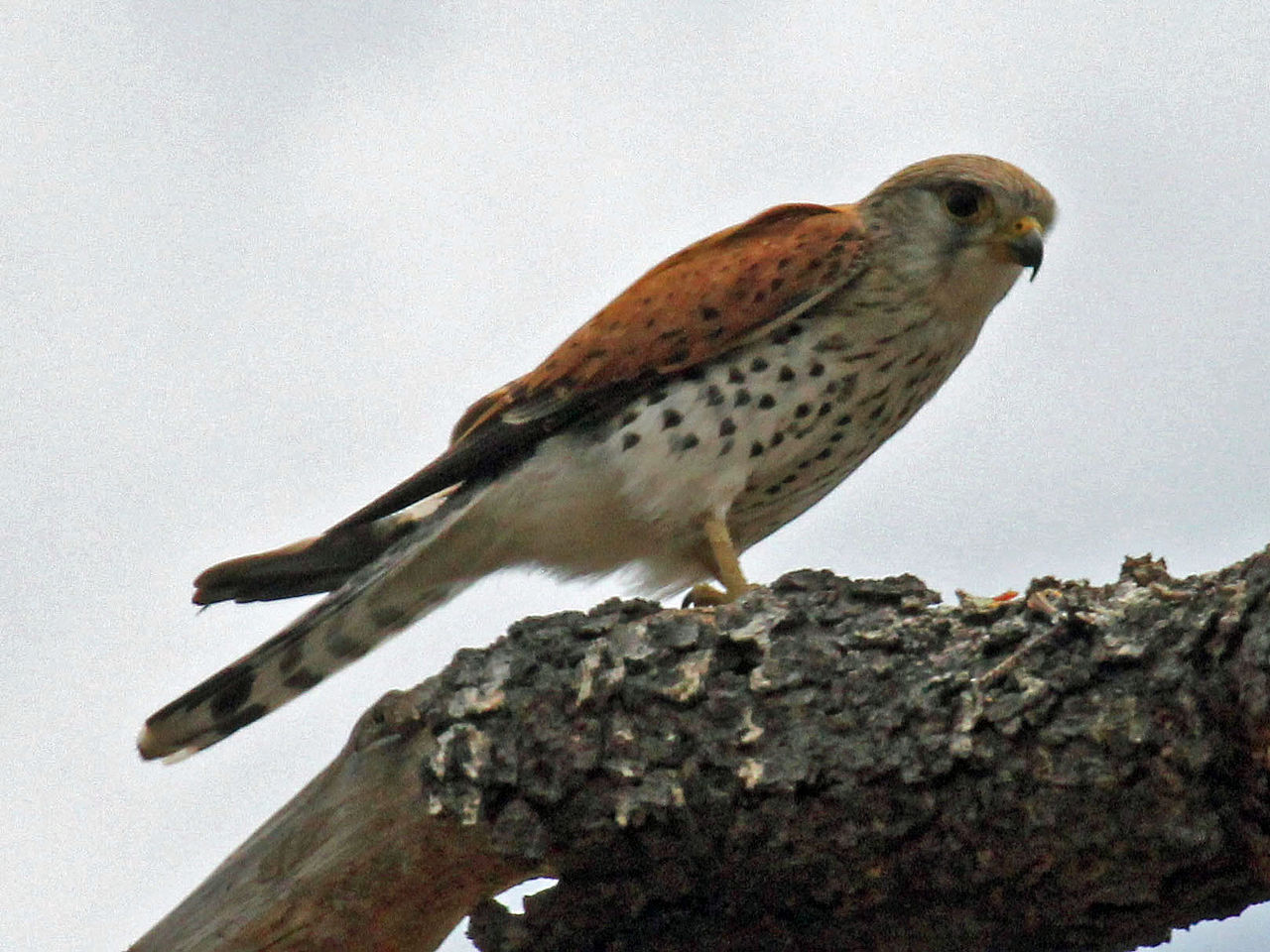
The Malagasy kestrel, also known as the Madagascar kestrel, Malagasy spotted kestrel, Newton's kestrel, Madagascar spotted kestrel, katiti (Creole) or hitsikitsika (Malagasy), is a small bird of prey of the genus Falco. It is named after British ornithologist Edward Newton. It occurs in two subspecies on Madagascar and at Aldabra. The race from Aldabra is also called Aldabra kestrel. Its closest living relative is the Seychelles kestrel; they were at one time considered conspecific. Their common ancestors appear to have diverged very recently, probably less than 1 million years ago during the Early or Middle Pleistocene. The Mauritius kestrel is more distantly related.
Region
Western Indian Ocean
Typical Environment
Widespread across Madagascar from coastal plains to the Central Highlands, and present on Aldabra Atoll. It favors open and semi-open habitats such as savannas, agricultural land, and forest edges. The species commonly occurs around towns and villages, using perches on buildings and utility poles to hunt. It is adaptable and persists in human-modified landscapes, provided perches and open foraging spaces are available.
Altitude Range
Sea level to 2000 m
Climate Zone
Tropical
Ease of Keeping
Beginner friendly: 1/5
The Malagasy kestrel is a small falcon common across Madagascar and also found on Aldabra. It readily uses human-made structures for nesting, including buildings and ledges. Two subspecies are recognized, with the Aldabra form sometimes called the Aldabra kestrel. Its closest relative is the Seychelles kestrel, from which it likely diverged within the last million years.

Temperament
solitary and territorial
Flight Pattern
short rapid wingbeats with frequent hovering and swift stoops
Social Behavior
Typically seen singly or in pairs, maintaining small territories. Pairs are largely monogamous and nest in cavities, cliffs, building ledges, or old stick nests of other birds. Both sexes participate in territory defense; the female incubates while the male provides food.
Migratory Pattern
Resident
Song Description
Vocalizations include sharp, repeated kik-kik-kik calls, especially during territorial displays. Alarm calls are rapid and chatter-like, while contact calls between mates are shorter and softer.
Plumage
Rufous upperparts with dark spotting and pale, streaked underparts; males show a bluish-grey head and tail with a dark subterminal band. Females and immatures are browner overall with heavier streaking. Feathers are sleek and compact, suited for agile flight and hovering.
Diet
Primarily hunts large insects such as grasshoppers, beetles, and dragonflies. It also takes small reptiles like geckos and skinks, and occasionally small mammals or birds. Hunting is often from a perch or by hovering before a short stoop to the ground or vegetation.
Preferred Environment
Forages along edges of open country, farmland, and urban green spaces. Common near rice fields, roadsides, and village perimeters where prey is abundant and perches are available.


