

The laughing gull is a medium-sized gull of North and South America. Named for its laugh-like call, it is an opportunistic omnivore and scavenger. It breeds in large colonies mostly along the Atlantic coast of North America, the Caribbean, and northern South America. The two subspecies are L. a. megalopterus — which can be seen from southeast Canada down to Central America — and L. a. atricilla, which appears from the West Indies to the Venezuelan islands. The laughing gull was long placed in the genus Larus until its present placement in Leucophaeus.
Region
Atlantic coasts of the Americas and the Caribbean
Typical Environment
Breeding occurs along the Atlantic and Gulf coasts of North America, the Caribbean, and into northern South America. It favors barrier beaches, saltmarshes, mudflats, mangroves, estuaries, and coastal lagoons. Outside the breeding season it disperses widely along warm coasts and into bays and harbors, with northern populations moving southward. It is most common near shore but will venture inland to large lakes, rivers, and landfills when food is abundant.
Altitude Range
Sea level to 300 m
Climate Zone
Subtropical
Ease of Keeping
Beginner friendly: 1/5
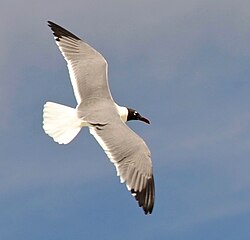
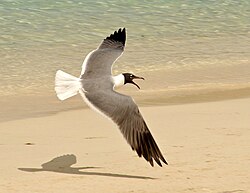
Named for its distinctive, laugh-like call, the laughing gull is a bold and adaptable coastal gull. In breeding plumage it sports a black hood and crisp white eye crescents, switching to a white head with dusky smudging outside the breeding season. It nests in dense colonies on beaches, saltmarshes, and low-lying islands, where pairs defend small territories. Opportunistic and clever, it often scavenges at fishing docks and coastal towns.



Temperament
social and bold
Flight Pattern
buoyant flier with steady wingbeats and easy glides
Social Behavior
Highly colonial during breeding, nesting on the ground in loose to dense groups. Pairs are seasonally monogamous, and both sexes build the nest, incubate 2–3 eggs, and feed the chicks. They defend nest sites vigorously and frequently mob intruders.
Migratory Pattern
Partial migrant
Song Description
The signature call is a loud, cackling series of ‘ha-ha-ha’ notes that resemble laughter. They also give harsh squawks, chatters, and nasal calls in flight and during colony interactions.
Plumage
Breeding adults have a smooth black hood, slate-gray mantle, and white underparts with black primaries edged by white crescents. Nonbreeding adults lose the hood, showing a white head with gray-brown smudging and the same dark gray upperparts. Juveniles are mottled brown and gray with progressively more gray as they age.
Diet
An opportunistic omnivore that eats small fish, shrimp, crabs, marine invertebrates, insects, and carrion. It readily scavenges human refuse and fishery bycatch and may steal food from other birds. During breeding it also takes eggs or small chicks of other shorebirds when available and forages for invertebrates on mudflats and beaches.
Preferred Environment
Typically feeds along shorelines, tidal flats, estuaries, and harbors. It also forages at piers, parking lots, and landfills, and will follow fishing vessels. When inland, it works plowed fields, lakeshores, and reservoirs.


