

The laughing kookaburra is a bird in the kingfisher subfamily Halcyoninae. It is a large robust kingfisher with a whitish head and a brown eye-stripe. The upperparts are mostly dark brown but there is a mottled light-blue patch on the wing coverts. The underparts are cream-white and the tail is barred with rufous and black. The plumage of the male and female birds is similar. The territorial call is a distinctive laugh that is often delivered by several birds at the same time, and is widely used as a stock sound effect in situations that involve a jungle setting.
Region
Australasia
Typical Environment
Native to eastern Australia, from Queensland through New South Wales to Victoria, and parts of South Australia; introduced populations occur in Tasmania, southwestern Western Australia, and locally in New Zealand. It favors open eucalypt woodlands, forest edges, and riparian belts, but readily occupies suburban parks, gardens, and farmland. The species is highly tolerant of human presence and often hunts from backyard fences and utility wires. Territories are maintained year-round by family groups, centered on suitable tree hollows for nesting.
Altitude Range
Sea level to 1200 m
Climate Zone
Temperate
Ease of Keeping
Beginner friendly: 2/5
The laughing kookaburra’s loud, cackling chorus is famously used as a stock jungle sound in films, even though the species is native to Australia. They are cooperative breeders, with older offspring often helping parents raise new chicks. Despite being a kingfisher, it seldom eats fish and instead takes terrestrial prey, including snakes and small mammals. It adapts well to human-modified landscapes and is sometimes called the 'bushman’s alarm clock' for its dawn calls.


Coloured plate with the incorrect legend that was used by both Johann Hermann and Pieter Boddaert

A laughing kookaburra making a hollow for a nest in an arboreal termite nest.

Large bill and head detail

In Royal National Park, NSW

Kookaburra with a captured gecko in its beak
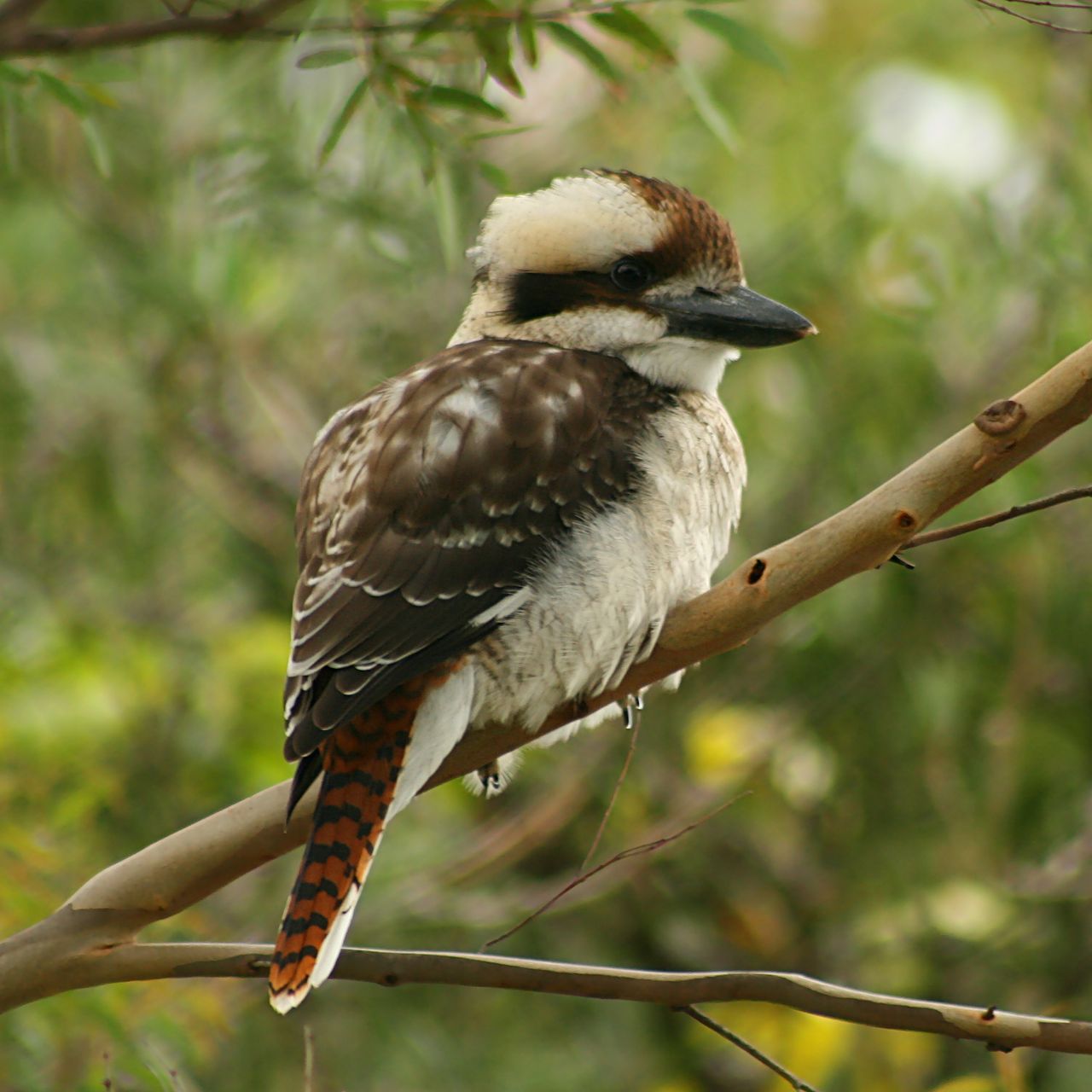
Juvenile in Sydney: Juveniles have shorter bills with a dark underside, and a strong white on the wing and mantle feathers

A laughing kookaburra eating a sausage taken from a barbecue.
Temperament
social but strongly territorial
Flight Pattern
short rapid wingbeats with brief glides between perches
Social Behavior
Typically forms stable pair bonds and defends a territory with vocal choruses. Cooperative breeding is common, with previous offspring acting as helpers at the nest. Nests are usually in natural tree hollows or occasionally in arboreal termite mounds.
Migratory Pattern
Resident
Song Description
A loud, rolling cackle that crescendos into an unmistakable 'laugh', often delivered by multiple birds in a chorus at dawn and dusk. Calls also include harsh chuckles, chatter, and contact notes used to coordinate within family groups.
Plumage
Large, robust kingfisher with creamy-white underparts, a whitish head, and a bold dark brown eye-stripe. Upperparts are dark brown with mottled pale blue patches on the wing coverts. Tail is rufous with black barring; wings and back show a scaly pattern. Sexes are similar, with subtle variation in tinge and patterning.
Diet
Hunts primarily from a perch, swooping to seize prey on the ground. Diet includes large insects, spiders, earthworms, small reptiles (including snakes and lizards), small mammals, and occasionally small birds and amphibians. Prey is often beaten against a perch before being swallowed. It rarely takes fish compared to other kingfishers.
Preferred Environment
Forages along open edges, lawns, and clearings within woodland and suburban areas. Often uses fences, branches, and wires as vantage points overlooking open ground.


