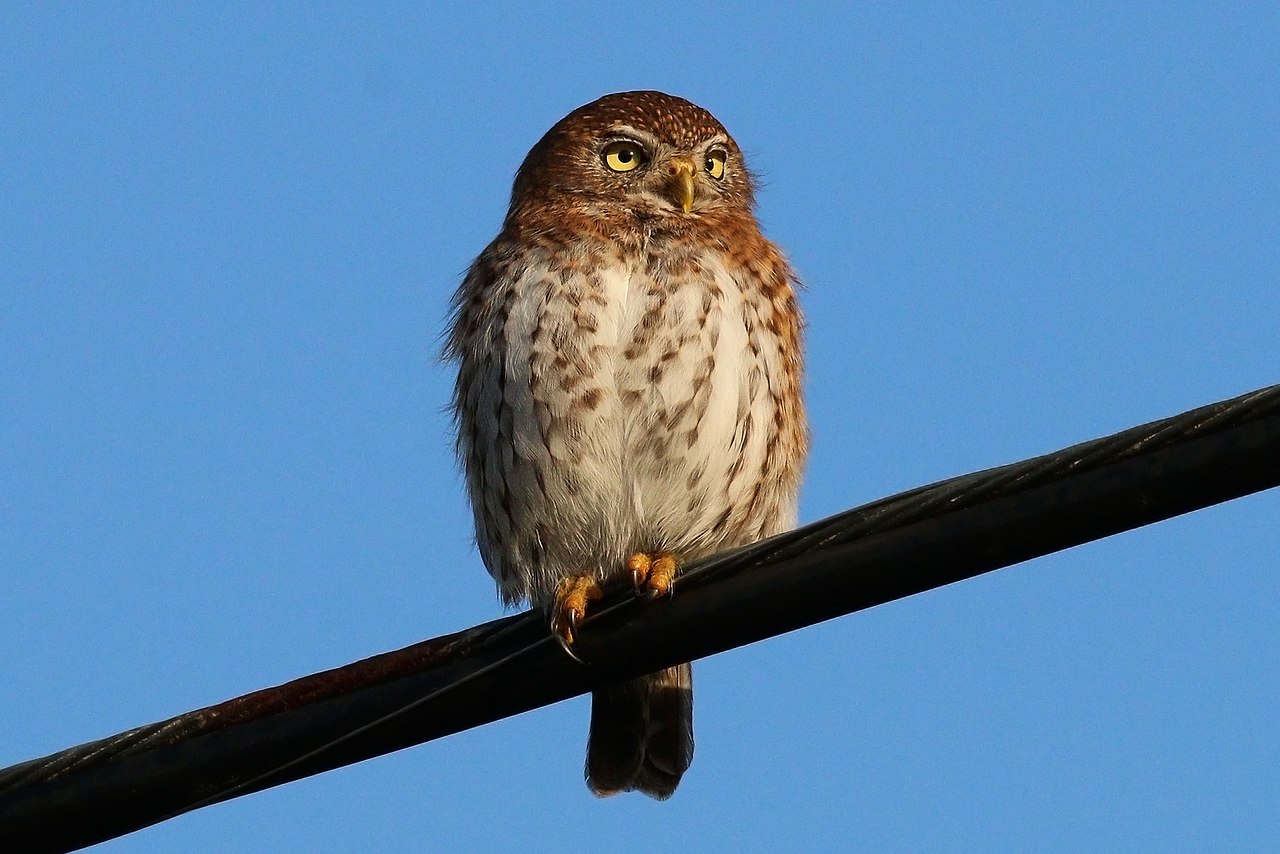
The Cuban martin is a large swallow endemic to Cuba.
Region
Caribbean
Typical Environment
Occurs throughout Cuba, including Isla de la Juventud, from coastal towns to interior open habitats. It favors human settlements, farmland, forest edges, and wetlands where aerial insects are abundant. Colonies often form on buildings, bridges, cliffs, and in caves. Birds range widely while foraging, frequently over rivers, lagoons, and coastal shorelines.
Altitude Range
Sea level to 1500 m
Climate Zone
Tropical
Ease of Keeping
Beginner friendly: 1/5
The Cuban martin is a large swallow endemic to Cuba, often seen coursing high over towns and open country. It can be confused with the Purple Martin and Caribbean Martin; close views of the underparts and tail shape help separate them. It readily nests in cavities in buildings and natural crevices, and occasionally turns up as a vagrant in the Florida Keys.


Temperament
social and active
Flight Pattern
strong flier with rapid wingbeats and agile glides
Social Behavior
Often forms loose colonies at nesting sites and gathers in communal roosts outside the breeding season. Nests in cavities in buildings, cliffs, and caves; pairs are typically monogamous within a season. Both sexes participate in nest defense and feeding of young.
Migratory Pattern
Resident
Song Description
Vocalizations are a series of mellow, gurgling chatters and liquid twitters, interspersed with soft chirrs. Calls carry during group foraging and around colony sites but are generally less musical than many small swallows.
Plumage
Male is glossy purplish-blue to blue-black above and below; female has dusky-brown upperparts and mostly whitish underparts with a smudgy breast band and some dusky flanking. Both sexes show long, pointed wings and a shallowly forked tail. Juveniles resemble females but are duller with more mottling below.
Diet
Feeds almost entirely on flying insects, including flies, beetles, winged ants and termites, and small dragonflies. Prey is captured on the wing, often at considerable height. It adapts to seasonal swarms and may concentrate over water or fields when insect abundance peaks.
Preferred Environment
Forages over open country, wetlands, coastal zones, and urban areas with open airspace. Frequently hunts above rivers and lagoons and along forest edges where updrafts concentrate insects.