
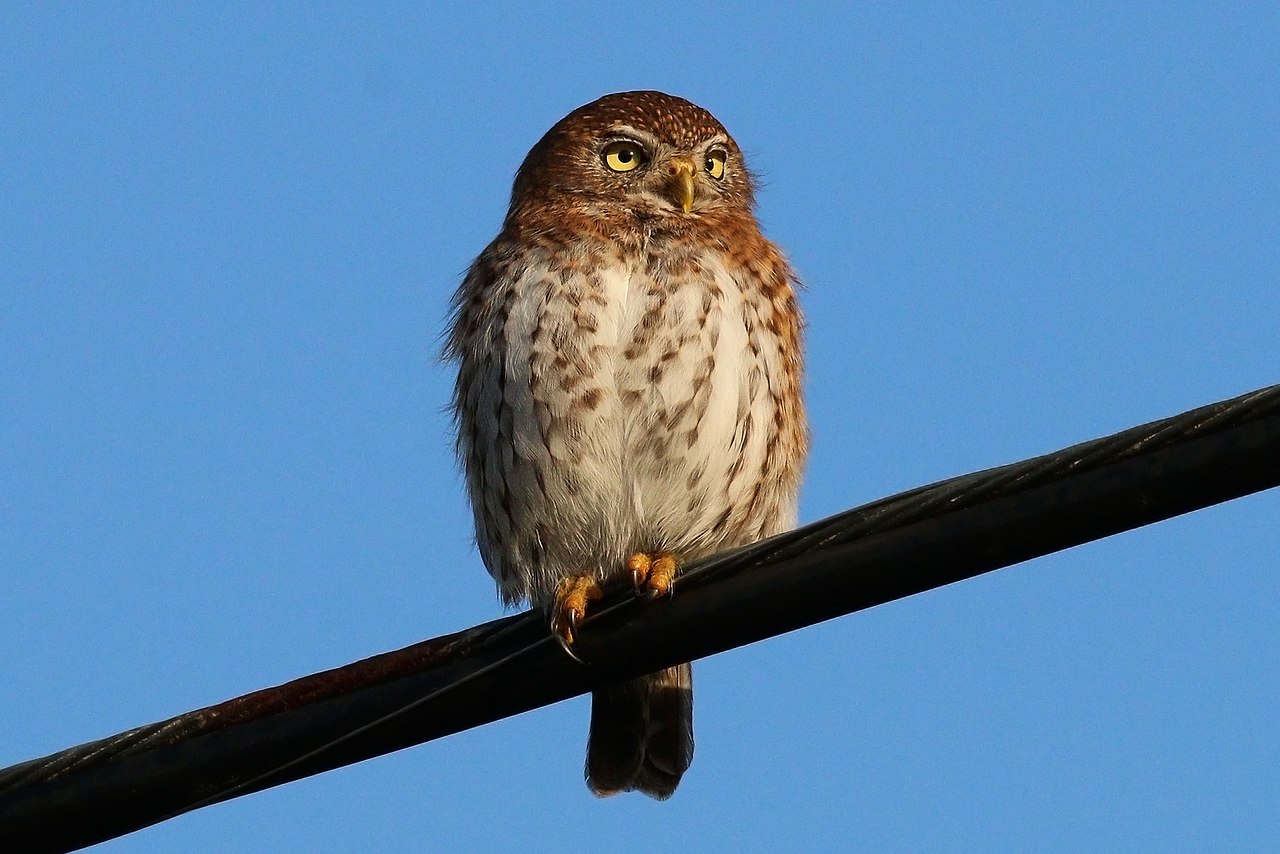
The Cuban pygmy owl is a species of owl in the family Strigidae that is endemic to Cuba.
Region
Greater Antilles
Typical Environment
Occurs throughout much of Cuba and some surrounding cays, inhabiting forests, pinewoods, mangroves, scrub, coffee and cacao plantations, and wooded urban parks. It favors areas with scattered trees and plenty of cavities for nesting. The species uses both interior forest and edges, often hunting in the lower and mid-canopy. It is present from lowlands to foothills and is tolerant of moderately disturbed habitats.
Altitude Range
Sea level to 1200 m
Climate Zone
Tropical
Ease of Keeping
Beginner friendly: 1/5
The Cuban pygmy owl is a tiny, cavity-nesting owl endemic to Cuba and nearby islets. It is unusually active by day as well as at dusk and night, and often hunts from low perches in gardens and forests. Like many pygmy owls, it has bold eye-like spots on the nape that may deter predators. It adapts well to a range of wooded habitats, including human-modified landscapes.


Temperament
solitary and territorial
Flight Pattern
short rapid wingbeats with brief glides
Social Behavior
Typically found singly or in monogamous pairs during the breeding season. Nests in tree cavities, often using old woodpecker holes; the female incubates while the male provides food. Territorial calling is common at dawn and dusk, and pairs maintain small territories year-round.
Migratory Pattern
Resident
Song Description
The song is a series of evenly spaced, clear whistled notes—often a repeated toot or poo sequence—carrying well through forest edges. It may intersperse trills and short bursts of notes during territorial exchanges.
Plumage
Compact, earless owl with brown upperparts heavily spotted with white; underparts whitish with bold brown streaking. Tail is brown with narrow pale bars. Nape bears prominent dark-and-pale eyespots; throat often shows a small whitish patch.
Diet
Feeds on large insects such as beetles, moths, and orthopterans, as well as small lizards (anoles), frogs, and occasionally small birds and rodents. Hunts from low to mid-level perches with swift pounces to the ground or onto foliage. May cache surplus prey in dense vegetation or cavities.
Preferred Environment
Forages along forest edges, in secondary growth, plantations, and wooded parks where perches and open sightlines are available. Frequently hunts within the understory and mid-canopy, especially near clearings and paths.


