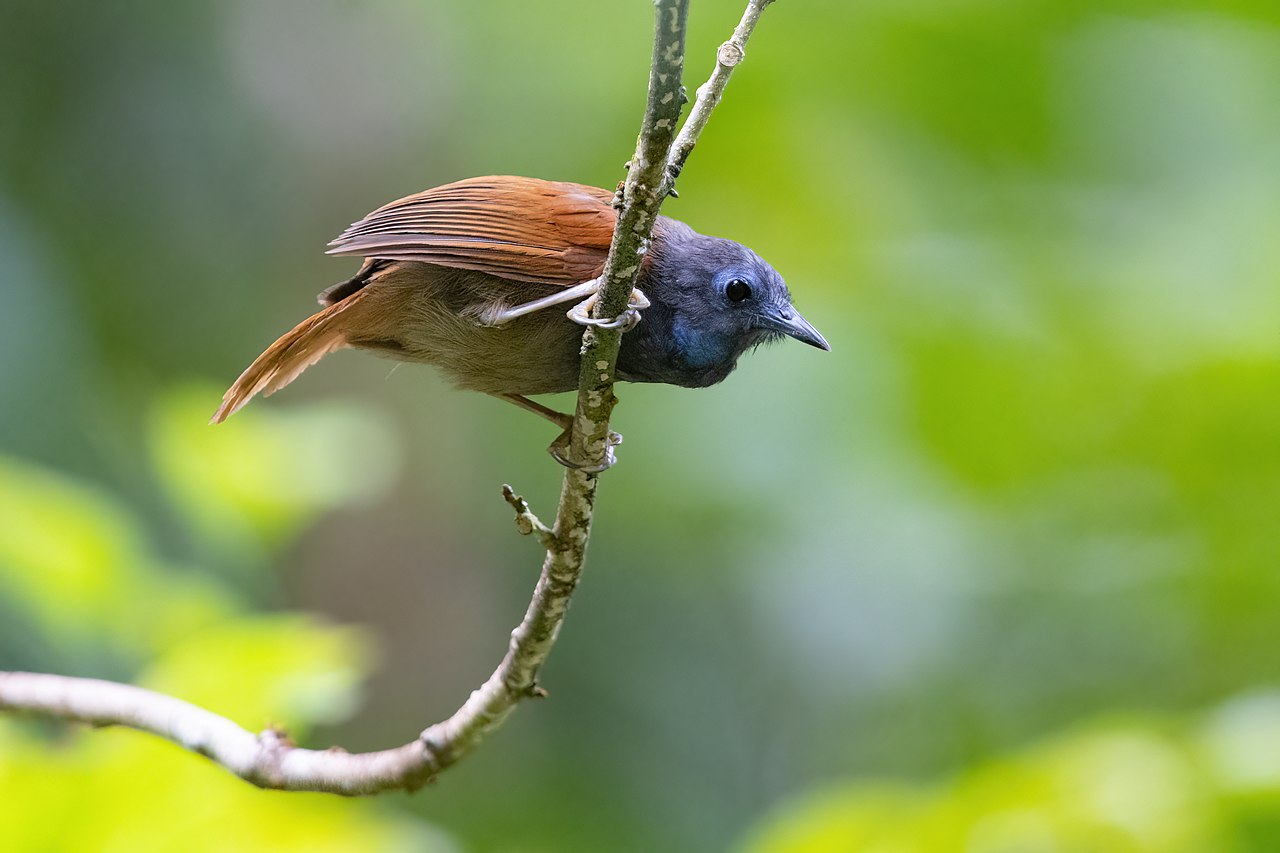
The chestnut-throated spinetail is a species of bird in the Furnariinae subfamily of the ovenbird family Furnariidae. It is mainly found in Bolivia, Brazil, Colombia, Ecuador, and Peru.
Region
Western and central Amazon Basin
Typical Environment
Occurs in lowland Amazonia of Bolivia, Brazil, Colombia, Ecuador, and Peru. It inhabits dense secondary growth, river-edge scrub, and seasonally flooded forests, frequently using vine tangles, young riverine woodland, and Guadua bamboo. Often associated with river islands and early-successional habitats near waterways. It keeps to the lower strata, typically within 1–4 m of the ground.
Altitude Range
Sea level to 1200 m
Climate Zone
Tropical
Ease of Keeping
Beginner friendly: 1/5
A skulking understory furnariid, the chestnut-throated spinetail is most often detected by its rapid, chattering song from thickets along Amazonian rivers. It favors dense second growth, river islands, and bamboo tangles where it forages close to the ground. Like other spinetails, it sports a stiff, graduated tail used for balance as it maneuvers through tangled vegetation.


Temperament
skulking and active
Flight Pattern
short rapid wingbeats
Social Behavior
Usually found singly, in pairs, or family groups, often remaining in dense cover. It occasionally joins mixed-species flocks along river edges. Nest is a bulky, domed stick structure with a side entrance, placed low in dense shrubs or bamboo.
Migratory Pattern
Resident
Song Description
Song is a fast, chattering series that may accelerate or slightly rise, delivered from concealed perches. Calls include sharp chips and dry rattles used to maintain contact in thick cover.
Plumage
Warm brown upperparts with rufous wings and a long, stiff, slightly graduated tail; underparts grayish to buff with a distinct rich chestnut throat patch. Subtle pale supercilium and darker ear coverts give the face a slightly masked look. The tail feathers are stiff-tipped, typical of spinetails.
Diet
Primarily takes arthropods such as insects and spiders, gleaned from dead leaves, vine tangles, and bamboo culms. It probes into curled leaves and peels at bark flakes to expose hidden prey. Occasionally hawks short distances to snatch flushed insects.
Preferred Environment
Feeds in dense understory along river margins, secondary scrub, and bamboo thickets. Often forages within a few meters of the ground, moving methodically through tangled vegetation.