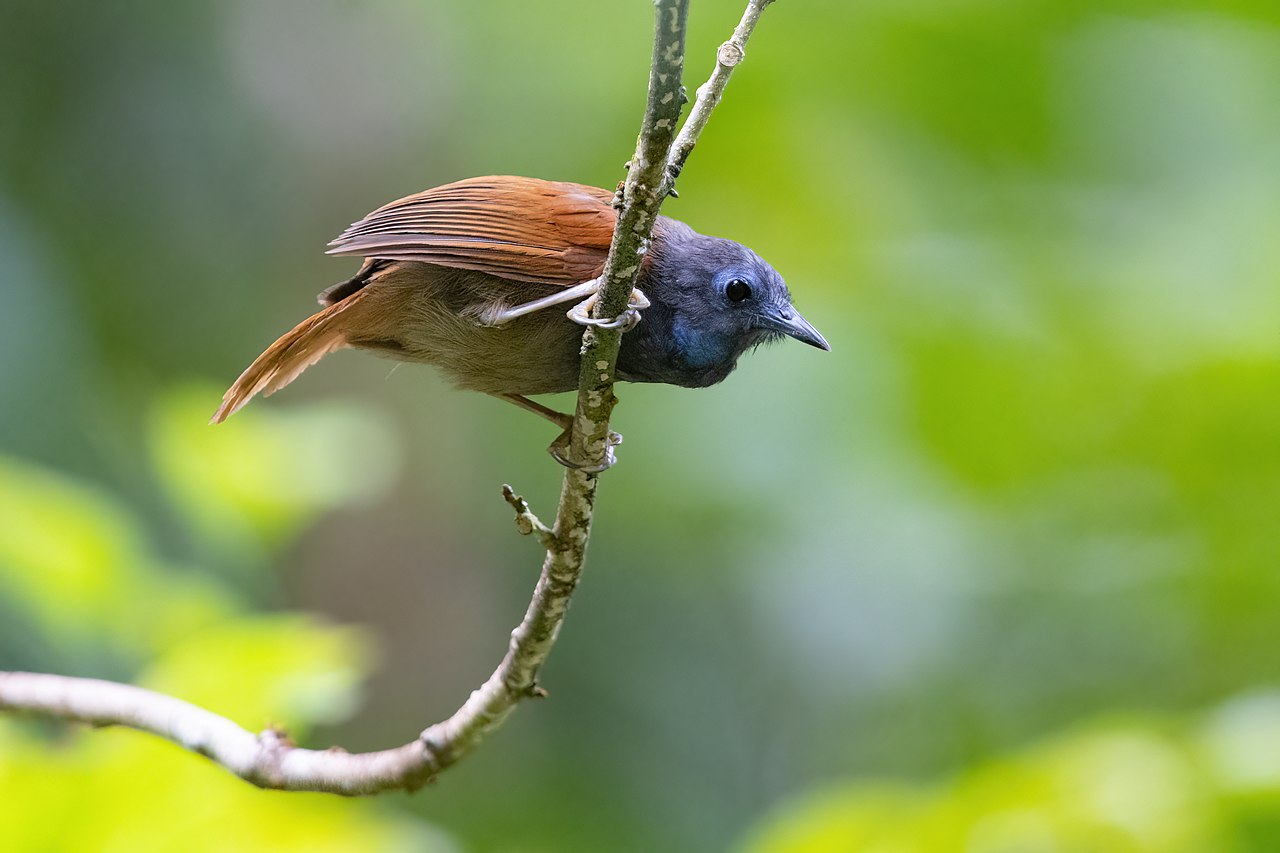
The chestnut-vented nuthatch is a species of bird in the nuthatch family Sittidae. It is a medium-sized nuthatch, measuring 12.5–14 cm (4.9–5.5 in) in length. The upperparts are a solid grey-blue, with a markedly black loral stripe. The underparts are uniform grey to buff from the throat to belly, with brick red on the flanks. The undertail is white with a rufous border. The chestnut-vented nuthatch utters different kinds of calls, which can sometimes sound like a wren alarm, and its song is a monotonous, stereotypical crackle, typically chichichichi. Its ecology is poorly known, but it probably feeds on small arthropods and seeds, and the breeding season begins between March and May. The nest is typically located in a hole in the trunk of a tree, and the clutch has two to five eggs.
Region
Southern China and mainland Southeast Asia
Typical Environment
Found from the eastern Himalayas through northern Myanmar into southern China (e.g., Yunnan and Guangxi) and Indochina, including Thailand, Laos, and Vietnam. It inhabits montane forests, especially mixed pine–oak and evergreen broadleaf woodlands. Birds use mature forest but also forage along edges and in semi-open stands with scattered large trees. They move through the mid to upper canopy as well as along large trunks and main branches.
Altitude Range
800–2800 m
Climate Zone
Highland
Ease of Keeping
Beginner friendly: 1/5
Like other nuthatches, it frequently climbs down tree trunks headfirst while foraging. It often joins mixed-species flocks outside the breeding season. Several subspecies show subtle differences in tone and saturation of the underparts across its range.


S. n. montium on Wawu Mountain, Hongya County, Sichuan, China

The white-tailed nuthatch (S. himalayensis) has uniform underparts and is much more colourful than the chestnut-vented nuthatch.

In winter, the yellow-cheeked tit (Machlolophus spilonotus) may roam with the nuthatch in mixed-foraging flocks.

Temperament
active and agile
Flight Pattern
short rapid wingbeats
Social Behavior
Typically seen singly or in pairs during the breeding season, nesting in tree cavities. The clutch usually contains two to five eggs, and breeding generally starts from March to May. Outside breeding, it may form small groups and often joins mixed-species foraging flocks.
Migratory Pattern
Partial migrant
Song Description
Song is a monotonous, crackling series of notes, often rendered as repeated chichichichi. Calls include sharp, scolding notes that can resemble a wren’s alarm.
Plumage
Solid grey-blue upperparts with a distinct black loral/eye stripe; underparts uniform grey to buff with brick-red on the flanks and a chestnut-tinged vent. Undertail is white with a rufous border; wings and tail are dusky with bluish tones.
Diet
Feeds primarily on small arthropods such as beetles, caterpillars, and other insects gleaned from bark and foliage. It also takes seeds and nuts, especially in the non-breeding season. Individuals probe crevices and flake bark to extract hidden prey and may occasionally cache food.
Preferred Environment
Forages on large trunks, main branches, and in the mid to upper canopy of montane forests. Uses mixed pine–oak and evergreen habitats, and sometimes edges and semi-open stands with mature trees.