
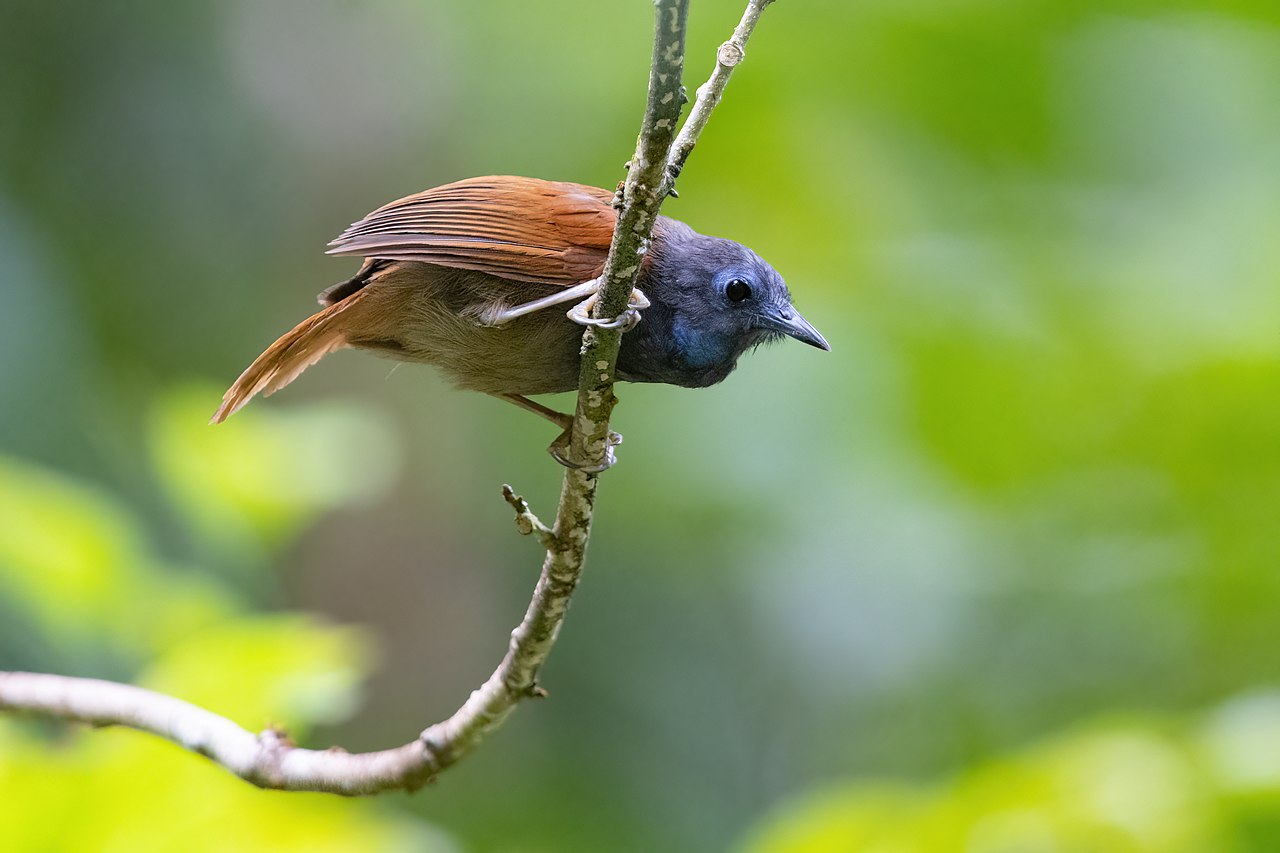
The chestnut-winged babbler is a babbler species in the family Timaliidae.
Region
Sundaland (Malay Peninsula, Sumatra, Borneo)
Typical Environment
Occurs in lowland and foothill evergreen forests, peatswamp and kerangas forests, and well-vegetated secondary growth. Favors dense tangles, bamboo, rattan thickets, and forest edges where it forages close to the ground. Common in riverine and swampy areas with thick understory. Readily uses regenerating habitats provided there is sufficient cover.
Altitude Range
0–1500 m
Climate Zone
Tropical
Ease of Keeping
Beginner friendly: 1/5
The chestnut-winged babbler is a skulking understory bird of Southeast Asian forests and was formerly placed in the genus Stachyris. It often joins mixed-species flocks and keeps contact with soft calls while moving through dense vegetation. Its rich chestnut wing panels are a key field mark when the bird flicks through thickets.

Temperament
skulking but active
Flight Pattern
short rapid wingbeats through understory
Social Behavior
Typically found in pairs or small family parties and frequently participates in mixed-species flocks. Nests are cup-shaped, placed low in dense vegetation. Pairs maintain contact with soft calls while foraging.
Migratory Pattern
Resident
Song Description
A series of thin, sweet whistles interspersed with soft chattering notes. Contact calls are soft ticks and chips, often given repeatedly from cover.
Plumage
Warm brown to olive-brown upperparts with a distinct rich chestnut panel on the wings; paler buff underparts and throat. Fine, soft-textured plumage suited to dense understory living.
Diet
Primarily consumes small arthropods such as insects, larvae, and spiders gleaned from leaves, stems, and dead foliage. Will occasionally take small berries or seeds when insect prey is scarce. Forages methodically, often hanging or probing into curled leaves.
Preferred Environment
Feeds in dense understory, vine tangles, bamboo, and rattan thickets, usually below 3 meters. Often forages along forest edges and in regenerating secondary growth where cover is thick.


