The carrion crow is a passerine bird of the family Corvidae, native to western Europe and the eastern Palearctic. Along with the hooded crow, the carrion crow occupies a similar ecological niche in Eurasia to the American crow in North America. The two species look very similar to one another, but can be differentiated by size, as the carrion crow is larger and of a stockier build compared to the American crow.
Region
Western Europe and Eastern Palearctic
Typical Environment
Found across much of western and central Europe extending into the eastern Palearctic. Occupies a wide range of habitats including farmland, woodland edges, parks, gardens, moorland, coastal cliffs and estuaries. Readily exploits urban areas and refuse tips. Avoids dense unbroken forest and the most arid regions but tolerates human presence well.
Altitude Range
Sea level to 2000 m
Climate Zone
Temperate
Ease of Keeping
Beginner friendly: 1/5
Carrion crows are highly intelligent corvids capable of problem-solving and tool use. They are adaptable generalists, thriving from remote coastlines to dense cities. Often seen in pairs, they defend territories year‑round but can gather in larger groups where food is abundant. They are easily confused with rooks and ravens, but lack the rook’s bare facial skin and are smaller than ravens.


Adult male carrion crow moulting at the Jardin des Plantes of Paris

A map of Europe indicating the distribution of the carrion and hooded crows on either side of a contact zone (white line) separating the two species

In Southend-on-Sea, England

In flight
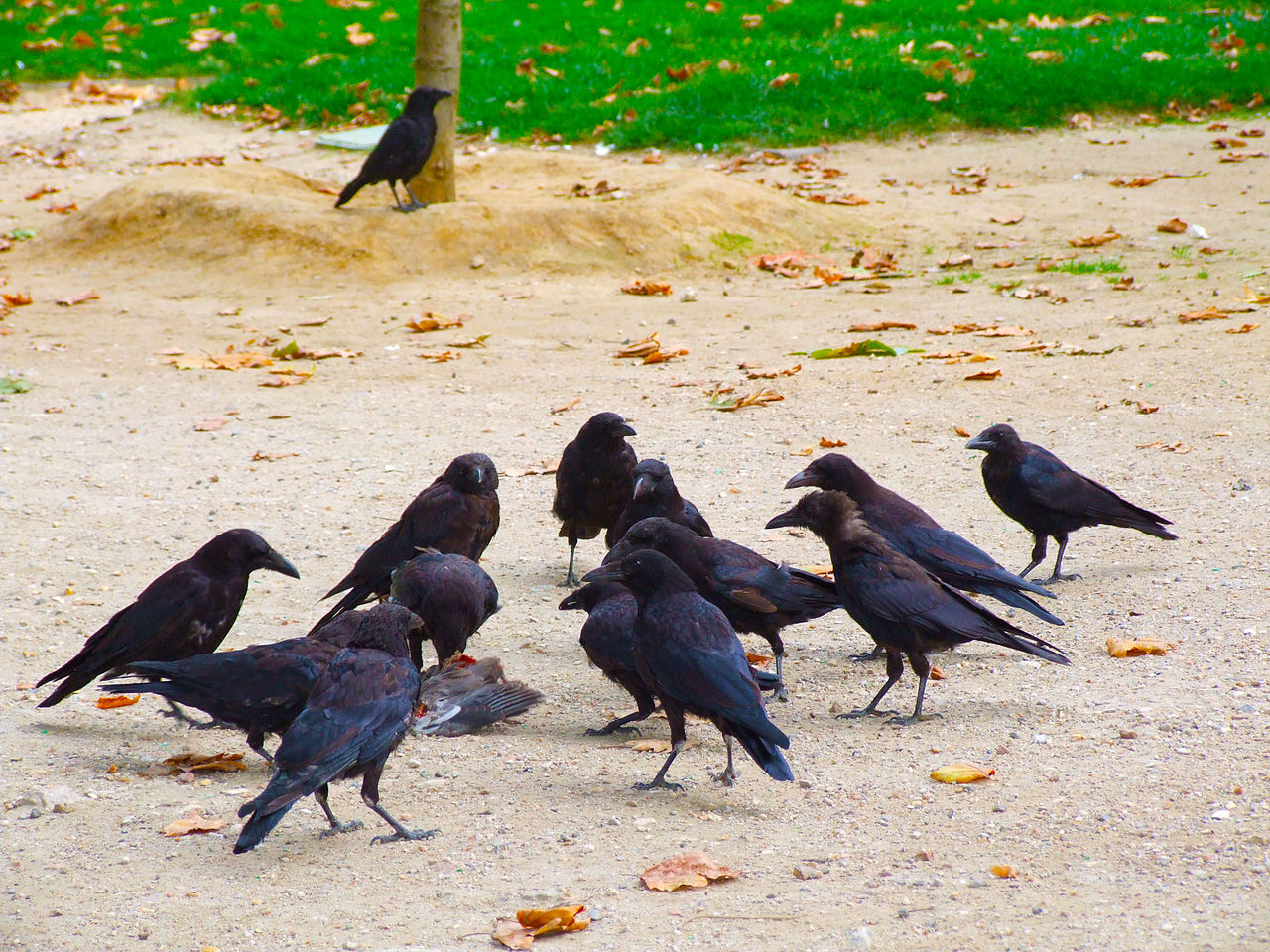
Scavenging around a dead bird in Paris, France

Eggs, Collection Museum Wiesbaden

Chicks in the nest
Temperament
cautious, intelligent, and moderately territorial
Flight Pattern
steady, deep wingbeats with occasional soaring and gliding
Social Behavior
Usually seen singly or in bonded pairs that defend territories year-round; pairs are typically monogamous. Nests are bulky stick structures placed high in trees, on pylons, or on cliffs, lined with softer materials. Juveniles and non-breeders may form small flocks and communal roosts.
Migratory Pattern
Partial migrant
Song Description
Vocalizations dominated by harsh, resonant caws (kraah) delivered singly or in series. Also gives softer rattles, croaks, and guttural notes in close-range communication.
Plumage
Entirely black with a glossy purplish-green sheen; dense, sleek feathers with slightly shaggy throat.
Diet
Opportunistic feeder taking carrion, insects, earthworms, and other invertebrates, as well as small vertebrates and eggs when available. Also consumes grains, seeds, fruits, nuts, and human food waste. Will cache surplus food and return later.
Preferred Environment
Forages in open fields, shorelines, intertidal zones, parks, and urban streets. Often searches freshly ploughed fields and tidelines, and patrols roadsides for roadkill.