
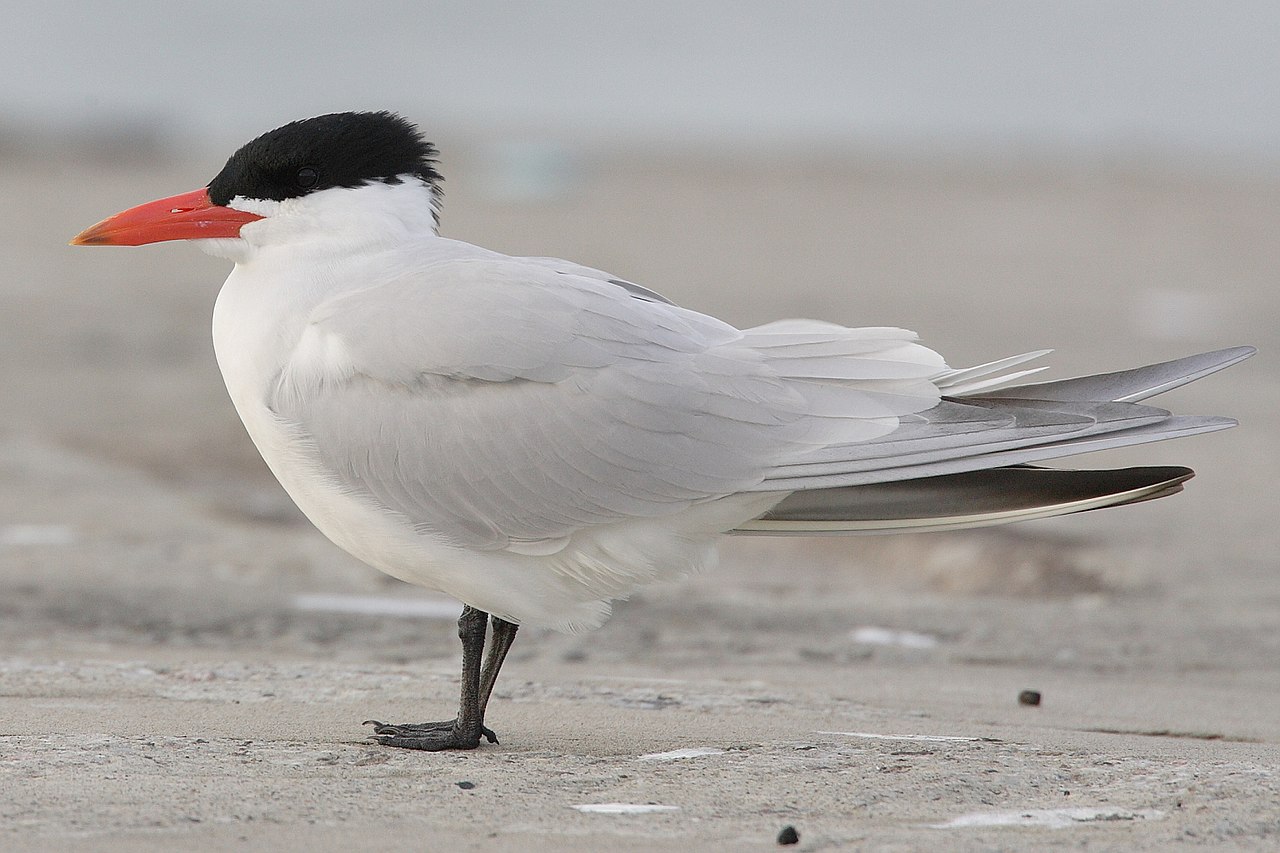
The Caspian tern is the world's largest species of tern, with a subcosmopolitan but scattered distribution. Despite its extensive range, it is monotypic of its genus, and has no accepted subspecies. The genus name is from Ancient Greek hudro-, "water-", and Latin progne, "swallow". The specific caspia is from Latin and, like the English name, refers to the Caspian Sea.
Region
Subcosmopolitan coasts and large inland waters of North America, Europe, Africa, and Asia
Typical Environment
Caspian terns occur along marine coastlines, estuaries, and large inland lakes and rivers. They favor sparsely vegetated sand or gravel islands for nesting and roosting, often forming colonies on isolated islets. Outside breeding, they use broad coastal embayments, deltas, lagoons, and large reservoirs. They forage over open water and along shorelines, sometimes following schools of fish. Human-altered water bodies such as reservoirs and fish ponds are also used when available.
Altitude Range
Sea level to 2500 m
Climate Zone
Other
Ease of Keeping
Beginner friendly: 1/5
The Caspian tern is the world’s largest tern, with a powerful, thick red-orange bill used to plunge-dive for fish. It is monotypic within the genus Hydroprogne and has a scattered, subcosmopolitan distribution across coasts and large inland waters. Northern populations migrate long distances to ice-free coasts, while some tropical groups are resident or move locally.


Egg, Collection Museum Wiesbaden



Temperament
social and colonial
Flight Pattern
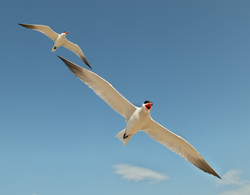
strong flier with deep, deliberate wingbeats and brief glides
Social Behavior
Breeds in colonies on low, open islands, typically nesting on bare sand or gravel in shallow scrapes. Pairs are generally monogamous for the season, with both adults incubating and feeding the chicks. They defend nest sites vigorously against intruders and often nest near other waterbirds.
Migratory Pattern
Partial migrant
Song Description
Vocal and far-carrying, with loud, harsh, barking calls often rendered as a deep 'kraah' or 'aaah'. Calls are used in flight, during territorial disputes, and to maintain contact with mates and chicks.
Plumage
Clean white underparts with pale grey upperwings and back; black cap in breeding season becoming mottled with a white forehead outside breeding. Outer primaries show a darker wedge; tail is shallowly forked.
Diet
Primarily piscivorous, taking small to medium-sized fish captured by hovering and plunge-diving. They may also eat crustaceans and aquatic insects, and rarely small amphibians or rodents. Prey is often carried crosswise in the bill and delivered whole to chicks.
Preferred Environment
Feeds over open coastal waters, estuaries, river mouths, and large inland lakes and reservoirs. Commonly hunts along shorelines and over nearshore shoals where fish are concentrated. Roosts and digests on sandbars, islets, and exposed beaches.


