
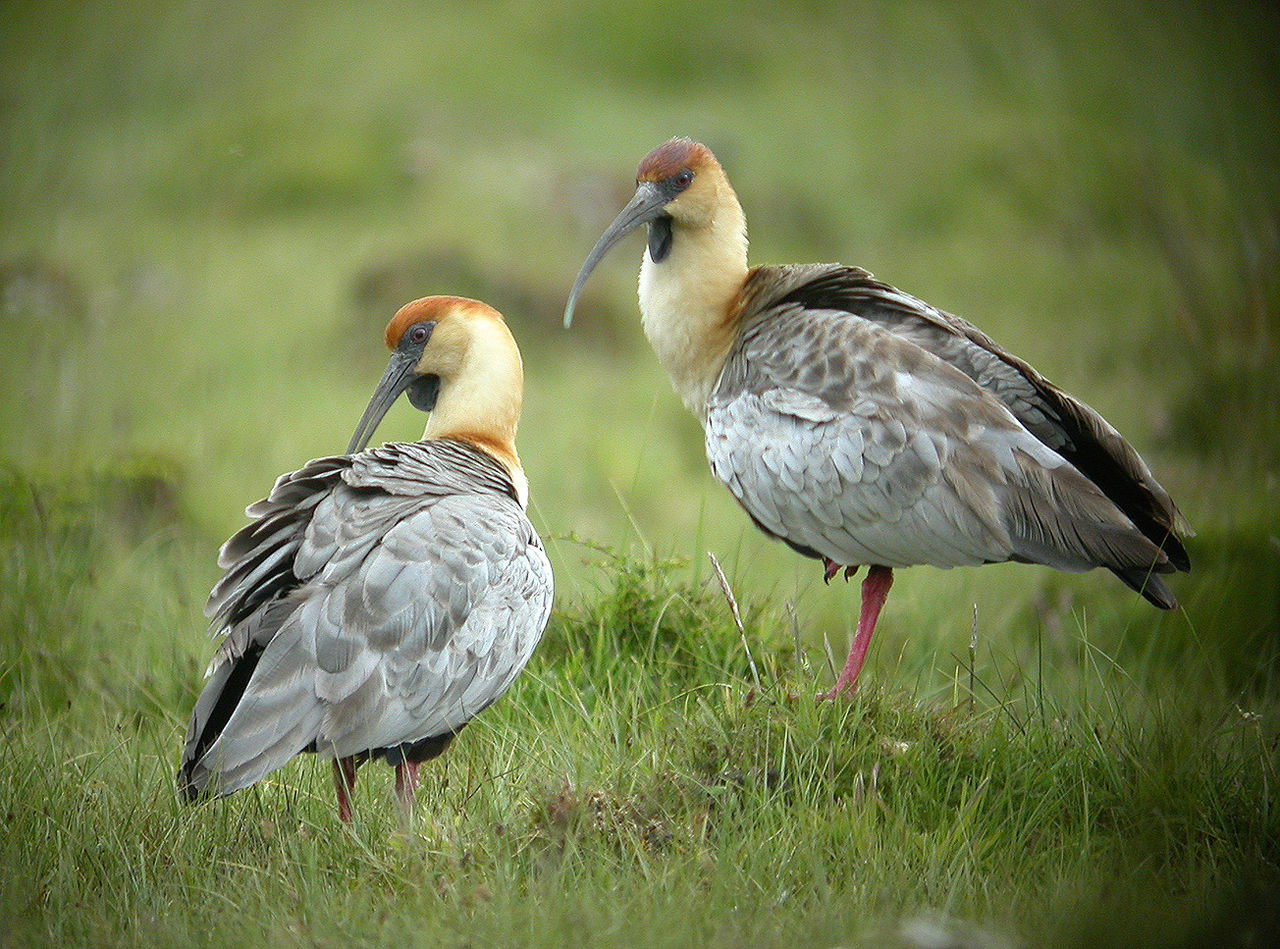
The black-faced ibis is a species of bird in the family Threskiornithidae. It is found in grassland and fields in southern and western South America. It has been included as a subspecies of the similar buff-necked ibis, but today all major authorities accept the split. The black-faced ibis also includes the Andean ibis as a subspecies. Some taxonomic authorities still do so.
Region
Southern Cone and Andean highlands
Typical Environment
Occurs from central and southern Chile and adjacent southwestern Argentina across open country, farmlands, and steppe, with a high-Andean form ranging through puna grasslands of Peru, Bolivia, northern Chile, and northwestern Argentina. It favors open habitats such as grazed pastures, wet meadows, pampas grasslands, and agricultural fields near wetlands. In coastal and lowland zones it uses marsh edges and damp fields, while in the Andes it frequents puna and páramo-like grasslands near bogs and streams. It may roost on cliffs, rocky outcrops, tall trees, or human structures. Local movements track water availability and food resources.
Altitude Range
Sea level to 4500 m
Climate Zone
Temperate
Ease of Keeping
Beginner friendly: 1/5
The black-faced ibis is a large, conspicuous ibis of southern and western South America, often seen striding through pastures and wet meadows. It has sometimes been lumped with the buff-necked ibis, and some authorities still include the high-Andean form (often called the Andean ibis) within this species. Its loud, braying calls carry over long distances, and it often follows grazing livestock, benefiting farmers by consuming grubs and other invertebrate pests.


Temperament
social and alert
Flight Pattern
strong flier with steady wingbeats and brief glides
Social Behavior
Usually seen in pairs or small groups, sometimes forming loose flocks in suitable feeding areas. Nests solitarily or in small colonies, placing stick platforms on cliffs, trees, or human structures. Pairs are strongly territorial around nest sites and share incubation and chick-rearing duties.
Migratory Pattern
Partial migrant
Song Description
Vocalizations are loud, braying honks and nasal calls, often delivered in series. Calls are most frequent during flight, territorial displays, and at colony sites.
Plumage
Buff to ochre neck and head contrasting with a dark, bare face and throat; mantle and back gray with fine barring; underparts dusky with darker belly; flight feathers blackish with a conspicuous pale wing patch visible in flight.
Diet
Feeds primarily on invertebrates such as earthworms, beetles, grubs, grasshoppers, and spiders, which it locates by probing soft soil and vegetation. It also takes amphibians, small reptiles, and occasionally small mammals when available. Foraging often follows livestock, where hoof disturbance exposes prey, and may include opportunistic feeding on carrion or insects flushed by machinery.
Preferred Environment
Most often forages in grazed pastures, damp meadows, and the margins of marshes and irrigation ditches. In the Andes it uses wet puna grasslands and bofedales, probing in saturated soils and shallow water. It readily exploits agricultural landscapes with nearby water sources.


