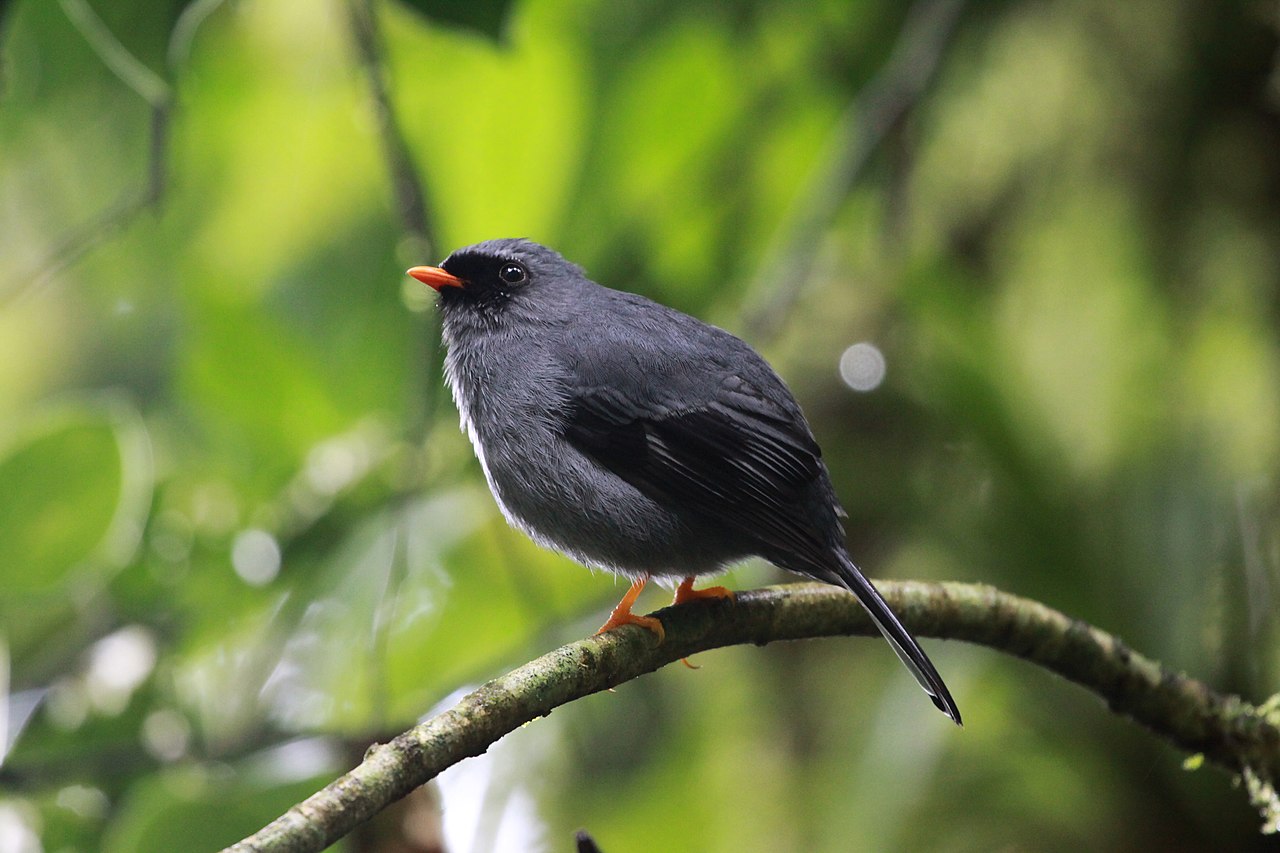
The black-faced pitta is a species of bird in the family Pittidae. It is found on Bougainville Island in Papua New Guinea, and Choiseul Island as well as Santa Isabel Island in the Solomon Islands. Its natural habitat is subtropical or tropical moist lowland forest. It is threatened by habitat loss and most certainly by introduced predators and/or competitors.
Region
Solomon Islands archipelago
Typical Environment
Occurs on Bougainville (Papua New Guinea) and in the northern Solomon Islands on Choiseul and Santa Isabel. It inhabits primary and lightly disturbed subtropical or tropical moist lowland forests, especially areas with deep leaf litter. Birds are most often found on shaded forest floors, along forested ravines, and near small streams where invertebrate prey is abundant. It avoids open secondary growth and plantations. Fragmentation and degradation of forest cover limit its occurrence and movement between suitable patches.
Altitude Range
Sea level to 800 m
Climate Zone
Tropical
Ease of Keeping
Beginner friendly: 1/5
The black-faced pitta is a shy, ground-dwelling forest bird restricted to a few islands in the Solomon Islands archipelago, including Bougainville, Choiseul, and Santa Isabel. It depends on intact lowland rainforests with dense leaf litter, making it highly sensitive to logging and forest degradation. Predation and competition from introduced mammals, such as rats and feral cats, are additional threats. Its clear, whistled calls are often the best way to detect it in dense understory.


Temperament
shy and secretive
Flight Pattern
short rapid wingbeats; low, direct flights between cover
Social Behavior
Usually solitary or in pairs, keeping close to dense understory and leaf litter. Pairs defend territories, especially during the breeding season. The nest is typically a domed structure placed low to the ground or on a bank, with a small entrance. Clutches are small and both parents participate in care.
Migratory Pattern
Resident
Song Description
Gives clear, mellow whistles, often a simple series of notes repeated at intervals. The song carries well through dense forest and is most frequent at dawn and dusk. Calls can sound plaintive and are often used for territorial advertisement.
Plumage
Compact, short-tailed pitta with olive-green upperparts and a contrasting black face and throat. Underparts are buff to rufous with brighter rufous on the vent and undertail coverts. Shows bright cobalt-blue patches on the wings and sometimes on the tail edges. Feathers are smooth and glossy, giving a clean, well-defined color contrast.
Diet
Primarily feeds on invertebrates such as beetles, ants, termites, spiders, snails, and earthworms gleaned from leaf litter. It probes and flips leaves with its bill to expose hidden prey. Occasionally takes small vertebrates like tiny skinks or frogs when available. Foraging is deliberate, with short hops and frequent pauses to listen.
Preferred Environment
Forages on the forest floor of mature lowland rainforest, especially in damp, shaded areas. Often near streams, root tangles, fallen logs, and thickets where leaf litter accumulates. Avoids open areas and heavily disturbed habitats.