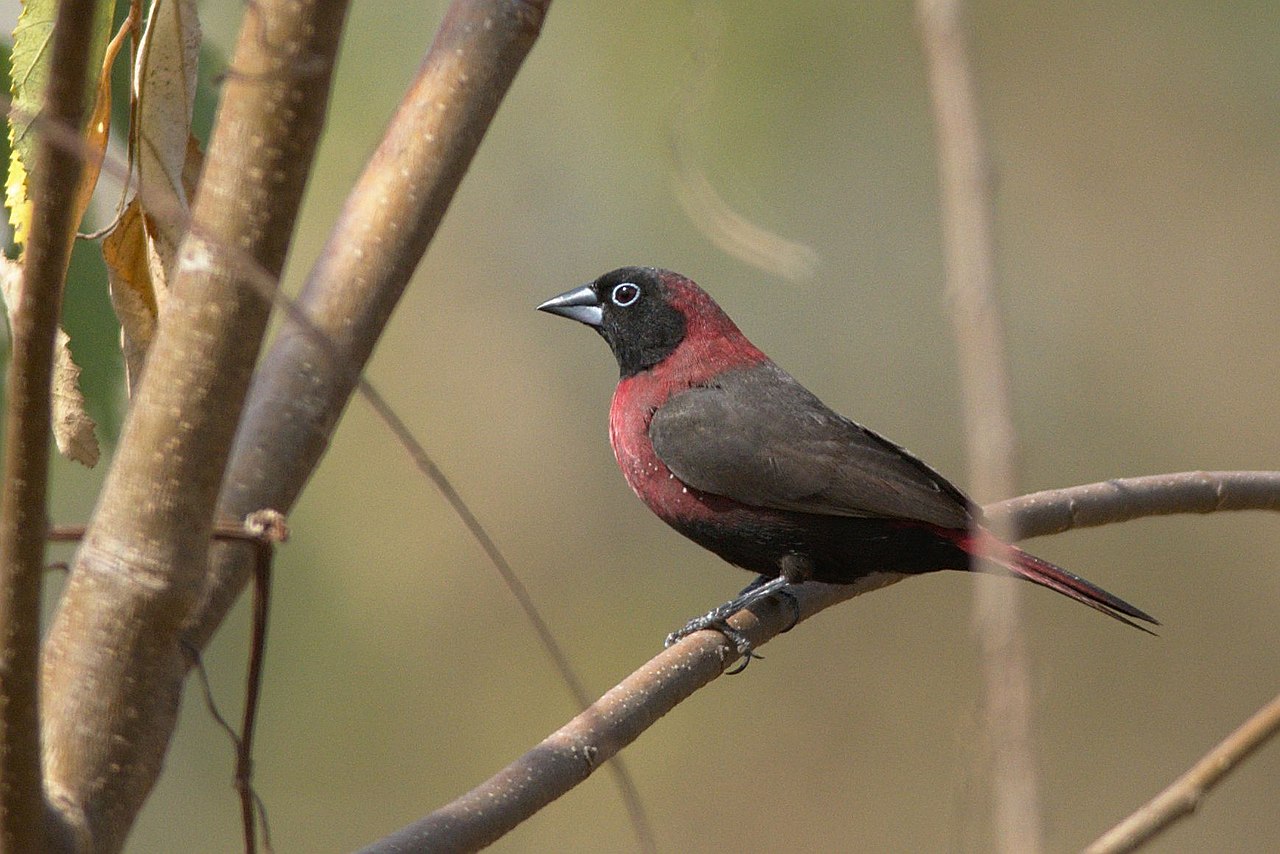
The black-faced firefinch is a common species of estrildid finch found in Africa. It has an estimated global extent of occurrence of 2,100,000 km2.
Region
West and Central Africa
Typical Environment
Occurs in savanna and open woodland mosaics, forest edges, and bushy grasslands, often near watercourses and cultivated areas. It favors areas with dense low cover for nesting and protection while feeding on open ground nearby. It adapts to lightly disturbed habitats and can be found around villages and farms where seed is abundant. Local movements may follow seeding grasses after rains.
Altitude Range
0–1800 m
Climate Zone
Tropical
Ease of Keeping
Beginner friendly: 2/5
This small estrildid finch is often heard before it is seen, keeping close to dense cover and foraging near the ground. Males show a distinctive black facial mask that gives the species its name. It is a known host of the brood-parasitic Black-faced Firefinch Indigobird (Vidua larvaticola). Pairs are typically discreet and may form small family parties outside the breeding season.

Temperament
shy and skulking
Flight Pattern
short rapid wingbeats with low, undulating flights
Social Behavior
Usually found in pairs or small family groups, keeping close to cover. Nests are domed structures of grass hidden in dense shrubs or low thickets. Pairs are monogamous during the breeding season, with both sexes participating in nest building and chick rearing.
Migratory Pattern
Resident
Song Description
Soft, high-pitched twitters and trills delivered from within cover or low perches. Calls include thin tseep notes and brief buzzy phrases, often exchanged quietly between pair members.
Plumage
Compact finch with rich reddish to vinous body, darker wings and tail, and a contrasting dark face in males; females are duller with a less distinct mask. Underparts are largely red with subtle mottling on the flanks; upperparts can appear brownish-red. The bill is short, thick, and conical.
Diet
Primarily consumes small grass seeds and other fine grains picked from the ground or low seed heads. During breeding, it supplements with small insects such as termites, ants, and other arthropods to provide protein for chicks. It often forages quietly in pairs, moving between patches of seeding grasses.
Preferred Environment
Feeds along track edges, fallow fields, and grassy clearings near bushy cover. Also uses the margins of wetlands and watercourses where grasses seed abundantly.