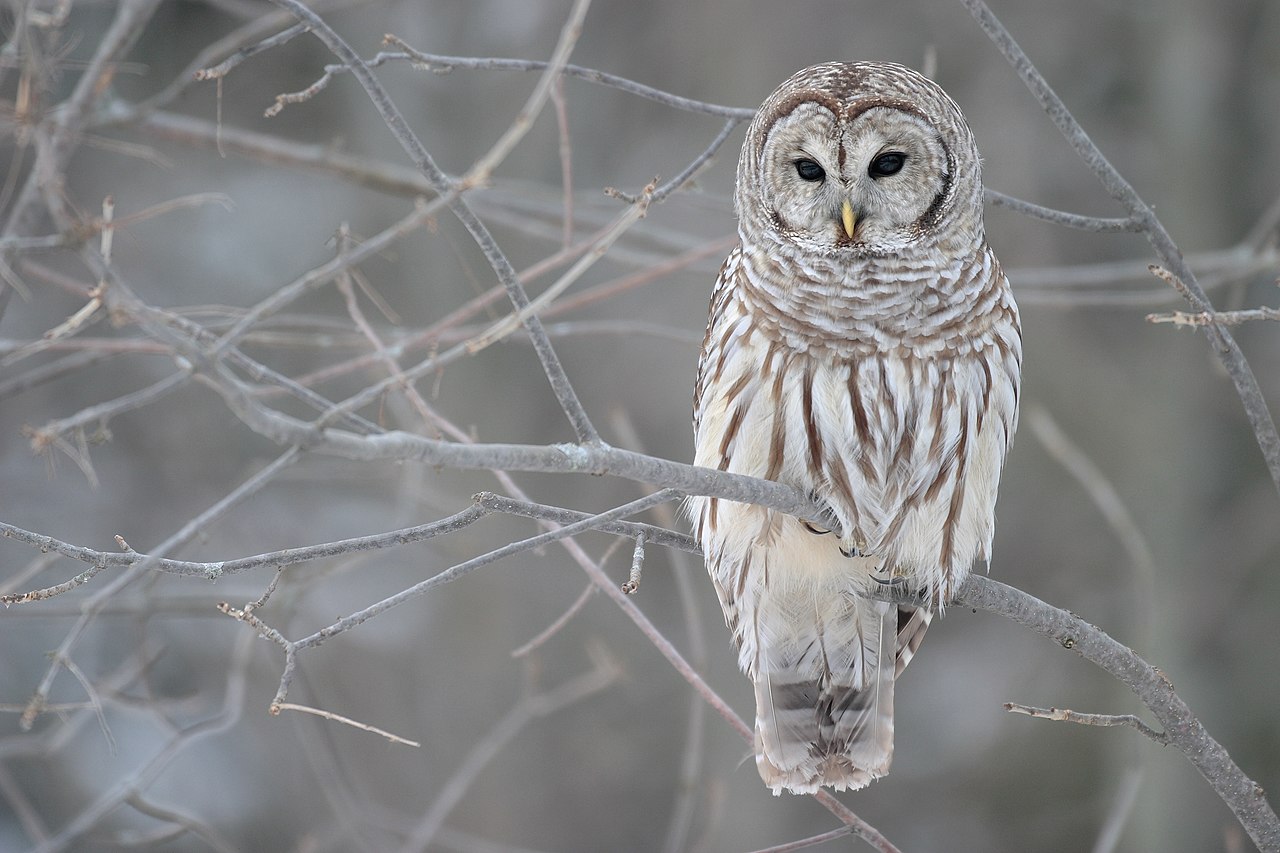
The barred forest falcon is a species of bird of prey in subfamily Herpetotherinae of family Falconidae, the falcons and caracaras. It occurs from southern Mexico south through most of Central America and in every mainland South American country except Chile and Uruguay.
Region
Neotropics (Central and South America)
Typical Environment
Occurs from southern Mexico through most of Central America and widely across South America, absent only from Chile and Uruguay. It inhabits lowland and foothill evergreen forests, gallery forests, and mature second growth, and tolerates edges and plantations adjacent to intact forest. Most active within dense understory and midstory, where it hunts by ambush. It is typically scarce to fairly common but hard to detect due to its secretive habits.
Altitude Range
Sea level to 2500 m
Climate Zone
Tropical
Ease of Keeping
Beginner friendly: 1/5
A secretive raptor of dense tropical forests, the barred forest falcon hunts by stealth from perches and by short, rapid dashes through understory. It often calls at dawn and dusk with plaintive, carrying whistles that reveal its presence. Adapted to life under the canopy, it has short rounded wings and a long tail for agile maneuvering. It nests in tree cavities, frequently reusing old woodpecker holes.


Immature in São Paulo, Brazil

Temperament
solitary and territorial
Flight Pattern
short rapid wingbeats with agile maneuvering
Social Behavior
Usually encountered singly or in pairs that maintain year-round territories. Breeds in tree cavities, often using old woodpecker holes; clutch typically 2–3 eggs with both parents attending. Secretive, spending much time perched quietly within dense cover.
Migratory Pattern
Resident
Song Description
Gives a series of clear, mournful whistles that descend slightly in pitch, often at dawn and dusk. Calls can carry far through forest and are the best way to detect this species.
Plumage
Upperparts dark grey-brown to slaty; underparts whitish to buff heavily barred with dark bands. Tail long with bold, narrow white bands; throat usually paler, often whitish. Short, rounded wings and long tail give a compact, forest-adapted silhouette.
Diet
Primarily takes small birds, rodents, lizards, and large insects. Hunts by silent sit-and-wait from shaded perches, then rushes to seize prey on the ground or in low vegetation. Will also pursue prey on foot and exploit forest edges and trails where prey is more exposed.
Preferred Environment
Feeds within dense understory, along forest edges, and near clearings or trails where ambush is effective. Uses perches with good visibility to launch short surprise attacks.