
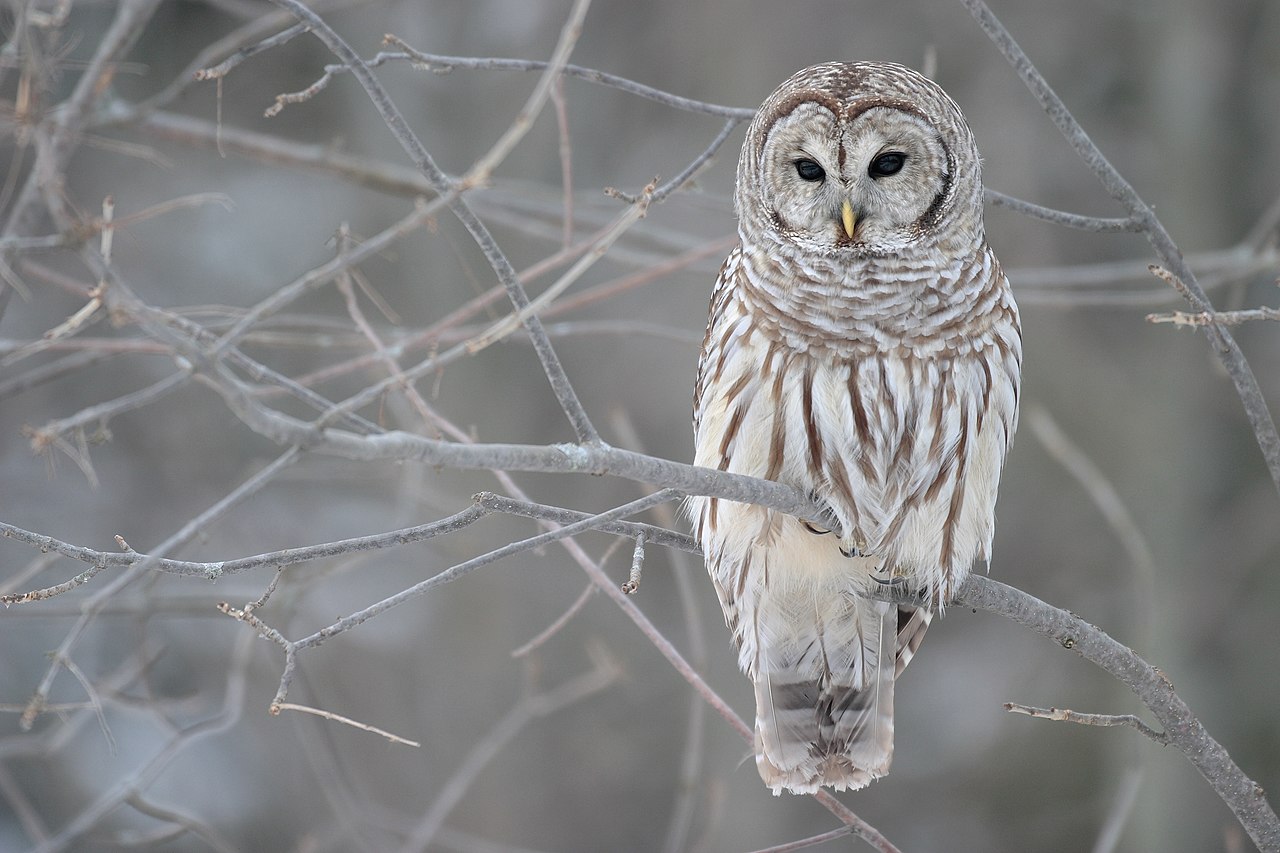
The barred owl, also known as the northern barred owl, striped owl or, more informally, hoot owl or eight-hooter owl, is a North American large species of owl. A member of the true owl family, Strigidae, they belong to the genus Strix, which is also the origin of the family's name under Linnaean taxonomy. Barred owls are largely native to eastern North America, but have expanded their range to the west coast of North America where they are considered invasive. Mature forests are their preferred habitat, but they can also acclimatise to various gradients of open woodlands. Their diet consists mainly of small mammals, but this species is an opportunistic predator and is known to prey upon other small vertebrates such as birds, reptiles, and amphibians, as well as a variety of invertebrates.
Region
North America
Typical Environment
Native to forests of eastern North America from the Gulf Coast through the Great Lakes and into southern Canada, the barred owl has expanded across the Great Plains into the Pacific Northwest and California. It occupies mature deciduous and mixed conifer-hardwood forests, wooded swamps, riparian corridors, and suburban woodlots with large trees. It favors areas with standing water or wetlands and dense canopy cover for roosting. In the West it now occurs from coastal lowlands into montane conifer forests. It generally avoids treeless open country but will hunt along edges and clearings.
Altitude Range
Sea level to 2000 m
Climate Zone
Temperate
Ease of Keeping
Beginner friendly: 1/5
Famous for its resonant “Who cooks for you? Who cooks for you-all?” hooting, the barred owl is a common forest owl of North America. It has expanded westward and can outcompete the closely related northern spotted owl, creating conservation challenges. Barred owls are powerful, opportunistic hunters that will take prey from crayfish to small mammals and birds. They defend nest sites vigorously and readily use tree cavities or old raptor nests.


Although previously considered a subspecies of barred owl, the fulvous owl is now considered a distinct species

Some subspecies such as S. v. georgica from Florida differ from northern barred owls by their darker brown streaks and, more noticeably, their bare toes

The Texas subspecies, S. v. heveola, has mostly bare and relatively sizable toes and distinctly cinnamon-hued plumage

A barred owl in Ontario
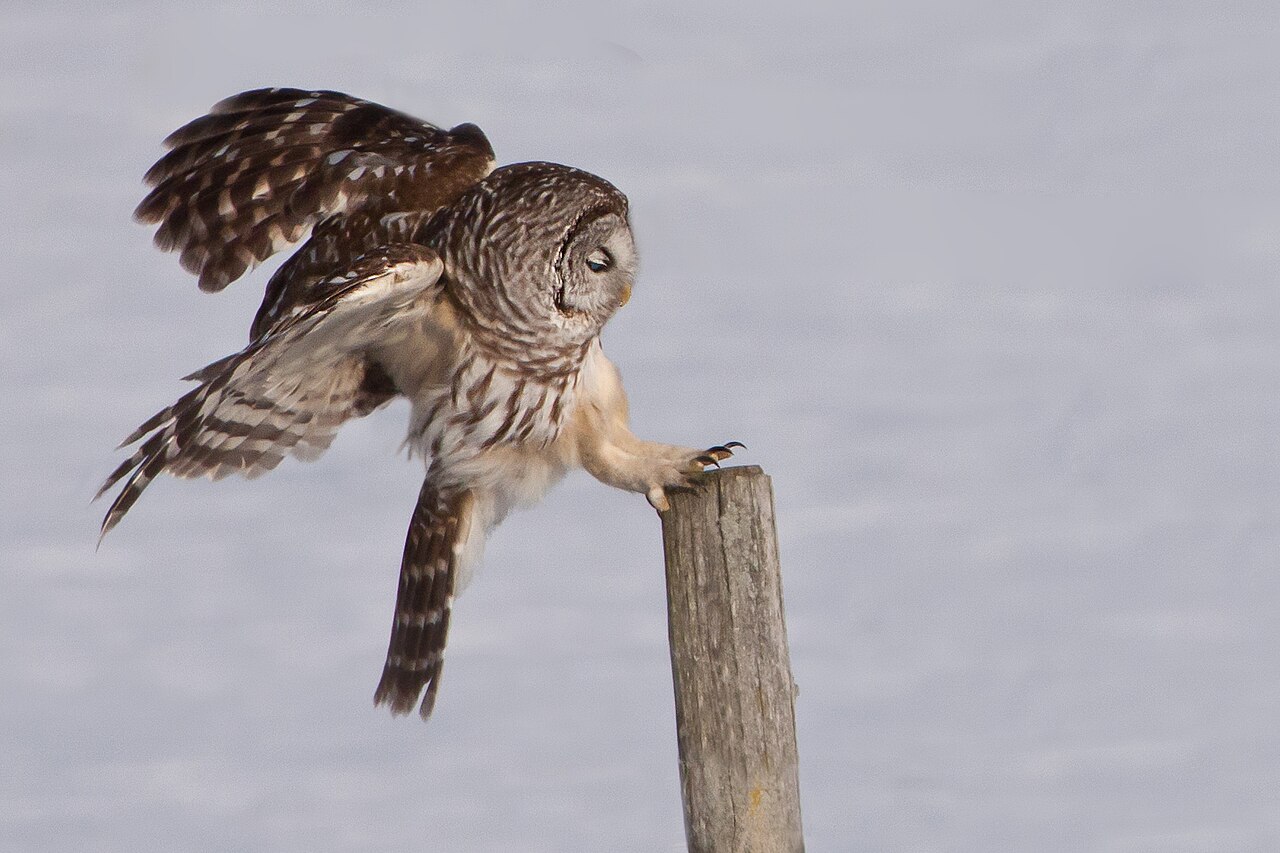
A barred owl using its tail as an air dam and brake

Winter in Vermont

A juvenile barred owl peers out in the verdant forests of Washington, where the species is an "invasive" recent invader

The barred owl usually makes its home in deciduous forests

Barred pattern, Ontario, Canada

The barred owl is normally nocturnally active and sleeps during the day

Small mammals tend to be the characteristic prey for barred owls

A 1908 photo of a site found with a massive amount of barred owl casts and pellets near Carlisle, Pennsylvania
![Barred owls will eat fledglings of the hermit thrush[160]](https://upload.wikimedia.org/wikipedia/commons/thumb/6/67/Hermit_thrush_%2827991992249%29.jpg/1280px-Hermit_thrush_%2827991992249%29.jpg)
Barred owls will eat fledglings of the hermit thrush[160]

Ruffed grouse are known prey in extensive parts of the range

Frogs such as wood frogs are a regular prey source for barred owls

Great horned owls are the most severe competitor and predator of barred owls

A probable mated pair of barred owl adults in daytime

Barred owl nestlings peer out of the typical nesting site, a spacious tree hollow

A chick nuzzles its mother after leaving its nest

A barred owl that drowned after entanglement with fishing line

Barred owl skeleton (Museum of Osteology)
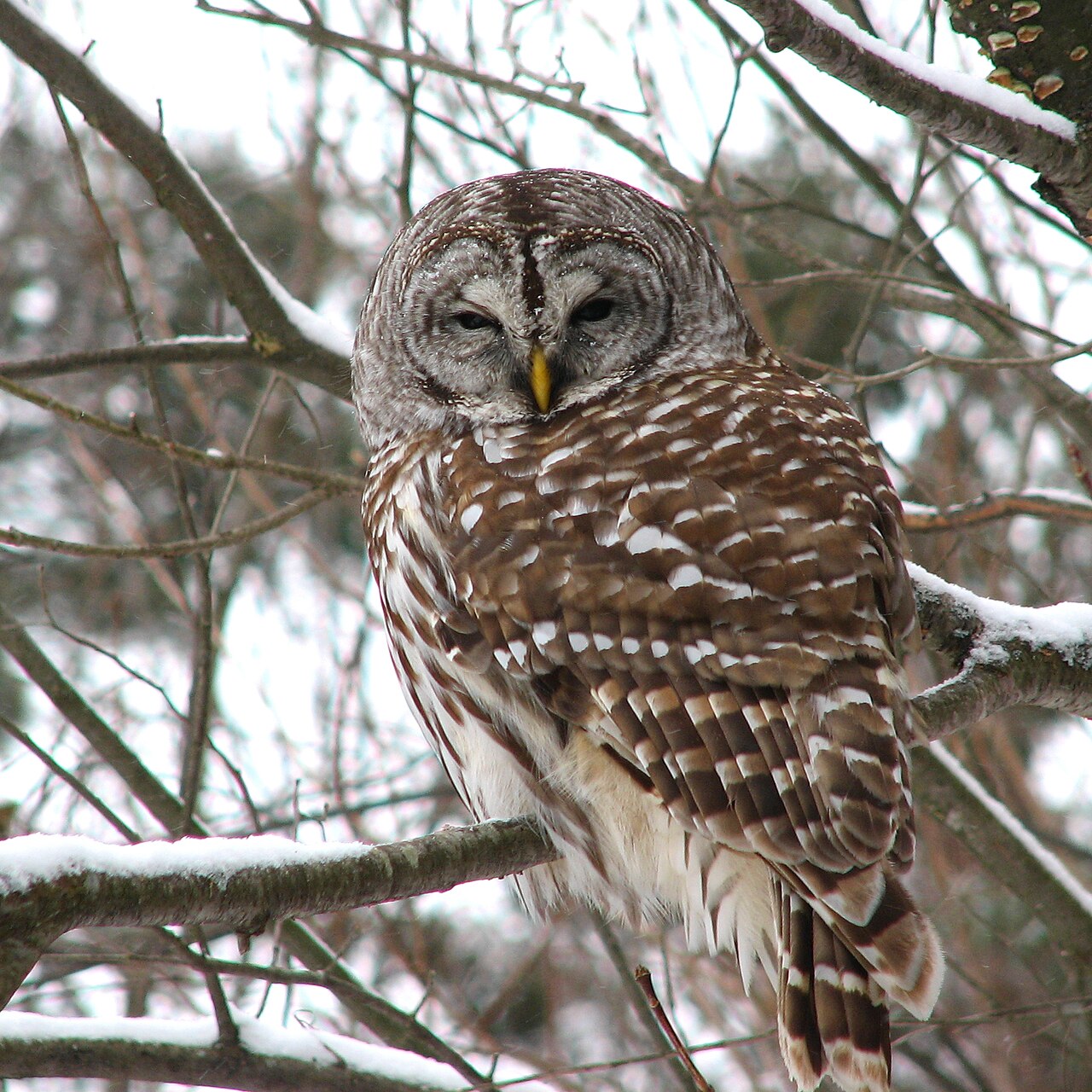
Gatineau Park, Gatineau, Quebec

Audubon's illustration of a barred owl attacking a squirrel
Temperament
solitary and territorial
Flight Pattern
buoyant, silent flier with broad rounded wings and short glides between strong wingbeats
Social Behavior
Generally monogamous and territorial, with pairs maintaining year-round territories. Nests in large tree cavities, broken snags, or old hawk or crow nests, and readily uses nest boxes. Adults aggressively defend nest sites, especially during the chick-rearing period.
Migratory Pattern
Resident
Song Description
Deep, rhythmic hoots rendered as “Who cooks for you? Who cooks for you-all?” often given in sequences. Pairs may duet and engage in loud caterwauling during courtship and territorial encounters.
Plumage
Rounded-headed owl with a pale facial disk; brown-and-white barring across the chest and neck with vertical streaks on the belly; finely barred brown upperparts.
Diet
Primarily hunts small mammals such as mice, voles, rats, and rabbits. Also takes birds, amphibians, reptiles, fish, and large invertebrates like crayfish and beetles. An opportunistic sit-and-wait predator, it drops from perches or swoops silently to seize prey with its talons. In wet habitats, it may wade to capture aquatic prey.
Preferred Environment
Often hunts along forest edges, over wetlands and riparian corridors, and in wooded suburban areas with scattered openings. Perches on limbs or snags with good sightlines, frequently near water.


