

The white-faced heron also known as the white-fronted heron, and incorrectly as the grey heron, or blue crane, is a common bird throughout most of Australasia, including New Guinea, the islands of Torres Strait, Indonesia, New Zealand, and all but the driest areas of Australia.
Region
Australasia
Typical Environment
Widespread across most of Australia (except the driest deserts), Tasmania, New Zealand, New Guinea, and nearby islands, with occasional vagrants to Indonesia and the Pacific. Occupies a broad range of habitats including tidal flats, mangroves, coastal lagoons, rivers, lakes, sewage ponds, rice fields, and damp grasslands. Readily uses human-altered landscapes such as urban wetlands and farmland. It is one of the most commonly encountered herons in towns and agricultural areas.
Altitude Range
Sea level to 2000 m
Climate Zone
Temperate
Ease of Keeping
Beginner friendly: 1/5
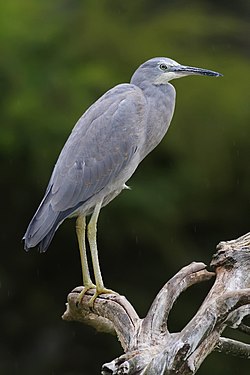
A highly adaptable heron, it frequents wetlands, estuaries, paddocks, and even urban parks and golf courses. It often hunts with a slow, deliberate stalk, or by standing motionless before striking with a rapid jab. During breeding, it grows elegant plumes on the neck and back and may show flushed pinkish legs. Nests are usually flimsy stick platforms placed in trees, shrubs, or reeds, often in loose colonies.


Non-breeding plumage

In flight, Tasmania


Temperament
generally wary but tolerant of people
Flight Pattern
steady flight with slow, deliberate wingbeats and retracted neck
Social Behavior
Usually seen singly or in pairs while feeding, but can gather in small groups where prey is abundant. Breeds solitarily or in loose colonies, sometimes with other waterbirds. Both parents share incubation and chick-rearing duties.
Migratory Pattern
Partial migrant
Song Description
Usually quiet, giving harsh croaks and guttural grunts, especially around nests. Displays include rasping calls and bill-snapping during territorial or courtship interactions.
Plumage
Smooth blue-grey body with long, fine plumes in breeding season; crisp white face and forehead contrasting with darker crown and mantle.
Diet
Feeds primarily on small fish, crustaceans, aquatic insects, tadpoles, frogs, worms, and occasionally small reptiles. Hunts by slow stalking, standing-and-waiting, or by stirring the substrate with its feet to flush prey. Strikes quickly with its dagger-like bill and swallows prey whole.
Preferred Environment
Forages along shallow water margins, mudflats, flooded paddocks, drainage ditches, and estuarine edges. Also uses artificial habitats like settling ponds and urban lakes where small aquatic prey are abundant.


