

The white-faced ibis is a wading bird in the ibis family, Threskiornithidae.
Region
Americas
Typical Environment
Found from the western and central United States and Gulf Coast through Mexico and Central America to parts of southern South America. Breeds in interior wetlands of the western U.S. and locally along the Gulf Coast, and winters farther south into Mexico and Central America. South American populations occur in lowland marshes, estuaries, and flooded grasslands. Prefers shallow freshwater and brackish marshes, ponds, irrigation canals, and flooded agricultural fields such as rice and alfalfa.
Altitude Range
0–2500 m
Climate Zone
Temperate
Ease of Keeping
Beginner friendly: 1/5
The white-faced ibis is a wading bird in the ibis family, Threskiornithidae. In breeding plumage it shows a crisp white border around the face that helps distinguish it from the similar Glossy Ibis; outside the breeding season this mark is faint or absent, making identification trickier. It often nests colonially over water in dense marsh vegetation and readily uses flooded agricultural fields, especially rice, for feeding.


A flock of White-faced Ibis take flight.
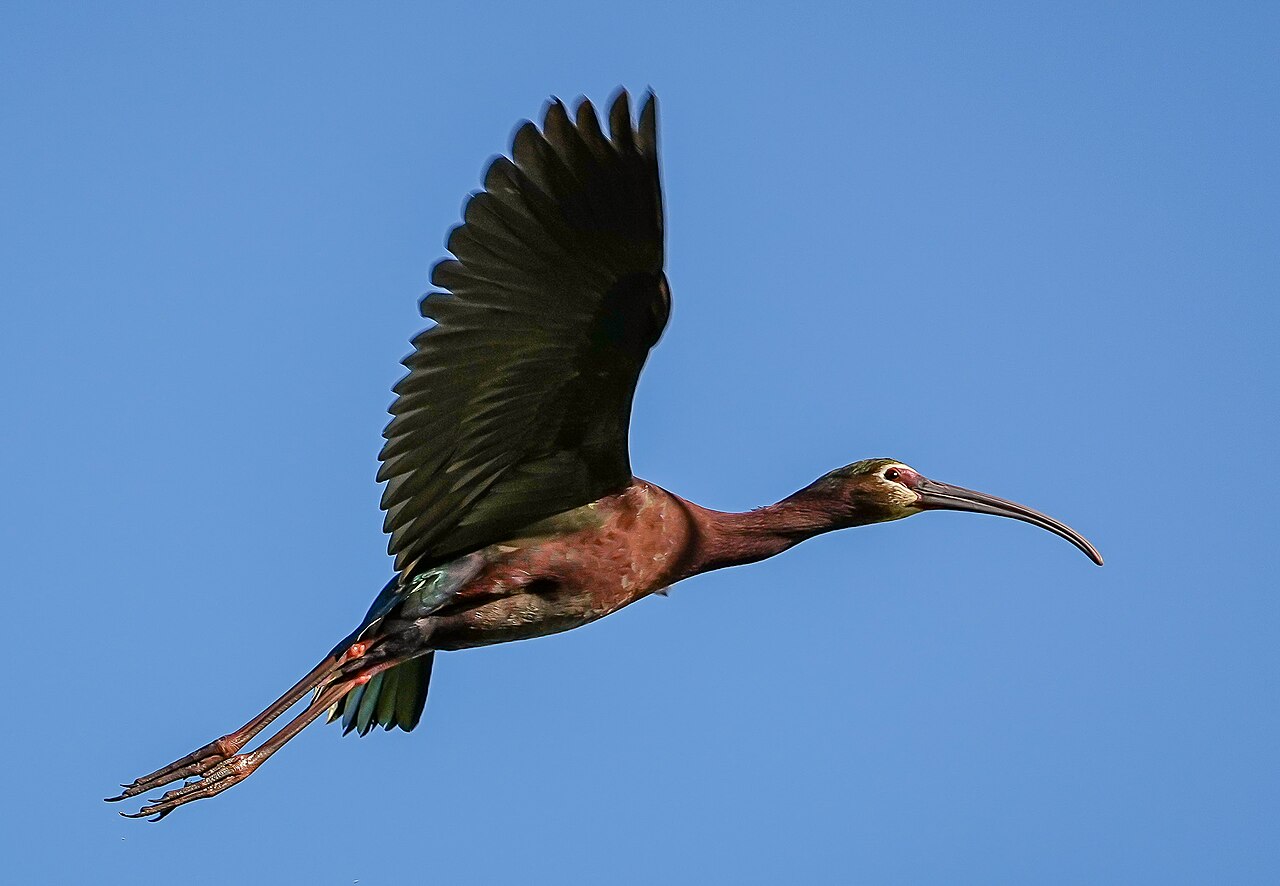
A White-faced Ibis in flight.

Juvenile feeding
Temperament
social and active
Flight Pattern
steady wingbeats with occasional glides; often flies in lines or V-formations
Social Behavior
Highly colonial, nesting in groups over water in cattails, bulrushes, or low shrubs. Typically monogamous within a season, building platform nests from sticks and reeds. Forages in flocks, probing soft substrates while walking through shallow water.
Migratory Pattern
Seasonal migrant
Song Description
Vocalizations are low grunts and croaks, especially at colonies. In flight it gives nasal, grrrek-like calls rather than melodious songs.
Plumage
Glossy, iridescent chestnut-brown body with green and bronze sheen on wings; smoother, uniform plumage without bold spotting.
Diet
Feeds mainly on aquatic invertebrates such as insects, larvae, dragonflies, beetles, and crustaceans like crayfish, as well as worms, snails, and occasionally small fish and amphibians. It probes with its long bill in soft mud and shallow water, often feeding tactilely. In agricultural areas it often exploits flooded fields and irrigation ditches, where prey is concentrated.
Preferred Environment
Shallow freshwater or brackish marshes, flooded meadows, rice fields, and pond margins. Often forages along the edges of emergent vegetation and in recently inundated fields.


