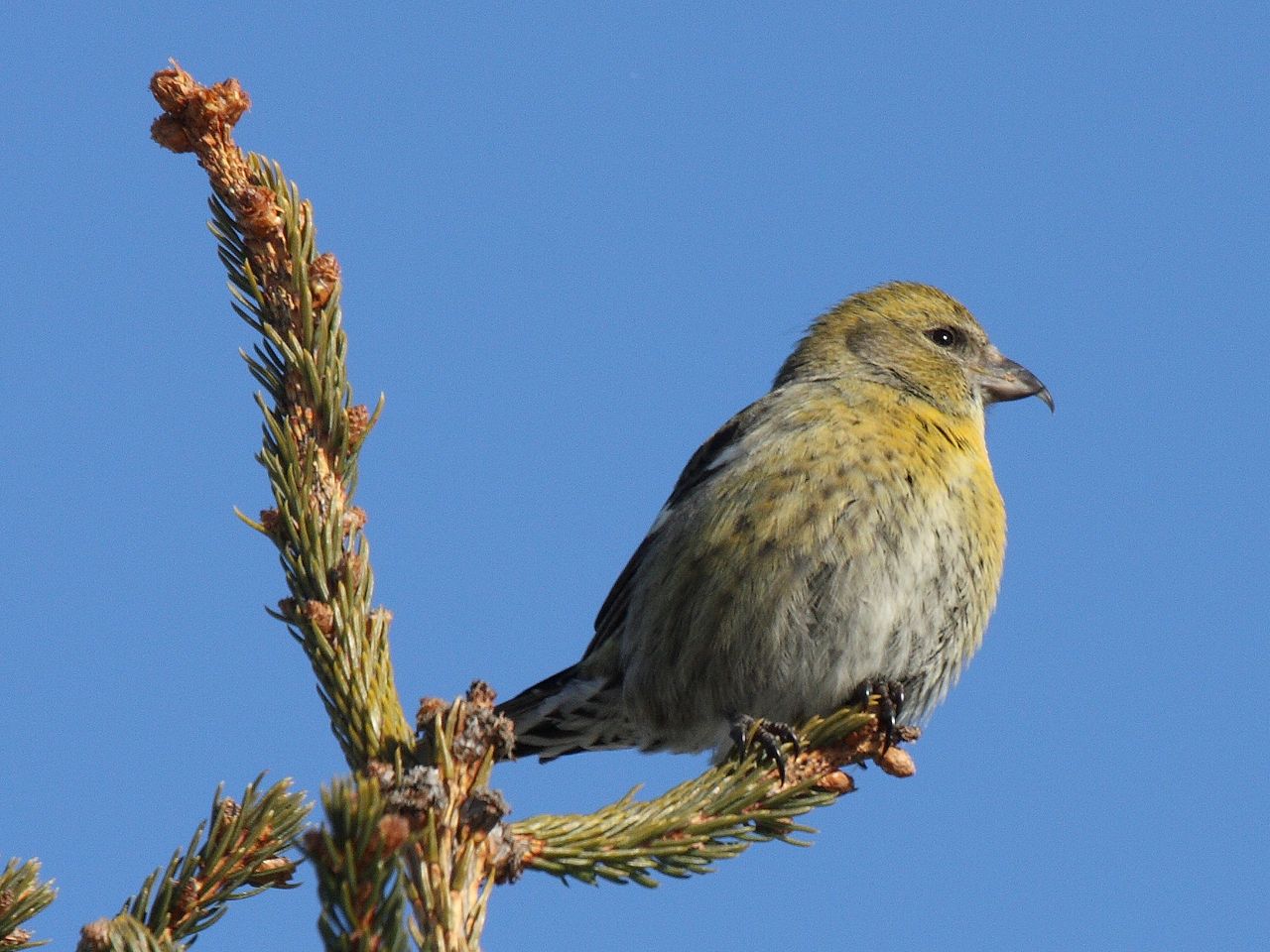
The two-barred crossbill or white-winged crossbill is a small passerine bird in the finch family Fringillidae. It breeds in the coniferous forests of North America and the Palearctic.
Region
Boreal North America and northern Eurasia
Typical Environment
Breeds across the coniferous taiga from Scandinavia and Siberia to Alaska and Canada, with the North American form often called the white-winged crossbill. It relies on mature stands of spruce, larch, and hemlock where cone crops are reliable. Outside the breeding season it wanders widely and may irrupt south into temperate conifer forests, coastal spruce belts, and montane conifers. It also uses boggy black spruce forests and subalpine zones where cone availability is high.
Altitude Range
Sea level to 2500 m
Climate Zone
Continental
Ease of Keeping
Beginner friendly: 1/5
This species has uniquely crossed mandibles specialized for prying open conifer cones, especially spruce and larch. It is highly nomadic and irruptive, moving widely in response to cone crops and sometimes nesting in mid-winter when seeds are abundant. Males are rosy-red while females are olive-yellow, both showing bold white wing bars. Its sharp 'jip-jip' flight calls often reveal flocks moving over boreal forests.


Egg, MHNT
Temperament
social and active
Flight Pattern
bounding flight with rapid wingbeats
Social Behavior
Forms lively flocks year-round, often mixing with other finches when food is plentiful. Typically monogamous and nests in conifers, sometimes in late winter if cone crops are strong. Pairs defend the immediate nest area but forage socially in flocks.
Migratory Pattern
Partial migrant
Song Description
A lively, jumbled series of twitters and trills delivered from treetops or in flight. The characteristic sharp 'jip-jip' flight call carries over long distances and helps maintain flock cohesion.
Plumage
Compact finch with two bold white wing bars and a distinctly crossed bill; males are rosy-red with dark wings and tail, females olive to yellowish with streaking.
Diet
Specializes on conifer seeds, prying open cone scales with its crossed mandibles and extracting seeds with the tongue. Prefers spruce and larch but will also use hemlock and pine as available. Supplements with insects and spiders, especially during the nesting period, and occasionally takes buds or grit.
Preferred Environment
Forages high in the crowns of mature conifers, clambering and hanging acrobatically to reach cones. During irruptions it also visits roadside conifers, shelterbelts, and sometimes seed feeders in northern towns.